 |
PageBox |
| Support | Map |
|
|
|
|
|
|
|
|
Software and business method patents
This page is about software and business method patents. Even for those who live from filing, examining and ruling them software and business method patents are a new and evolving domain. Forming an opinion about what is an invention, what can be patented and whether a program infringes a patent requires:
A knowledge of law and of examiner guidelines and manuals.
An understanding of past patent practices. The historical perspective is necessary to understand why some things are patentable and some other things requiring as much ingenuity are not.
An understanding of current patent practices. The time of the independent inventors, spending their own money and working alone to develop their invention, has gone. Today inventors are usually salary men working in teams and without incentive and time to create outstanding inventions and patents.
An understanding of the inventive work.
This page is not a cookbook on writing or reading software and business method patents. Such cookbook would be useful but is impossible to write. I would like to explain why. When you write a program, you create a small universe that you and your users can observe from outside. Because you are outside you can present this program in a simple and undisputable way. For Intellectual Property and law in general we are in a completely different situation. If you find something new you expect a benefit from that. If I’m not the one who found this thing I will minimize the finding and try to copy it. To arbitrate the conflict we will ask the help of an authority. This authority has an unfeasible task because the judge, the plaintiff and the defendant are in the same universe. As Goedel demonstrated there are proposals whose truthfulness cannot be determined if we observe this universe from inside. Trying to overcome this problem is like seeking the secret of perpetual motion. Hence, to be consistently close to what is best for all of us, the Society has no choice but to have plenty of rules "if this and this then do that" and case laws. The Society also has to keep these rules and case laws consistent both spatially (for instance, handle in the same way chemists and programmers) and temporally (the big bang is not an option). Therefore the law and notably the Intellectual Property law are necessarily complex.
Law aims to classify issues and to define how to deal with each class of issues. Law is designed to be equitable in most cases but it cannot be equitable all the time because (1) a classification implies a simplification (2) the law is reactive, not proactive. The world changes and then law adapts. The Society cannot expect from law more than making sense of data in a consistent way. Therefore the Society complements law with jury trials and equity and an important function of law is to allow parsing the inputs of parties and experts to generate facts that can be submitted to juries, made of persons independent from the parties and randomly chosen, or, to say it in the Goedelian way, of the best possible approximation of outsiders.
There are many cases in which a simple judgment for either party will not do entire justice to either party. In the same way as a patent office applies procedures, courts and juries apply the common law described above, which is essentially a method of proceeding. This method limits their capability to modify the rights of the parties or to restrain one party. In UK and USA such issues are addressed by courts of equity. More precisely these courts have jurisdiction in cases where a plain, adequate and complete remedy cannot be had at law. In Middle Age a court of equity ruled the case of a farmer whose neighbor did not return his only milk cow, which wandered onto the neighbor's property. A court of law could only award monetary damage but the farmer could want that particular cow back and not just its monetary value. A court of equity could order the neighbor to return the cow.
The procedures are more flexible in equity than in law though equity courts are not anymore taking discretionary decisions based on the specific facts of a single case. Preliminary and permanent injunctions are a matter of equity in Intellectual Property.
I assume that the reader understands words and phrases like patent, business method or prior art. I also assume that the reader knows how to make a search on the US Patent and Trademark Office (USPTO) and on the European Patent Office (EPO). To learn these prerequisites you can read Patent search on this site. For an introduction to business method issues you can also read Social Meaning of the Patentable Subject Matter – the case of Business Method Patents by Nari Lee that compares the law in USA, Japan and Europe.
Countries have to adapt their Intellectual Property law to economical and technical evolutions with two main constraints, which are to (1) conform to the international treaties these countries have signed and (2) to keep the system compatible with their legal tradition. This is therefore not surprising to find differences between the countries’ laws though principles are similar. The American law allows patenting "anything under the sun that is made by man". This definition excludes discoveries and mathematical algorithms because they are the expressions of natural laws that are merely abstract ideas constituting disembodied concepts or truths that are not useful. This definition does not exclude algorithms that do not manipulate abstract ideas. In Japan a patentable invention is "a highly advanced creation of technical ideas, utilizing a law of nature." The European Patent Office proposed "European patents shall be granted for inventions in all fields of technology, as far as they are new, involve an inventive step and are susceptible of industrial application."
In this section I present the International framework defined by TRIPS, the European law, which put some restrictions on the sort of software patents that can be patented and forbid patenting pure business methods and the USA law that allows patenting "anything under the sun that is made by man" with some substantial exceptions.
Governments agree on a common understanding of patents, defined by the Agreement on Trade-Related aspects of Intellectual Property rights (TRIPs) that was signed at the end of the Uruguay round. Article 27(1) of TRIPS states that "patents shall be available for any inventions, whether products or processes, in all fields of technology, provided they are new, involve an inventive step and are capable of industrial application". This document leaves some space for interpretation. Technology is not defined. Experts generally believe that technology includes software and excludes business methods but the issue is less obvious than it looks.
Programs are used to solve problems, which can be technical or not. Patenting a software invention that solves an organizational problem is close to patenting a business method, which must be computerized to be useful. However this is not exactly the same thing. If only software patents are allowed the inventor is granted an exclusive right for a particular way of implementing the business method whereas when business method patents are allowed too the inventor is granted an exclusive right for the business method itself. But again the difference is slim. The business method patent must include a preferred embodiment, which is a software apparatus to clarify the exact function of the implementation. A software patent can use common sense means to implement a business method.
The European law is primarily defined in Article 52:
"§1 European patents shall be granted for any inventions which are susceptible of industrial application, which are new and which involve an inventive step.
§2 The following in particular shall not be regarded as inventions within the meaning of paragraph 1
discoveries, scientific theories and mathematical methods;
aesthetic creations;
schemes, rules and methods for performing mental acts, playing games or doing business, and programs for computers;
presentations of information.
§3 The provisions of paragraph 2 shall exclude patentability of the subject-matter or activities referred to in that provision only to the extent to which a European patent application or European patent relates to such subject-matter or activities as such."
Business methods fall in the "schemes, rules and methods for performing mental acts" category and software patents describe "programs for computers". This does not mean that you cannot patent a software invention or even a business method invention. Paragraph 3 means that you cannot patent a software or a business method invention whose subject matter is a program, scheme, rule and method for performing mental acts. This also means that most software inventions can be patented because usually their subject matter is not programming and most business method inventions cannot be patented because their subject matter is indeed a method for performing mental acts.
Paragraph 2 has both a weakness (this is an exclusion list) and a strength (this is a workable definition of technology). A European patent must have a technical character. The way to proceed is further clarified by the examiner manual that, in case of doubt, recommends "proceeding directly to the questions of novelty and inventive step, without considering beforehand the question of technical character. In assessing whether there is an inventive step, the examiner must establish an objective technical problem which has been overcome." For instance "A computer system suitably programmed for use in a particular field, even if that is, for example, the field of business and economy, has the character of a concrete apparatus, in the sense of a physical entity or product, and thus is an invention within the meaning of Art. 52."
In Europe the patent prosecution has a prerequisite, the international search report. If the invention does not solve a technical problem the search examiner may answer something like "In view of the fact that the claims are worded in such a way that they claim such subject matter or the technological achievement thereof by means of trivial features, the search examiner has been unable to identify a technical problem whose solution might involve an inventive step" or "No meaningful research is possible in respect of all of the claims because the claims relate to a scheme, rule or method of doing business". In such cases the search examiner does not issue the prior art search report. When the international search report is established the examination normally takes place. The examiner can disagree with the conclusion of the search report and find that the "the claims relate to subject matter that is excluded from patentability" or find new prior art or revert a negative conclusion of the search report. The applicant may also ask for a EPO search report.
You can also read The patentability of business methods at the European Patent Office, a good document that presents this subject in a different way.
In 1998 a Court of Appeals for the Federal Circuit ruled an appeal from a decision of a District Court, which had found a patent 5,193,056 invalid on the ground that the claimed subject matter was not patentable. The Court of Appeal reversed the District Court decision and concluded that business method matter were statutory subject matter. You can find this case law at http://caselaw.lp.findlaw.com/scripts/getcase.pl?court=fed&navby=case&no=961327.
The Court of Appeals describes 5,193,056 in the following way: "The patented invention relates generally to a system that allows an administrator to monitor and record the financial information flow and makes all calculations necessary for maintaining a partner fund financial services configuration. [...] A partner fund financial services configuration essentially allows several mutual funds, or 'Spokes,' to pool their investment funds into a single portfolio, or 'Hub,' allowing for consolidation of, inter alia, the [operating] costs of administering the fund combined with the tax advantages of a partnership. In particular, this system provides means for a daily allocation of assets for two or more Spokes that are invested in the same Hub. The system determines the percentage share that each Spoke maintains in the Hub, while taking into consideration daily changes both in the value of the Hub's investment securities and in the concomitant amount of each Spoke's assets." The description of 5,193,056 is well structured and well written. The inventor presents the goal of the invention, explains why this goal is desirable and uses eight figures on fourteen sleeves to show in detail how the invention works and can be implemented with programs. 5,193,056 has six claims and only the first one is independent. These claims enumerate means that are well disclosed in the description. The prosecution of 5,193,056 was fast (two years and a half) though the applicant (Signature Financial Group) had to abandon six method claims. Then another company (State Street Bank) went to the District Court to invalidate 5,193,056.
http://caselaw.lp.findlaw.com/scripts/getcase.pl?court=fed&navby=case&no=961327 is remarkable. In my view the key points are:
"The question of whether a claim encompasses statutory subject matter should not focus on which of the four categories of subject matter a claim is directed to (process, machine, manufacture, or composition of matter) but rather on the essential characteristics of the subject matter, in particular, its practical utility."
The court reaffirm the other exceptions to patentability, namely "laws of nature, natural phenomena, and abstract ideas" including mathematical algorithms.
The first topic goes beyond enabling business methods when just supporting business methods was hard enough, the novelty of something whose means is abstract being difficult to establish. I further think that the difficulty in prior art search is only a symptom of a deeper problem.
Today companies file business method patents, in which they aim to protect the specification rather than the actual designs, notably because they put in place procedures to ensure that their designs are the most obvious and safest way to meet the specifications. In a way this illustrates the trend toward more abstract inventions. To invent the vulcanization Goodyear could only use rubber, salts, solvents and similar things. A software inventor uses computers, networks and general-purpose programs such as Operating Systems and databases. Though most of these items are not visible they form a matter - we could say a vocabulary - as suitable for inventive activities as the salts and rubber of Goodyear. Today a company can hire a contractor to implement a specification. The specification deliverables compare to the parts ordered by Watt to develop his steam engine. These parts had never been ordered before and Watt had to make sure that they could be produced. If Watt could patent his combination of parts a company should be allowed to patent a combination of specifications.
But specification is not new. For 4000 years architects specify how pyramids, palaces, houses and ships should be built and, so far, architects cannot get utility patents for their drafts though some of these drafts are better than others and though their work requires ingenuity. I think that inventions differ from that kind of specification work in three ways:
Freedom. An inventor has a goal and constraints including laws of nature. But he is free in his design choices. An architect has project-specific constraints such as the shape and nature of the building land. He further must show preliminary drafts and mockups and needs the approval of the customer to go on. In some cases it may even be difficult to find out who is the real author, the draft proceeding from the customer requests and feedback.
Possible secrecy. An inventor can keep his invention secret. Nobody can deduce from the invention result the exact way the result was produced. For instance China successfully kept the silk and china inventions secret for centuries though Europeans had bought huge quantities of silk and china. With patents the Society proposes a deal to inventors, which is to give an exclusive right on the invention in return of an invention disclosure. It is enough for a person of the art to visit a building or a ship to identify its novel parts and be able to reproduce them. Because the novel matter is disclosed anyway the Society has no need to grant an exclusive right.
Feasible prior art search. For prior art search to be possible there must be conscious disclosures. An examiner cannot visit all buildings or ships in the World to make sure that what an architect would like to patent was not already made before. For a conscious disclosure to exist something that could have been kept secret had to be disclosed. So this topic is linked to the second topic.
A business method can be an invention (when it uses more abstract building blocks to achieve an inventive effect) though in most cases it is not. Most of the time a business method is an architect work. It is novel in the same way as a building is different from buildings drawn before. There is a test that should allow making the difference between the former case in which a patent can be granted and the latter case in which the application should be rejected. A invention can be reproduced as such, which means that if you combine an independent claim with the parts of the description that support this claim you should get something that you can reproduce to solve the problem addressed by the invention. With an architect work you must adapt or you must complement or you can simplify the combination, before reproducing it to solve the problem that the architect work pretends to address. For instance the presence in the specification of elements that do not go to the solution of the problem addressed by the invention is a sure sign of architect work.
Granting a patent for an architect work raises two problems. If a company A files a patent application disclosing precisely the way it solved a problem that it faced because of its culture and organization there is almost no chance that another company will have the same problem. So if the patent office grants a patent to company A for its application nobody is hurt. Company A simply wasted its money. Most business method patents are of this sort. This is a problem because a patent office is like a University. If a University gives a degree to all students who register and pay the fees no company will regard the degree as valuable. If companies file thousands of patents without getting a single dollar in return (license fee, monopole) analysts will lose confidence in the system and regard patents as expensive legal paper. Patents have to be hard to obtain.
The second problem comes from improper claims. Let’s imagine that an architect is asked to build a house in Antarctic. This will be the first house in Antarctic. Though this house must accommodate a colder temperature and more wind than other houses the architect can build it with proven methods. This house will be essentially a combination of Canadian and Siberian house. What happens with improper claims is the same thing as if the architect could get an exclusive right on building Antarctic houses. Instead of claiming a novel way of building houses the architect would claim the invention of the Antarctic house. He could then get a valuable patent because the patent office could not oppose prior art in Antarctic or find that the means was not new, nobody having ever described log cabins and isbas in Intellectual Property terms.
In Europe an invention must solve a technical problem, which makes easier to check if an invention is an architect work. A technical problem usually has a simple and precise definition. When the problem is not technical most of the time its definition must be construed with elements of economical, cultural and even social nature. For centuries solutions to technical problems are recorded in a relatively consistent way when solutions to non-technical problems are passed and taught in an informal way. In that respect the European law looks more workable than the American law that put fewer constraints on the problem nature.
The USPTO had to enforce and explain the case law that came out from the 5,193,056 appeal while it knew how difficult it was. It did two apparently contradicting things. It explained that the US patent system granted business method patents since its creation and defined a new type of patents, the modern business data processing patents.
Regarding the first topic the USPTO presented evidences of different merit. It is unclear to me if "A mode of preventing counterfeiting" granted to John Kneass on April 28, 1815 represented a progress in useful arts and if the patent office did not simply erred when it granted this patent. On the other hand the Art of Compiling Statistics patents, 395,781, 395,782 and 395,783 filed by Hollerith in 1889 were seminal patents.
Improper claims turned to be difficult to rule even when people were less specialized than today. The "inventor" of the telegraph, Samuel Morse was a painter hardly closer to be a domain expert than people who examined his invention. I quoted inventor because the novelty and non-obviousness of some of his claims was debatable. You can read in http://www.du.edu/~jcalvert/tel/morse/morse.htm: "The mechanical parts of the telegraph had every right to patent protection, by Vail as part of the Morse Group. These were good, useful inventions of great commercial value. Morse had achieved the federal subsidy by his persistence and devotion, and had seen the enterprise through. It was very unjust, however, to claim exclusive rights to things that others had discovered, and were well-known or had been given to the public by men like Faraday, Henry and Steinheil." A court ruled the Morse patent case in this remarkable way:
It ignored European prior art (which was questionable, scientists like Faraday being European)
It rejected the eighth claim of the Morse patent "I do not propose to limit myself to the specific machinery, or parts of machinery, described in the foregoing specifications and claims; the essence of my invention being the use of the motive power of the electric or galvanic current, which I call electro-magnetism, however developed, for making or printing intelligible characters, letters, or signs, at any distances, being a new application of that power, of which I claim to be the first inventor or discovered" on the ground that "Professor Morse has not discovered, that the electric or galvanic current will always print at a distance, no matter what may be the form of the machinery or mechanical contrivances through which it passes. You may use electro-magnetism as a motive power, and yet not produce the described effect, that is, print at a distance intelligible marks or signs. To produce that effect, it must be combined with, and passed through, and operate upon, certain complicated and delicate machinery, adjusted and arranged upon philosophical principles, and prepared by the highest mechanical skill. And it is the high praise of Professor Morse, that he has been able, by a new combination of known powers, of which electro-magnetism is one, to discover a method by which intelligible marks or signs may be printed at a distance. And for the method or process thus discovered, he is entitled to a patent. But he has not discovered that the electro-magnetic current, used as motive power, in any other method, and with any other combination, will do as well." So the court correctly rejected an improper claim. [It seems that Morse had the intuition that his invention could also work without wire. Though he did not achieve practical results and did not know how a wireless system could work he tried to protect further developments of his invention.]
It confirmed the validity of the fifth, sixth and seventh claims whose subject matter was certainly not of technical nature in the context of the invention. These claims relate to the definition of a system of signs, composed of dots, spaces, and horizontal lines and to the art of marking the signs, composed of dots, spaces, and horizontal lines, (susceptible of being variously combined, representing numerals, words, and sentences,) by closing and breaking a galvanic circuit more or less rapidly for telegraphing. This decision was certainly correct. Morse first described a simple and practical means for information encoding.
Under the USA law (§103) the patent office examiners must determine the scope and content of the prior art, ascertain the differences between the prior art and the claims and resolve the level of ordinary skill in the pertinent art. Supporting "anything under the sun that is made by man" as statutory subject matter is not a workable approach in a modern world, in which all activities are so specialized that only domain experts using specialized prior art databases have can examine patents. I think that the USPTO after:
observing that most business method applications filed in 1998 related to e-commerce and therefore to data processing,
finding that the most important business method patents granted before also loosely related to data processing,
logically decided to introduce a new type of patents, the modern business data processing patents and to establish a non-patent prior art database of business data processing methods.
Nari Lee wrote in his thesis "The knowledge that the USPTO classified as business data includes the knowledge concerning the identification of the customers and their preferences (operations research or market analysis data), publicizing data (advertising management, catalogue systems, incentive programs, coupon redemptions), processing of knowledge that concerns the monetary exchange throughout the business transactions (credit and loan processing, point of sale systems, billing, fund transfer, banking, clearing houses, tax processing, investment planning), and data that concerns the tracking resources, money and products (human resource management, scheduling, accounting, and inventory monitoring)."
The "modern business data processing” class (705) is defined like this: "This is the generic class for apparatus and corresponding methods for performing data processing operations, in which there is a significant change in the data or for performing calculation operations wherein the apparatus or method is uniquely designed for or utilized in the practice, administration, or management of an enterprise, or in the processing of financial data. This class also provides for apparatus and corresponding methods for performing data processing or calculating operations in which a charge for goods or services is determined."
Since 1998 the meaning of State Street has been clarified. State Street didn’t abolish the technological test established by Toma as acknowledged by the Board of Patent Appeals and Inferences (BPAI) in affirming that a claimed invention (Bowman) was not statutory. The Toma case was an appeal from the BPAI that was decided by the Court of Customs and Patent Appeals (CCPA). The CCPA said: "The 'technological' or 'useful' art inquiry must focus on whether the claimed subject matter... is statutory, not on whether the product of the claimed subject matter... is statutory, not on whether the prior art which the claimed subject matter purports to replace... is statutory, and not on whether the claimed subject matter is presently perceived to be an improvement over the prior art, e.g., whether it 'enhances' the operation of a machine." The Toma test is a two-prong test of:
whether the invention is within the technological arts; and
whether the invention produces a useful, concrete and tangible result.
It established whether the invention has a statutory object matter [35 U.S.C. 101].
State Street didn’t abolish Toma because State Street decided about the validity of a patent that had passed the Toma test, and though the State Street decision ("The question of whether a claim encompasses statutory subject matter should not focus on which of the four categories of subject matter a claim is directed to (process, machine, manufacture, or composition of matter) but rather on the essential characteristics of the subject matter, in particular, its practical utility") seems to refer 35 U.S.C. 101 that reads: "Whoever invents or discovers any new and useful process, machine, manufacture, or composition of matter, or any new and useful improvement thereof, may obtain a patent therefor, subject to the conditions and requirements of this title." To summarize:
The first prong of Toma still applies.
State Street refines the meaning of the second prong of Toma (stress on usefulness rather than concreteness).
So the claims of an invention have to be within the technological arts for the invention to be granted in USA. This measure, better prior art databases and a better training of patent examiners may be enough to address the business patent issue. A decreasing percentage of business method patents lead to patent grants.
The U.S. Congress also tried to address business method patents. In late 1999, Congress enacted the American Inventors Protection Act, which added a new Section 273 to the Patent Act. 20 Section 273 provides a limited defense against a charge of patent infringement in a case involving a method of "doing or conducting business." The defense provides that if the alleged infringer had, in good faith, actually used the method at least one year before the effective filing date of the patent, and also commercially used it before the effective filing date, then it would be shielded from infringement liability. This has become known as the "First Inventor Defense." On October 3, 2000, Representatives Howard Berman and Rick Boucher introduced H.R. 5364, the "Business Method Patent Improvement Act of 2000" that contained notably these proposals:
Lower the standard of proof required for rebutting the presumption of validity for a business method patent from a "clear and convincing evidence" standard to a "preponderance of the evidence" standard;
Create a presumption of obviousness for business method patents if the subject matter in the application is the combination or modification of prior art references and the only difference between the references and the claimed invention is the computer implementation of the business method;
Provide for a period in which the public could challenge the validity of the business method invention before a patent would issue;
I think that H.R. 5364 would have created de facto a second class of patent. When a "classical" patent has been examined and duly granted, "judicial review must give due weight to the presumption of validity." So applicants would have tried to get "classical" patents for applications that were perhaps business methods. Alleged infringers of business method patents would not have hesitated to go to court. Now, the U.S. already depends more heavily on judicial scrutiny when patentees bring infringement actions than other countries. So a litigation increase was not welcome. H.R. 5364 was never enacted.
On April 3, 2001, Congressman Berman introduced H.R. 1332, the "Business Method Improvement Act of 2001." This bill is much like H.R. 5364. Its prospects of being enacted, however, may be far from certain.
All patent systems follow the same principle which is to grant an exclusive right to inventors of "anything under the sun that is made by man" except expressions of natural laws and abstract things like mathematical algorithms but the exact borders of what is patentable or not vary depending on the patent system. We can also note that tolerant systems are almost supersets of most restrictive systems. For instance if you file an application whose description unequivocally supports a claim set meeting the requirements of the most restrictive patent system:
you will be able to patent this application with this claim set everywhere;
you will also be able to patent this application with a claim set adapted to the target patent system, and therefore wider for less restrictive patent systems
The American system seems more complicated than his European counterpart. Both are fascinating. The EPO is the first multi-country patent office, at least at this scale. EPO membership is a prerequisite to enter European Union. But the American system processes more patents and is more tested in courts, which may explain its complexity. For centuries it is politically, culturally and economically important. It was defined in the US Constitution and Jefferson contributed to its creation. It participated to the American dream (file a patent and become the next Edison). It played a role in the creation of powerful corporations.
I think that the public interest is to have a strong patent system also for software and business method patents, for two reasons:
To ban secrecy as exposed in Patent search. A company should ultimately have two options, file a patent or make its design public (for instance through Open Source development).
To allow patent mergers. Today companies merge to have a bigger market or make economies of scale. The public interest is that mergers are made as much for intellectual property as much as for market and finance.
When I analyze a competitor patent I do two things:
I assess the risk that a program of my company infringes this patent, which is also legal work
I assess the innovation disclosed by the patent.
It is important to keep the assessment of the infringement risk and the innovation assessment separated. It may look obvious to some readers but in real life when you understand the matter this is tough to not be influenced by your opinion. You tend to overlook patents that do not teach you anything you do not know already. You have to repeat yourself that:
The role of a patent examiner is not to assess innovation but to determine (1) if a patent application meets patent criteria defined in a manual (2) if the method or system of the patent application is already described in a set of databases.
The role of courts is to determine (1) the patent validity and scope (2) the facts that the jury will use to render the verdict.
The role of juries is to determine if the defendant uses the process or method claimed in the plaintiff patent.
Today to get a legally-strong patent an applicant only needs to describe on time a combination of known processes and methods, novel and useful because of an environment change like the Web or a new regulation. We can understand that the Constitution sentence: "Congress shall have power ... to promote the progress of science and useful arts, by securing for limited times to authors and inventors the exclusive right to their respective writings and discoveries." means "Congress secures an exclusive right on their discoveries to the inventors because these discoveries represent a progress in science or useful arts." However the patent system is gently moving away from this utilitarian model toward a proprietarian model as shown in the thesis of Nari Lee. I believe that the reasons for this evolution are simple:
Patent offices and lawyers live in a commercial world. Nolens volens they have to deliver the patents that their customers want.
Customers have changed. In 18th and 19th century the applicant was a person. Since the beginning of 20th century the applicant is usually a corporation. Before WWII only research centers were patenting. Now patenting is a part of the development process. The question tends to no longer be to secure exceptional findings due to chance and combination of talents but to protect the Intellectual Property of a company, this Intellectual Property being a development deliverable in the same way as the product and the documentation. Therefore customers are pushing for the proprietarian model.
Today the vast majority of the software and business method patents are "proprietarian" patents that hardly represent a progress in science or useful art. The MercExchange patents, which are examples of "proprietarian" patents, show the downside of the "proprietarian" model. The money spared by companies in identifying inventions (almost any development can be patented) is more than counterbalanced by penalties and extra burden on development (monitoring of the infringement risk) and legal work (lawsuits, settlements).
The debate about proprietarian versus utilitarian Intellectual Property is not new. Jefferson wrote: "Stable ownership is the gift of social law, and is given late in the progress of society. It would be curious then, if an idea, the fugitive fermentation of an individual brain, could, of natural right, be claimed in exclusive and stable property. If nature has made any one thing less susceptible than all others of exclusive property, it is the action of the thinking power called an idea, which an individual may exclusively possess as long as he keeps it to himself; but the moment it is divulged, it forces itself into the possession of every one, and the receiver cannot dispossess himself of it. Its peculiar character, too, is that no one possesses the less, because every other possesses the whole of it. He who receives an idea from me, receives instruction himself without lessening mine; as he who lights his taper at mine, receives light without darkening me. That ideas should freely spread from one to another over the globe, for the moral and mutual instruction of man, and improvement of his condition, seems to have been peculiarly and benevolently designed by nature, when she made them, like fire, expansible over all space, without lessening their density in any point, and like the air in which we breathe, move, and have our physical being, incapable of confinement or exclusive appropriation. Inventions then cannot, in nature, be a subject of property. Society may give an exclusive right to the profits arising from them, as an encouragement to men to pursue ideas which may produce utility, but this may or may not be done, according to the will and convenience of the society, without claim or complaint from any body."
So the original rejection of the proprietarian model was inspired by philosophy. An unfortunate consequence of this choice is that the drawbacks of the proprietarian model were never made apparent.
Turning back to innovation assessment I would like to explain
What is its target
Why this assessment is useful
How I proceed
How innovation assessment techniques could be used to improve the patent process
The innovation assessment targets patents and public patent applications filed by other companies and organizations. The target must be adapted to the resources and to the ambitions of the top management. An innovation assessment takes one week and more. One person may realistically assess thirty patents per year and even less if she has other tasks. So this is important to reduce the scope and to eliminate as many patents as possible through a shorter patent analysis. This scope should be consistent with the scope monitored with other means like traditional business intelligence and web site monitoring.
The main objective of the patent analysis is to acquire an understanding of the patent or patent application sufficient to talk about it and get feedback. However the patent analysis is useful in another way. This is one of the best business intelligence means. A patent or patent application teaches you the technical choices of the competitors and the constraints they have to manage. Combined with financial reports (10K forms), Web sites and press releases patents even allow to guess organization charts. My experience is that the patent analysis takes at least one day and substantially more when the patent or patent application discloses interesting data.
We need innovation assessment to
identify the strong points of a competitor
predict in which areas they will grow
identify the areas in which the patent or patent application may hinder the development of our company
When we conclude from the patent analysis that a patent or patent application may contain a valuable innovation or represent a particular threat we try to find the competitor product that implements the patented process or method and we check if and how the company reported this innovation to stock holders.
Before discussing how I proceed to assess the innovation in a patent I must introduce some ideas and concepts. First an invention is always a combination of old inventions. It may look obvious if you think that an invention always leverages on an existing environment but this is also true in another and more important way. We invent using a bank of old inventions much in the same way as we speak using a bank of words, just because our brain is designed to work in that way and not in another way. Furthermore we do not try combinations of old inventions randomly. We associate old inventions in a way that conforms to some production rules. I believe that a person is a good inventor, not because he knows more old inventions than others or superior capabilities to combine old inventions but because he has a more sophisticated representation of the old inventions he knows and better links or bridges between these inventions. If your work consists in designing or creating you probably noticed that:
You do not have so often "flashes of genius".
When you have such flashes the idea usually turns to be impractical.
When you did something big you do not necessarily remember a moment where you had an inspiration. With the time I came to the conclusion that "flashes of genius" are frequently signs of lack of concentration: if you are focused on your task you do not pay attention to what happens to you.
You have more often these "epiphanies", when something you have learnt suddenly makes sense. For me an epiphany is just the moment an enumerable list of recipes becomes a set of nodes connected to each other and to pre-existing knowledge. The nodes themselves are more complex than recipes and they can attract or push back other nodes.
You may find that "old invention" is probably not the way to name what the inventor knows. We do not call old invention what we use every day. But nobody describes an old invention in the way his inventor would have described it. Writers frequently say that once they achieve commercial success their books do not belong anymore to them (metaphorically - authors have reproduction rights.) If you are programmer you may have experienced the same thing. If your program works and addresses the customer need, after a couple of days people start using it in ways you never imagined and they talk about it in a way different of your way. Something in the program exists on its own. Even if the program is rewritten many times this thing will remain. So, as a contribution to the progress of science and useful arts, an invention is better defined by people who use it than by people who invented it. Therefore inventions relate more to perception (and later knowledge) than to performance and we can rightfully say that knowledge is made of natural laws, other abstract stuff and "old inventions".
To further clarify the issue I would like to give an example. In 1994 I attended a meeting with a customer. Just before the meeting a system engineer told me that he wanted to show me something of interest. The thing was the first browser I ever see, Mosaic. For me the nuts and bolts of the Web were apparent: I was using Internet. I was writing client/server and X programs. For me interpreting a message to display a corresponding image was known art. I found some choices surprising. For instance why this HTTP protocol and not the simpler FTP or a really sophisticated protocol if needed? I also found HTML too verbose. Later on I met people of Airbus who were extensively using SGML. I realized that for these people HTML was SGML for dummies. So I had doubts but I agreed that the browser was an invention because its inventors choose a correct combination of old inventions and made the right compromises to produce something effective. I did not have such doubts for personal computers. When the first personal computers were released (kits and then Apple II), I was student in Computer Science. For me it could not be an invention because personal computers were just using the same Von Neuman design as mainframes with cheaper components. Still in one century from now people will probably remember that between 1980 and 2000 there were two key inventions, the personal computer and the Web.
There is another point: if I had seen the original CERN browser in 1991 with pictures and text on different windows I would have needed all my skills to identify the Web novelty and all my imagination to envision its future. I would have perhaps concluded that it was an invention but I would not have written that it was a big invention because Xanadu looked more promising.
We can deduce from these examples the following rules:
To identify the novel part of a proposal or patent application you need to understand the matter.
More you understand the matter, less you are able to grade an invention.
Now we can see in another way the observation that to get a legally-strong patent an applicant only needs to describe on time a combination of known processes and methods, useful and novel because of an environment change like the Web or a new regulation. Even the biggest and most useful inventions are nothing more that combinations of known processes and methods, useful and novel because of an environment change. An invention is essentially combinatorial and opportunistic.
There is another point of importance. In our brain there are no parts specialized in inventing. There are parts able to learn, to store knowledge and to retrieve or design solutions. Formally we cannot say that an invention is always a combination of old inventions. We should say that an invention is a design that represents a progress of science or useful arts, a design being a combination of knowledge items previously learnt by the inventor. Though the details of the brain implementation are not known efforts have already been made to reproduce this function in artificial intelligence. To represent design knowledge the Function, Structure, Behavior (FSB or SFB) model has been developed. Very coarsely a known design can be represented by:
Its function, the goal of the design. To represent the function in a computer program the system can use a hierarchy of sub-functions.
Its structure, the parts of the design and their relationships.
Its behaviour represented by explanation chain/graphs that model causality and temporal relationships and state-transitions diagrams.
There are a couple of documents reasonably easy to read about FSB. You can try for instance a Function -Behavior - Structure view of social situated design agents by John S. Gero and Udo Kannengiesser. Learning to be creative and the creative memory by T Zamenopoulos and K Alexiou presents a project where learning is seen as a function used to capture, maintain and restructure SBF interdependencies.
The use of function, structure and behavior in design by Marton E. Balazs & David C. Brown is an introduction to design using FSB knowledge of interest in a document about patenting. The input is the function of the object to design. This is quite similar to project requirements. Balsz and Brown note that the knowledge associated with design objects can be classified into the following types:
Structural knowledge -- knowledge about the components which comprise the object and their relations;
Behavioral knowledge -- knowledge about the behavior of the object, i.e., about ways the device responds to changes in its environment and/or in its own state;
Teleological knowledge -- knowledge about the purpose and the way the object is intended to be used;
Functional knowledge -- knowledge about how the behavior of the object is used to accomplish its intended use.
Balsz and Brown further note an essential difference between the nature of the first two and the last two types of knowledge. This difference results from the following:
For a given object both structure and behavior are objective in the sense that the former is given by the physical existence of the object, while the latter can be (objectively) determined based on physical principles.
On the other hand teleology and function of an object are subjective. The first one reflects the intention of a human (the designer or the user) in using the object. The second one (the functional knowledge) is an abstraction of the behavior by a human through recognition of the behavior in order to utilize it [Umeda & Tomiyama, 1993].
A system using a bank of designs defined in FSB can solve problems defined in function terms. If the system doesn’t find a design with the problem function it looks at sub-functions. It can also look for analogies. For the moment researchers are just able to reinvent door handles, taps and so forth. I thought about using FSB to represent existing program designs. Then it should be possible to use the design bank to create new designs also represented in FSB and even to generate dynamically patent skeletons. Frankly I do not know if this application of FSB will ever be practical. For instance representing the problem to solve is tedious, time consuming and requires more skills than traditional design.
We can see that an invention differs from a simple design by a particularly useful teleology and function (this teleology and function being subjective and ascertained by the invention users) in regard of its structure and behaviour (which are objective and represent the inventors’ work).
When inventors write patents they talk about what they know,
the structure and the behaviour of a design, which is necessarily an opportunistic combination of old inventions,
the problem they had to solve and not the problem actually solved by this invention
The patent office must determine if a patent application is patentable with the information contained in this application. In USA but not in Europe the invention success is also considered. This method is not necessarily effective. Other factors like the management and marketing skills of the application may influence the success of the invention. Furthermore software and business method patents have a deterring effect. The best illustration is maybe Smalltalk. This language had the features that eventually succeeded with Java. It allowed developing good quality and portable programs in less time. But the customers did not want a pricey single source and preferred to wait for a free industry-endorsed solution.
The patent manual may say that "non-obviousness is demonstrated by showing that practicing the invention yields surprising, unexpected results." To know these unexpected results the inventors would need to wait for others to practice the invention. So inventors would have to wait before filing the patent, so would get a later priority date. This would further imply that the invention would not be kept secret before the filing. In that respect inventors have necessarily to cope with conflicting requirements.
However this does not mean that patent offices have to accept the proprietarian model and to grant patents to all applications meeting some rules.
I’m convinced that today some companies developing software products start the patent process as soon as product requirements are known:
The first step consists in checking if a process or method satisfying these requirements may infringe a patent. This is possible because the product requirements are derived from an analysis of competing products and defined in order to minimize development risks. The requirements are defined to be implementable and therefore with a design blueprint in mind. They contain enough information for a person of the art to conduct prior art searches, raise a warning or suggest requirement changes if the envisioned product is too close to a patent.
The second step can start as soon as the product patenting has been approved and consists in writing (1) a list of references, which is basically the prior art search result (2) the abstract which is a "concise statement of the technical disclosure [...] and should include that which is new in the art to which the invention pertains" (3) the background of the invention where the drawbacks of prior art are shown and the usefulness of the invention is demonstrated (4) a first draft of the claims.
The third step starts as soon as the design is completed. It consists in writing the summary of the invention and drawing the figures.
Some requirements may require a proof of concept. In that case the fourth step starts once the results of the proofs of concept are known. Otherwise the fourth step immediately after the third step. The fourth step consists in writing the detailed description of the preferred embodiments.
The "beauty" of the system is that the patent application is filed before the beginning of the programming phase. Patent strategies being confidential this is impossible to give a percentage of patents processed in that way. My conviction is based on the following facts:
The US patent law allows filing provisional patents containing claims and drawing but no claims, and whose unique constraint is to disclose the invention subject matter. American companies frequently file regular project documents as provisional applications. In such cases there is evidence that the patent subject matter is the project and hence the product subject matter.
Some patents are made public before the announcement of the corresponding product.
Some patents have preferred embodiments that contain no technical difficulty requiring research and prototype development.
Depending on the point of view such practices may be perceived as an abuse or as the recognition that the applicant cannot appreciate if a design is only a design or if it is an invention:
An invention is as combinatorial and opportunistic as any combinatorial and opportunistic design.
An invention differs from a simple design by a good ratio (teleology + function) / (structure + behaviour) where both teleology and function are subjective and ultimately graded by users
This is known for a while. Daniel Webster who represented in a Circuit court Charles Goodyear, the inventor of the vulcanization, that was combining rubber, sulphur, lead salt and heat said:
"If Charles Goodyear did not make this discovery, who did make it? Who did make it? Why, if our learned opponent had said he should endeavor to prove that some one other than Mr. Charles Goodyear had made this discovery, that would have been very fair.
On the contrary they do not meet Charles Goodyear's claim by setting up a distinct claim of anybody else. They attempt to prove that he was not the inventor by little shreds and patches of testimony. Here a little bit of sulphur, and there a little parcel of lead; here a little degree of heat, a little hotter than would warm a man's hands, and in which a man could live for ten minutes or a quarter of an hour; and yet they never seem to come to the point. I think it is because their materials did not allow them to come to the manly assertion that somebody else did make this invention, giving to that somebody a local habitation and a name."
[I present the disputed patent (#3,633) later. I found the excerpt at http://inventors.about.com/cs/inventorsalphabet/a/rubber.htm]
To assess the innovation in a software patent I assume that the disclosed invention was made in the following way:
The inventor(s) designed something from requirements, frequently issued by Marketing for a business method, according to constraints usually technical (available tools, existing infrastructure) and cultural.
The design became the preferred embodiment.
The requirements had a goal discussed for instance in the business case. This goal was to solve a problem. This problem is obfuscated to become the problem solved by the invention.
The design can be generalized in an invention summary. The inventors can then consider other embodiments.
Claims are usually designed by lawyers to get the most from the description stuff. However lawyers meet inventors who tell them about every requirement they had. So a means designed to satisfy a requirement typically translates into a claim element.
I believe that this scenario is correct because:
Usually only the preferred embodiment is detailed and quite frequently only one embodiment is disclosed.
Quite frequently the invention summary is the summary of the preferred embodiment.
An invention developed in that way I call later "project patent" may be a good invention. In fact any invention that is not a discovery is a lucky design and to design something we need requirements to find analogies and constraints to eliminate some analogies.
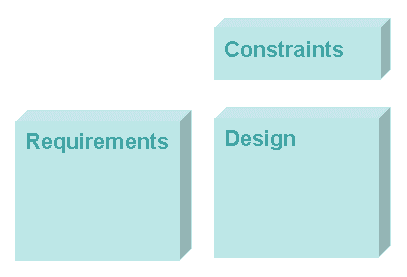
However when an invention is made by the book the process is:
The inventors have an idea.
Up to the time they have a workable solution inventors repeat an iterative process which consists in designing, implementing, testing, analysing the strengths and weaknesses of the implementation.
This process seems to still be used by researchers who work with Universities and look for licence fees. In these cases constraints exist but they relate to costs, know how... and not to compatibility issues with an existing infrastructure. For instance when he designed his steam engine Watt had to deal with providers unable to deliver parts conforming to specifications and he had to adjust his design to cope with this limitation. The inventors have a goal (reviewed by their sponsors) but no requirements. Companies will license the invention only when it meets their core requirements but they will usually agree to adjust their minor requirements to be able to use it. The innovation assessment described below does not deal very well with these "research patents" but is able to detect them.
There is a third type of patent process illustrated by Lockwood and MercExchange patents. In this process the applicant analyzes an existing system (used goods and collectibles shops and auction systems in case of MercExchange, CRSs in case of Lockwood) and a new facility (low-cost WAN for MercExchange and multimedia for Lockwood). Then the applicant applies a transformation of the old system with the new facility. The applicant is typically a person working alone and looking for license fees. With this process the requirements and constraints derive from the fact that the invention must implement the functions of the old system and satisfy the same users. I call these patents "transformation patents". The innovation assessment described below work well with these patents when the person who makes the assessment knows the old system and the new facility.
There is a considerable difference in resources between the three types of patents:
Transformation patents without prototypes and tests cost few man months in investigation.
Research patents with the iterative research effort cost one to ten man years.
Projects for which patents are filed may cost hundred and more man years. Though project management aims to minimize risk and therefore opportunities for participants to exercise their ingenuity, though the main delivery of the project is a product, project patents are the public manifestation of big efforts including almost inevitably some ingenuity.
This innovation assessment starts with the analysis of the preferred embodiment, of the invention background (problem solved and drawbacks of previous solutions) and of the claims. The innovation assessment aims to extract from this stuff:
The design. The goal is to identify the invention parts, what they do and how they communicate with each other. I frequently need to also read the invention summary. Design analysis is the easiest part of the assessment because the patent normally contains this information.
The requirements. To identify the requirements I read the invention background and the claims. To confirm my guesses I frequently consult the applicant web site and press releases.
The constraints. There is no place in a patent where to express a constraint except the invention background. Furthermore because they live with these constraints inventors do not feel necessarily to explain them. To identify constraints I list design blocks and requirements. When I cannot explain a design block or an apparatus with requirements I assume that there is a constraint. It is usually impossible to name a constraint with only one patent but because all inventions from an applicant were designed with the same constraints I frequently can name constraints when I have already analyzed a couple of patents from this applicant. Constraint identification is like traditional intelligence. I frequently need to cross different pieces of information.
This work is actually easier than it looks, at least for project patents usually filed by Corporations. Corporate patenting is a corporate process. Therefore I can safely assume:
A time-constrained patenting process. Documents have to be delivered on date regardless of their state of completion.
A patenting process monitored with quantitative rather than qualitative metrics. If a person involved in the process is unable to deliver work of the needed quality it usually goes undetected.
A workflow process. Each step produces deliverables that are forwarded to the next step, which is handled by another team. A team only knows what it needs to know to do its job. For instance inventors do not monitor the patenting process and usually do not review the patent application which is filed. So an error made at one stage cannot be fixed at a later stage.
The result is therefore less than perfect, which is both good and bad:
Companies are usually unable to control their disclosures in documents of more than 5,000 words. Press releases are controlled. Patents are not.
Explanations are frequently obscure. Usually this is because someone reproduced something that she did not understand. Obscurity is per se a useful piece of information: it means that people involved in the patent process do not talk to each other. But making sense of something obscure is challenging. Here living in a country whose language is not English is an advantage: you already perfected the art of translating back from your language to English to understand a paper.
Once I have a design, a requirement list and a constraint list I can assess the innovation. When there is one requirement or constraint per design block and when design blocks are independent then no synergistic effect is possible. Some novelty and inventiveness may be present in a given design block but
Usually design block serve a purpose in a well-known manner. This is the combination of blocks that makes the invention patentable.
Because of the patent scope not enough details are usually disclosed on a design block to establish its novelty or inventiveness.
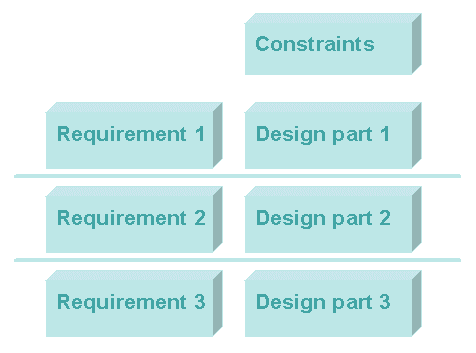
The design may be also layered. For instance a design can contain a module block per requirement and a service block per constraint. Module blocks uses service blocks but modules blocks are independent from other module blocks. Layered designs are the consequence of known analysis practices. If blocks do not communicate with each others in another way then I regard them as independent.
To illustrate this discussion we can turn our attention to something that is widely regarded as a major invention though it was not patented, the Web.
We can presume that there were two requirements:
Display hypertext documents from different sources
Handle queries
There were three constraints:
The invention had to use the IP network to get documents
The documents were stored in file systems
To handle queries the invention had to call programs
Then we can represent the original Web like this:
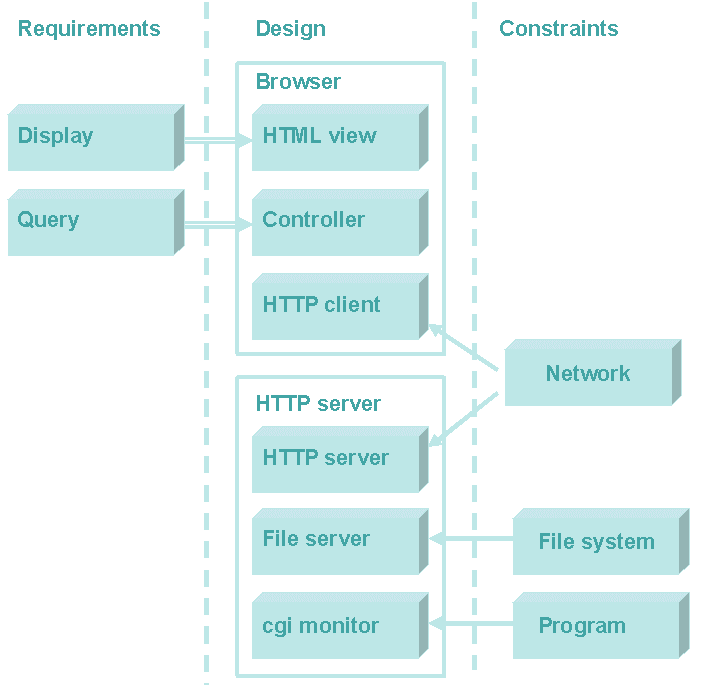
Because there is a network a client/server protocol, HTTP is defined. The browser contains an HTTP client block that uses this HTTP protocol to call an HTTP server block on server side. The server serves documents using a file server block and handles queries with a cgi block. The browser processes requests with a controller block and displays documents using an HTML block.
If I regard these blocks as independent because they communicate through well-defined interfaces and protocols and because the block design conforms to well-known practices in 1990 then I must conclude that the Web is a sophisticated design but not an invention. This observation may look surprising but it captures a part of the reality. There was no debate about the inventiveness of the Web in 1990 simply because the Web was born free and Open Source. Otherwise similar systems would have released and patented with different protocols and document formats. For instance, almost certainly, Adobe would have released a system displaying Display Postscript or Acrobat documents. A hypothetical Web patent would have been unable to prevent such things.
I think that the Web was an invention because of the relative simplicity of HTML and HTTP that made this invention relatively easy to implement. But if the Web had been a commercial product I would have identified the innovation only if the patent (or the applicant Web site) had disclosed details about HTTP (GET and POST requests at least) and about use of HTML tags like <A> and <FORM>.
To allow readers to safely state that this invention was novel and non obvious the patent had to claim:
The use of a text protocol (HTTP) and of a text document format (HTML)
A means to submit queries in documents
A means to represent queries and their parameters in HTTP
Such claims are not necessarily present in project patents because these claims are harder to word in a way that remains general enough to cover evolutions of the product and in transformation patents because such aspects were not necessarily explored by inventors.
In innovation assessment this is important to spend time on the first step in which we put your feet in the inventor shoes and try to reverse engineer the invention process. This is the only way we can get results of interest for business intelligence. However we only capture one dimension of the invention, its structure. Though this dimension is increasingly important, design blocks being abundant and for most of them known art, there are two other dimensions:
The objects used and produced by the invention. In case of software and business methods inventions these objects are data.
The processes of the invention. This is important to not confuse the structure and the processes. A large proportion of the design blocks exist to link the invention to the surrounding world, which is highly codified and provides many facilities. We may notice that what we called technical constraints above is the counterpart of using facilities such as networks and file systems. If the innovation consists in using facilities in a different way then it is captured by the structure analysis. If the innovation consists in using a new process with a traditional design then the innovation is captured by the process analysis.
We may notice that patents had always these three dimensions. We can consider for instance the patents of Charles Goodyear for the rubber:
240, the first patent of Goodyear (two pages, three claims) granted on June 17, 1837.
1,090 actually filed by Nathaniel Hayward, assigned to Goodyear for the use of sulphur (one page, one claim) and granted on February 24, 1839.
3,633 filed by Goodyear for the vulcanization (two pages, three claims) granted on June 15, 1844.
You still can find these patents on the USPTO site in TIFF format. You can also find 240 at http://www.todayinsci.com/G/Goodyear_Charles/GoodyearPatent240.htm. By the standard of today these patents are very short patents. They contain no figures and their claims are less formalized than in today patents (if you file a patent in the Goodyear way the US patent office will probably recommend you to hire a patent attorney.) However the three dimensions are already present. If we take the example of 3,633:
The objects used by the invention are India-rubber, sulphur, white lead and cotton. The object produced by the invention is a fabric.
The process consists in combining India-rubber, sulphur, salts of lead and heating the compound.
The structure is not apparent. However we may notice that a first design block combines the India-rubber, sulphur and white lead, a second design block makes a sandwich of the compound produced by the first block with cotton-batting, a third design block heats the compound produced by the second block. We even see that the structure comes from the facilities used by the invention and by the constraints they induce. The first block deals with chemistry. The second block deals with mechanical means and the third block deals with ovens.
In the rest of this section I focus on software and business methods inventions. Therefore objects are data and processes process data.
I check if the invention:
Represent data in a novel manner on disks, in documents and/or in protocols as illustrated by the Web example.
Distribute and access data in a novel manner. An example might be Grid architectures. For instance with the Message Passing Interface (MPI) collective operations input data are distributed to the different nodes and output data are merged. Data are submitted to programs on intermediate and end nodes.
I check if the invention:
Collect and use new data. Example: a search engine may record user queries and use these data to display advertisements corresponding to the user areas of interest.
Combines data in a novel manner.
Transforms or analyze data in a novel manner.
An innovation produces:
A known and useful result in a cheaper way. For instance since the eighties transactional systems are able to process 5,000 requests per second. Then these systems were running on mainframes and programmed in assembler. The cost of these systems limited their application to few cases. With diminishing costs it has been possible to use similar systems for applications that generate less revenue like systems that process cell phone messages and mails.
More of a known and useful result for a given cost. For instance online reservation systems offer a low fare search facility whose implementation is resource consuming. In 1999 processing 20 low fare search requests per second was a good result. Today online reservation systems can process far more requests.
A useful result that was not obtained before. In this case more desirable was the result, biggest is the innovation.
It is possible to assess the two first types of innovation, which are improvements. This is a demanding task because we need to know the existing solutions at a level of detail sufficient to evaluate the differences between the invention and the prior art. Usually it is not possible to reproduce the invention and to check if the benefits claimed by the invention are real. But we can find if an invention MAY be an innovation or if the invention is PROBABLY not an innovation.
The third type of innovation is harder to assess.
The easiest case is the case where the desirability of the invention is already established. For instance if an invention discloses a voice recognition system that does not require training and is reliable at 100%, this invention yields a highly desirable result and we can safely say that this invention is a big innovation. The problem is that such things happen almost only in literature and movies. The only examples in computer field that comes to mind are Smalltalk and the Apple Mac Intosh. I discussed Smalltalk above and the Mac Intosh is not so strong from a legal point of view. It came after another computer of Apple, the Lisa, which came after numerous findings in the Xerox PARC. So this innovation had many contributors.
A second case is the case in which the goal and the target (customers...) of the invention are well established. For instance if the competitor Web site refers to the invention with a "patent pending" notice or if the financial report of the competitor explains what is expected from the invention we have a serious work basis. We can identify the market impacted by the invention and evaluate the competitive advantage that the applicant can expect from the invention.
The third case is the case where neither the desirability nor the actual goal and target of the invention can be established by external means. When the only source of information is the invention itself we are in the same situation as the inventors and the patent office. As we have seen above we cannot guess how the invention will eventually be used. We can get a first idea of the invention result and usefulness from reading the title, abstract and background section of the patent. For instance the abstract of the Eolas patent (5,838,906) starts with:
"A system allowing a user of a browser program on a computer connected to an open distributed hypermedia system to access and execute an embedded program object. The program object is embedded into a hypermedia document much like data objects. The user may select the program object from the screen. Once selected the program object executes on the user's (client) computer or may execute on a remote server or additional remote computers in a distributed processing arrangement. After launching the program object, the user is able to interact with the object as the invention provides for ongoing interprocess communication between the application object (program) and the browser program."
This is an acceptable definition of an applet or of an ActiveX control. From the abstract and the lengthy background the reader can easily deduct that this patent produces a useful result. [The fact that 5,838,906 is novel and not obvious has yet to be confirmed in court but this is not the subject of this section.]
In 5,838,906 the result is the capability in the context of client/server programming to run the client in a browser page. This result almost confuses with the means, which is to embed a client object in the page. The result and the means may also be quite distinct. For instance the abstract of 5,845,265 contains:
"The present invention relates to used and collectible goods offered for sale by an electronic network of consignment stores. More specifically, the present invention may be an electronic 'market maker' for collectable and used goods, a means for electronic 'presentment' of goods for sale, and an electronic agent to search the network for hard to find goods. In a second embodiment to the present invention, a low cost posting terminal allows the virtual presentment of goods to market and establishes a two tiered market of retail and wholesale sales."
The result is a "market of retail and wholesale sales" and the means is "an electronic network of consignment stores selling used and collectible goods". 5,845,265 is a MercExchange patent that I present in more details below. For infringing this patent eBay and Half.com were ordered to pay MercExchange $29.5 million in damages. eBay establishes a market of retail sales but is certainly not an electronic network of consignment stores selling used and collectible goods.
We must consider both the result and the means. Otherwise the assessment of inventions achieving novel results would not be consistent with the assessment of improvement inventions, in which we only consider the means, the result being not novel. In case of 5,845,265 we necessarily conclude that:
The result (a market of retail and wholesale sales) is highly desirable
The means is not practical
5,845,265 is not practical because it requires a program to be installed in or on behalf of consignment stores and:
Consignment stores are frequently small organizations for which the cost of purchasing and operating a new program is a significant burden. In other words they will certainly buy the program (they already run programs) but only if the market evolves in such a way that they have to.
Therefore 5,845,265 faces the chicken and eggs problem. For the program to sell the program has to be already installed in many consignment stores. For the first adopter the program is not better than a Web site.
In this section I examine how techniques used in innovation assessment could be applied also to decide about the patentability of an invention. I discuss claims, the doctrine of equivalents and the non obviousness test (the inventive step).
I have showed that
An invention is always a combination of prior art
Inventors choose the prior art and combine this prior art using one process among corporate project, transformation analysis and research program. All these processes can be reverse-engineered using the Design-Requirement-Constraint (DRC) analysis exposed in the first step of the innovation analysis.
The DRC analysis helps:
To clarify the subject matter of an invention
To check if the description sufficiently supports the invention claims
To identify cases where the combination of prior art produces no synergistic effects or, to say it in another way, cases where the whole invention does not produce more results than the sum of its components, cases in which the invention should not be patentable.
To identify cases where an invention is only a transformation and this transformation (combination of known art with new means) is obvious, other cases in which the invention should not be patentable.
This analysis should be combined with an analysis of the objects (data in case of software and business method patents) used and produced by the invention and with an analysis of the invention processes.
The scope of a patent is determined by the claims only. The description serves three purposes:
The description must support the claims. The lack of an adequate description makes a claim invalid.
The exclusive right granted to the inventor has a counterpart, which is the disclosure of the invention. The description must explain the invention in order to enable persons of the art to reproduce the invention once the patent has expired.
The description can be used by the examiner and the court to clarify the meaning of words used in claims [claim construction].
Claims are not easy to interpret even for examiners and courts (see the Markman hearing later in this page). Claim analysis is a time-consuming and demanding task especially when a patent has hundred and more of them as it is frequently the case in USA. Only the richest companies can make a thorough analysis. The question could be raised whether or not there is willful infringement in such context. Let’s consider the following situation:
A company X files a patent in 2000.
A company Y uses the process of the company X patent, two months after the company X has filed the patent. Then company Y has twenty employees and calls a lawyer only to check contracts.
The company Y is very successful. In 2004 everybody knows about this company, which now has a legal department and files patents.
The same year a patent is eventually granted to company X, which immediately sues company Y.
This situation is more or less what happened to eBay a couple of years earlier. There is a limit to the due diligence that can be expected from a small company. In the situation above company Y had probably the resources to identify the company X patent in 2002 and to make a thorough analysis in 2003. In this case the court should logically find a willful infringement only for 2003 and 2004. There is another issue. The founder of Y got money from investors two months before company X filed its patent. When it is sued company Y has to postpone its IPO. Investors will get back less money and later. Because startup business is less profitable investors invest less in new companies. We can see that the complexity of the patent analysis combined with the growing number of filed patents favors incumbent companies able to cope with the risks associated with their size and make harder the creation and the growth of new entrants.
Today the abstract has to be consistent with the rest of the specification and is used to classify the invention. But though it is the first part of the invention the abstract does not contribute to the scope determination. The simplest solution to the problem exposed above would be to state that the scope of a patent is also determined by the abstract. Obviously the doctrine of equivalents would have then to apply to the abstract like it applies today to the claims.
An abstract has a definition as precise as the claim definition. In USA "a patent abstract is a concise statement of the technical disclosure of the patent and should include that which is new in the art to which the invention pertains. If the patent is of basic nature, the entire technical disclosure may be new in the art and the abstract should be directed to the entire disclosure. If the patent is in the nature of an improvement in an old apparatus, process, product or composition, the abstract should include the technical disclosure of the improvement. [...] If the new disclosure involves modifications or alternatives, the abstract should mention by way of example the preferred modification or alternative.
The abstract should not refer to purported merits or speculative applications of the invention and should not compare the invention with the prior art.
Where applicable, the abstract should include the following:
if a machine or apparatus, its organization and operation;
if an article, its method of making;
if a chemical compound, its identity and use;
if a mixture, its ingredients;
if a process, the steps."
The relationship between claims and specification is not the same as the relationship between the abstract and the specification. The specification is only required to support claims (provide an adequate description) whereas the abstract is a statement of the technical disclosure. So including the abstract in the scope determination would be a very important change. This change would make patent law closer to copyright law (the law would protect against copies of the disclosure in the way defined by claims).
Another solution may be to reduce the number of claims. This is the solution adopted by the EPO to facilitate the examiner job.
The Article 82 of the European law (EPC) is:
The European patent application shall relate to one invention only or to a group of inventions so linked as to form a single general inventive concept.
This principle is usually called Unity of Invention.
The Article 84 of the European law (EPC) is:
The claims shall define the matter for which protection is sought. They shall be clear and concise and be supported by the description.
Its interpretation is clarified by the Rule 29 that defines the form and content of claims:
(1) The claims shall define the matter for which protection is sought in terms of the technical features of the invention. Wherever appropriate claims shall contain:
(a) a statement indicating the designation of the subject-matter of the invention and those technical features which are necessary for the definition of the claimed subject-matter but which, in combination, are part of the prior art;
(b) a characterising portion - preceded by the expression "characterised in that" or "characterised by" - stating the technical features which, in combination with the features stated in sub-paragraph (a), it is desired to protect.
(2) Without prejudice to Article 82, a European patent application may contain more than one independent claim in the same category (product, process, apparatus or use) only if the subject-matter of the application involves one of the following:
(a) a plurality of inter-related products;
(b) different uses of a product or apparatus;
(c) alternative solutions to a particular problem, where it is not appropriate to cover these alternatives by a single claim.
(3) Any claim stating the essential features of an invention may be followed by one or more claims concerning particular embodiments of that invention.
(4) Any claim which includes all the features of any other claim (dependent claim) shall contain, if possible at the beginning, a reference to the other claim and then state the additional features which it is desired to protect. A dependent claim shall also be admissible where the claim it directly refers to is itself a dependent claim. All dependent claims referring back to a single previous claim, and all dependent claims referring back to several previous claims, shall be grouped together to the extent and in the most appropriate way possible.
(5) The number of the claims shall be reasonable in consideration of the nature of the invention claimed. If there are several claims, they shall be numbered consecutively in Arabic numerals.
(6) Claims shall not, except where absolutely necessary, rely, in respect of the technical features of the invention, on references to the description or drawings. In particular, they shall not rely on such references as: "as described in part ... of the description", or "as illustrated in figure ... of the drawings".
(7) If the European patent application contains drawings, the technical features mentioned in the claims shall preferably, if the intelligibility of the claim can thereby be increased, be followed by reference signs relating to these features and placed between parentheses. These reference signs shall not be construed as limiting the claim.
The most important topic is topic 2 that says that a European patent application should normally contain only one independent claim per category, the categories being product, process, apparatus and use. This means in practice that a European patent application usually contains only one independent claim. The topic 5 further says that the number of the claims shall be reasonable in consideration of the nature of the invention claimed. The topic 6 clarifies the principle of Article 84 that the claims completely define the matter for which protection is sought ("claims shall not rely on references to the description or drawings"). It is needed because topic 7 allows and recommends referring to the description in the claims.
The Unity of Invention also exists for International stage applications and in USA.
To get a patent in many countries the preferred means is to first file an application in the national patent office and then to file an international application, based on this application, and designating the other countries where the inventor wants to also get a patent. The main deliverable of the international stage is a prior art international search report. A prerequisite to the international search is a weaker Unity of Invention, described in one section of Chapter 37 of the Code of Federal Regulations, 37 C.F.R. 1.475 ("Unity of invention before the International Searching Authority, the International Preliminary Examining Authority and during the national stage"). This section says:
"An international and a national stage application shall relate to one invention only or to a group of inventions so linked as to form a single general inventive concept ('requirement of unity of invention'). Where a group of inventions is claimed in an application, the requirement of unity of invention shall be fulfilled only when there is a technical relationship among those inventions involving one or more of the same or corresponding special technical features. The expression 'special technical features' shall mean those technical features that define a contribution which each of the claimed inventions, considered as a whole, makes over the prior art."
For USA the Unity of Invention is defined in 37 C.F.R. 1.141 ("Different inventions in one national application") that says:
"Two or more independent and distinct inventions may not be claimed in one national application, except that more than one species of an invention, not to exceed a reasonable number, may be specifically claimed in different claims in one national application, provided the application also includes an allowable claim generic to all the claimed species and all the claims to species in excess of one are written in dependent form (1.75) or otherwise include all the limitations of the generic claim."
The European articles and rule have the following strong points:
A European application usually has between ten and thirty claims when the US application frequently has hundred and more claims.
A European application usually has one independent claim when the US application usually has half a dozen independent claims, most of them being rewordings of the first independent claim. With US applications, instead of focusing on the question "do we have a process similar to the process presented in this independent claim?", patent analysts spend time checking the differences between the independent claims.
As we have seen applicants who have filed a patent application in a first country can file an international application designating other countries. Thank to the international treaties these applicant keep the benefit of the filing date in the first country in other countries as far as they do not substantially change the patent specification. For the claims this is another story because the law and the prior art can be different, and - this is what requires the biggest effort - because the form and content of claims depends on the country. This has two consequences:
Extra expenses even if anyway getting a patent in several countries cannot be cheap, notably because translations in local language are frequently compulsory.
The applicants themselves do not know exactly the protection they have been granted.
The drawbacks of the current model are so apparent that the USPTO seems to have considered adopting the European Unity of Invention as explained in European Patent Office Implementation of Unity of Invention and Strategic Concerns of U.S. Practitioners for Proposed U.S. Restriction Reform Options
by Kevin J. Dunleavy, Esq. Knoble & Yoshida, LLC.
Doctrine of equivalents is (relatively) self-explanatory. It says that using essentially the same means to achieve essentially the same result is counterfeiting. A court wrote "mere colorable differences, or slight improvements, cannot shake the right of the original inventor." Doctrine of equivalents should not be confused with the obviousness test (discussed in the next section.) The doctrine of equivalents aims to widen the exclusive right granted to a patent whereas the obviousness test aims to prevent patenting minor improvements that people of the art would have made if they had faced the same problem as the inventor (there must be a minimal inventive step between the prior art and a patent application.)
To illustrate the difficulties raised by the doctrine of equivalents we can take the example of the first claim of 5,845,265 reproduced below in extenso. This claim describes a system using bar codes. Doctrine of equivalents makes impossible to patent, sell or use a system that would differ from 5,845,265 by the use of RFID tags instead of bar codes. However the claim presents a system comprising a digital image means for creating a digital image of a good for sale AND a bar code scanner. We could fully agree on a loose interpretation of bar code scanner like "means to identify the good" if the system comprised a scanner or a digital camera. But the system has a digital image means for creating a digital image of a good. Therefore we can assume that the author wrote bar code on purpose. If we do so then a system whose sole difference with 5,845,265 is the use of another means for identifying the good can be patented, sold or used. But this is not so simple. In the MercExchange v. eBay case we analyze below we learn that for the inventor "digital image means for creating a digital image of a good" could also be an image repository.
A direct consequence of such interpretation problems is that claims are worded with the most general expressions and overuse the word "means". Instead of using truck a claim will use "transportation means". Instead of using nail a claim will use "fastening means". This makes claims unnecessarily obscure and of claim reading a kind of crossword. [And when general expressions do not exist (which is common for inventions in metallurgy, ceramics, pharmacy, pharmacology and biology but not for business methods) inventors use Markush groups where they cite lists of multiple items, anyone of which can be used in part of an invention. To spot a Markush group look for phrases like "selected from the group consisting of".]
We can now turn our attention to prosecution history estoppel that I present in the patent search page. Generally speaking, if someone states that something is so and, in reliance upon that statement, another person acts in a particular way, possibly to her detriment, then the person who made the statement is prevented, or estopped, from denying the correctness of the statement which she originally made. During the patent prosecution an examiner checks the claim novelty. When the examiner objects to a claim the applicant usually amends this claim. If the examiner finds no more objections to the amended version of the claims the patent is granted. If the patentee (the former applicant) could use the doctrine of equivalents for an amended claim it would deny in some way the correctness of the amendment that allowed the examiner to grant the patent.
The consequence is that the doctrine of equivalents widens the patent scope in a way that cannot be deduced from the patent reading. To see if a claim can get the benefit of the doctrine of equivalents we must also read the documents of the patent prosecution. When we find that the examiner objected to a claim we must appreciate the objection and the claim amendment. If the applicants had to be more specific on one phrase then they are estopped on this phrase, which means that a process or system that only differs from the patent by this phrase does not infringe the patent.
On November 29, 2000 the United States Court of Appeals Court tried to put in place a more workable rule. In this Festo ruling the United States Court of Appeals Court held; (1) Any reason for amendment to a patent claim that is related to patentability will give rise to prosecution history estoppel; and (2) When the amendment creates a prosecution history estoppel, there is no range of equivalents available for the amended elements. But then to minimize the exposure to estoppel some attorneys increased the number of claims, the idea being that with so many claims with slightly different wording only a low percentage of claims would be estopped and therefore the patent should be given the expected scope. Instead of amending claims these attorneys replaced rejected claims with new ones. Were these attorneys trying to fool the courts, the competitors (that could feel that they infringed when they did not) or their customers? Anyway on May 28, 2002 the Supreme Court vacated the Festo decision. As reported here the Supreme Court disagreed with the complete bar rule set out by the Federal Circuit, preferring instead a flexible approach to the doctrine of equivalents, so on the approach used before Festo.
Therefore to properly assess the scope of a patent a potential infringer must:
check the examiner rejections and the inventor answers and amendments in the patent’s prosecution history available online in Europe (Online file inspection) and in USA (Patent Application Information Retrieval (PAIR)),
properly interpret the nature of these rejections, answers and amendments,
appreciate how claims are estopped by rejections, answers and amendments.
The prosecution history of a patent typically contain two rejections and as many answers and amendments. All these documents are files of about ten pages. So the analysis of a patent scope takes time and yields uncertain results.
Obviousness is defined for USA patents by 35 USC 103 "Conditions for patentability; non-obvious subject matter" that says:
"A patent may not be obtained though the invention is not identically disclosed or described as set forth in section 102 of this title, if the differences between the subject matter sought to be patented and the prior art are such that the subject matter as a whole would have been obvious at the time the invention was made to a person having ordinary skill in the art to which said subject matter pertains. Patentability shall not be negatived by the manner in which the invention was made."
Most readers of the MercExchange patent discussed below, 5,845,265 would probably conclude that if the differences between the subject matter sought to be patented ("A system for presenting a data record of a good for sale to a market for goods, said market for goods having an interface to a wide area communication network for presenting and offering goods for sale to a purchaser, a payment clearing means for processing a purchase request from said purchaser, a database means for storing and tracking said data record of said good for sale, a communications means for communicating with said system to accept said data record of said good and a payment means for transferring funds to a user of said system..." [claim 1]) and the prior art made of:
Means to provide an inexpensive online service (Internet, Web servers, X25, cheap servers using PC components...)
Consignment shops
Traditional auctioning
are such that the subject matter as a whole would have been obvious at the time the invention was made to a person having ordinary skill in the art to which said subject matter pertains, the person of ordinary skill in the art being in 1995 a analyst who knows means to provide an inexpensive online service and is assigned the task of implement electronically with these means the consignment shop and auctioning processes.
However the obviousness found by readers does not stand from a legal point of view. Obviousness must be decided by a uniform and definite test. Furthermore in obviousness assessment the emphasis has to be one of inquiry and not of quality. Innovation assessment may help to determine the scope and content of the prior art, ascertain the differences between the prior art and the claims at issue and resolve the level of ordinary skill in the pertinent art as commanded by §103. But a patent cannot be granted under the condition that it discloses something valuable, quality being a matter of opinion. On the other hand the differences between the prior art and the claims as well as the level of ordinary skill in the pertinent art can only be appreciated. Therefore I believe that someone needs first to form his opinion and then consciously take a step back to remove quality from the picture.
§103 is clarified by a case law, Graham vs John Deere Co in 1966. The dispute was about a plow effective in rocky or glacial soils. The patent described an apparatus permitting plow shanks to be pushed upward when they hit obstructions. The court first observed that "a number of spring-hinge-shank combinations are clamped to a plow frame, forming a set of ground-working chisels capable of withstanding the shock of rocks and other obstructions in the soil without breaking the shanks" and that "the prior art as a whole in one form or another contains all of the mechanical elements of the parent." Then the court identified two differences between the patent and the closest prior art and found that the essential difference between the patent and prior art results was that the patent allowed the shank to flex under stress for its entire length. The testimony of petitioners' experts showed that the flexing advantages flowing from the patent arrangement were not, in fact, a significant feature in the patent and the court further found that "certainly a person having ordinary skill in the prior art, given the fact that the flex in the shank could be utilized more effectively if allowed to run the entire length of the shank, would immediately see that the thing to do was what the inventor did, i. e., invert the shank and the hinge plate."
The court gave the following demonstration: "Even though the position of the shank and hinge plate appears reversed in the closest prior art, the mechanical operation is identical. The shank there pivots about the underside of the stirrup, which in closest prior art is above the shank. In other words, the stirrup in closest prior art serves exactly the same function as the heel of the hinge plate in the patent. The mere shifting of the wear point to the heel of the patent hinge plate from the stirrup of closest prior art - itself a part of the hinge plate - presents no operative mechanical distinctions, much less non-obvious differences."
To say it in another way obviousness is shown if a person with ordinary skill in the art would (not could) have made the invention, given the prior art, the need and the knowledge of a person with ordinary skill in the art. So to safely state that 5,845,265 is obvious we have to conclude that the person of ordinary skill in the art knowing means to provide an inexpensive online service and assigned the task of implement the consignment shop and auctioning processes with these means would have necessarily implemented a "system for presenting a data record of a good for sale to a market for goods, said market for goods having an interface to a wide area communication network for presenting and offering goods for sale to a purchaser, a payment clearing means for processing a purchase request from said purchaser, a database means for storing and tracking said data record of said good for sale, a communications means for communicating with said system to accept said data record of said good and a payment means for transferring funds to a user of said system..."
We necessarily answer no if we consider the rest of the patent and especially the cases where 5,845,265 errs, notably:
the background, which presents an electronic network of consignment stores acting as an electronic "market maker" for collectable and used goods and allowing an electronic "presentment" of goods for sale.
the abstract "A method and apparatus for creating a computerized market for used and collectible goods by use of a plurality of low cost posting terminals and a market maker computer in a legal framework that establishes a bailee relationship and consignment contract with a purchaser of a good at the market maker computer that allows the purchaser to change the price of the good once the purchaser has purchased the good thereby to allow the purchaser to speculate on the price of collectibles in an electronic market for used goods while assuring the safe and trusted physical possession of a good with a vetted bailee."
Every person of the art would not have made exactly the same choices. To my knowledge none of the companies that paid a fee to MercExchange have implemented an electronic network of consignment stores or a framework that establishes a bailee relationship and consignment contract with a purchaser of a good at the market maker computer that allows the purchaser to change the price of the good once the purchaser has purchased the good thereby to allow the purchaser to speculate on the price of collectibles in an electronic market. I explained in the third step of innovation assessment that a patent analyst would have concluded in 1995 that though the result of the invention was useful the means (network of consignment stores) was not practical.
Because the background and the abstract cannot be considered as a preferred embodiment and because they are consistent with the summary of the invention I think that the claims of 5,845,265 are an improper generalization of the description subject matter and that the scope of 5,845,265 is the consequence of two distinct pieces of work:
The work of designing a combination of prior art, means to provide an inexpensive online service (Internet, Web servers, X25, cheap servers using PC components...), consignment shops and traditional auctioning
The claim writing
The obviousness test says that if a person of the art would have made the invention then the invention is obvious. If the invention was obvious the person of the art would not have filed a patent. Therefore the subject matter that should be considered in the obviousness test has to be the subject matter following from the description and not the subject matter following from the claims.
Therefore the subject matter of the claims should be the same as or narrower than the subject matter of the description. Otherwise things can be unmanageable. This is fair and relatively easy to compare the claims of a patent application to the claims of older patents. For prior art, which is not patent applications but publications and presentations this is another story. What is published compares most of the time to a preferred embodiment and the question that the examiner and court can answer is:
"Can this preferred embodiment be regarded as a specialization of the summary of the invention?"
This is already difficult to answer this question but when claims are improperly supported by the description the question becomes
"How far the publication or presentation author would have gone in her claims if she had chosen to file a patent at the time she published or made a presentation?"
No examiner and no court can answer such a question in a uniform and definite way.
To check if the subject matter of the claims is the same as the subject matter of the description we can use the same test as the court that ruled the Morse patent and particularly its eighth claim. We already discussed this claim when we talk about USA business methods. We reproduce it again: "I do not propose to limit myself to the specific machinery, or parts of machinery, described in the foregoing specifications and claims; the essence of my invention being the use of the motive power of the electric or galvanic current, which I call electro-magnetism, however developed, for making or printing intelligible characters, letters, or signs, at any distances, being a new application of that power, of which I claim to be the first inventor or discovered." The court found that "Professor Morse has not discovered, that the electric or galvanic current will always print at a distance, no matter what may be the form of the machinery or mechanical contrivances through which it passes. You may use electro-magnetism as a motive power, and yet not produce the described effect, that is, print at a distance intelligible marks or signs. To produce that effect, it must be combined with, and passed through, and operate upon, certain complicated and delicate machinery, adjusted and arranged upon philosophical principles, and prepared by the highest mechanical skill."
In the same way the description of 5,845,265 does not demonstrate that "A system for presenting a data record of a good for sale to a market for goods, said market for goods having an interface to a wide area communication network for presenting and offering goods for sale to a purchaser, a payment clearing means for processing a purchase request from said purchaser, a database means for storing and tracking said data record of said good for sale, a communications means for communicating with said system to accept said data record of said good and a payment means for transferring funds to a user of said system..." is sufficient for establishing an electronic market. To the opposite of the eighth claim of Morse this claim is probably true (any system that includes the mentioned features above probably establishes an electronic market) but the description fails to demonstrate this fact. For instance 5,845,265 is titled "Consignment nodes" and consignment is one of the most frequent words of the specification, except in the claims where it is NEVER present.
Regarding obviousness you may also read Assessment of Inventive Step or Obviousness in the United States, Europe, and Japan by Katsuya Saito and Rosemary Sweeney.
Patent applications should conform to the Unity of Invention principle, which means that (1) a patent application should contain only one independent claim per category, the categories being product, process, apparatus and use (2) dependent claims should concern particular embodiments of that invention.
Documents of the patent prosecution should be freely available online anywhere.
Claims should have a scope smaller than or identical to the summary of the invention.
The abstract and the background of the invention should present the invention in a way consistent with the summary in such a way a person of the art that is not a patent specialist, could get a first, non-misleading idea of the invention just by reading the abstract and the background.
This case is almost as famous as Eolas vs Microsoft and triggered the same kind of reactions. Because many legal documents were made public by the plaintiff, MercExchange, and because the court interpretations may become a case law this is a very interesting case to study. U.S. District Court for the Eastern District of Virginia (Norfolk) had found eBay guilty of infringing the MercExchange patents on August 6, 2003, and eBay was ordered to pay MercExchange $29.5 million in damages. eBay is currently appealing the case. eBay petitioned the U.S. Patent & Trademark Office to reexamine MercExchange patents, and on June 4, 2004, the Patent office ordered a reexamination. So some chapters of this story have yet to be written like in case of Eolas.
Though Eolas case was frequently compared to MercExchange the MercExchange patents protect business methods whereas the Eolas patent protects a software process. In this analysis we first consider the MercExchange patents from the point of view of a person of the art. Then we comment the court decisions in a legal perspective.
MercExchange found that eBay was infringing three of their patents:
5,845,265
6,085,176
6,202,051
In this section we only consider facts:
The prosecution history. When and how carefully were these patents examined by the USPTO?
The number of patents that refer to these patents. This is the less questionable way to measure the quality of a patent.
Patent metrics, the number of claims and words and the most frequent words.
The patent classification, in which classes the USPTO has defined the patent.
The main claim. We cannot reproduce the whole patent for legal reasons and also because the purpose of this page is to comment rather than annotate the MercExchange patents.
Not surprisingly all these patents were classified in the business method class, 705.
This patent is a continuation in part of U.S. patent application Ser. No. 08/427,820 filed Apr. 26, 1995.
It was filed on November 7, 1995 and granted on December 1, 1998. Here is its prosecution history:
Date | Contents description |
|---|---|
04-30-2003 | Post Issue Communication - Certificate of Correction |
10-30-2002 | File Marked Found |
10-28-2002 | File Marked Lost |
09-04-2002 | Correspondence Address Change |
09-05-2002 | Change in Power of Attorney (May Include Associate POA) |
12-01-1998 | Recordation of Patent Grant Mailed |
10-28-1998 | Issue Notification Mailed |
05-01-1998 | Mailroom Date of Issue Fee Payment |
10-08-1998 | Drawing(s) Processing Completed |
10-08-1998 | Drawing(s) Matched to Application |
05-14-1998 | Application Received to Match Drawing(s) |
05-13-1998 | Application Ordered to Match Drawing(s) |
05-13-1998 | Drawing(s) Received at Publications |
05-01-1998 | Mailroom Date of Drawing(s) |
03-17-1998 | Mail Notice of Allowance |
03-17-1998 | Notice of Allowance Data Verification Completed |
03-16-1998 | Notice of Allowability |
12-30-1997 | Date Forwarded to Examiner |
12-12-1997 | Response after Non-Final Action |
10-16-1997 | Mail Non-Final Rejection |
10-14-1997 | Non-Final Rejection |
09-10-1997 | Examiner Interview Summary Record (PTOL - 413) |
08-04-1997 | Case Docketed to Examiner in GAU |
07-31-1997 | Date Forwarded to Examiner |
07-17-1997 | Response after Non-Final Action |
07-17-1997 | Request for Extension of Time - Granted |
07-08-1997 | Examiner Interview Summary Record (PTOL - 413) |
04-03-1997 | Mail Notice of Restarted Response Period |
04-03-1997 | Letter Restarting Period for Response (i.e. Letter re: References) |
03-04-1997 | Mail Non-Final Rejection |
03-03-1997 | Non-Final Rejection |
02-06-1997 | Correspondence Address Change |
09-18-1996 | Information Disclosure Statement (IDS) Filed |
04-03-1996 | Information Disclosure Statement (IDS) Filed |
02-29-1996 | Information Disclosure Statement (IDS) Filed |
01-02-1996 | Information Disclosure Statement (IDS) Filed |
02-08-1996 | Case Docketed to Examiner in GAU |
01-23-1996 | Application Captured on Microfilm |
12-12-1995 | Initial Exam Team nn |
We may notice that the examiner made two non-final rejections in 1997. In 2002 the applicant changed of patent attorney.
5,845,265 is referenced by 55 patents, which is a lot for a patent granted in 1998. 5,845,265 qualifies as a very good patent.
5,845,265 contains 14604 words and has 29 claims. 5 of these claims are independent (claims 1, 8, 15, 23, 26.) The most frequent words are node (308 occurrences), consignment (304), good (277), market (197), participant (185). There are only 92 occurrences of auction, 7 occurrences of www and 6 of internet.
5,845,265 has been defined in the following subclasses:
705/37: Subject matter including the trading or exchange of securities or commodities within an organized system.
705/27: Subject matter which includes a feature enabling a user to inspect a listing, or other visual or audible representation of plural items available for purchase.
The title of 5,845,265 is "Consignment nodes" and its abstract is:
A method and apparatus for creating a computerized market for used and collectible goods by use of a plurality of low cost posting terminals and a market maker computer in a legal framework that establishes a bailee relationship and consignment contract with a purchaser of a good at the market maker computer that allows the purchaser to change the price of the good once the purchaser has purchased the good thereby to allow the purchaser to speculate on the price of collectibles in an electronic market for used goods while assuring the safe and trusted physical possession of a good with a vetted bailee.
The first claim of 5,845,265 is:
A system for presenting a data record of a good for sale to a market for goods, said market for goods having an interface to a wide area communication network for presenting and offering goods for sale to a purchaser, a payment clearing means for processing a purchase request from said purchaser, a database means for storing and tracking said data record of said good for sale, a communications means for communicating with said system to accept said data record of said good and a payment means for transferring funds to a user of said system, said system comprising:
a digital image means for creating a digital image of a good for sale;
a user interface for receiving textual information from a user;
a bar code scanner;
a bar code printer;
a storage device;
a communications means for communicating with the market; and
a computer locally connected to said digital image means, said user interface, said bar code scanner, said bar code printer, said storage device and said communications means, said computer adapted to receive said digital image of said good for sale from said digital image means, generate a data record of said good for sale, incorporate said digital image of said good for sale into said data record, receive a textual description of said good for sale from said user interface, store said data record on said storage device, transfer said data record to the market for goods via said communications means and receive a tracking number for said good for sale from the market for goods via said communications means, store said tracking number from the market for goods in said data record on said storage device and printing a bar code from said tracking number on said bar code printer.
This patent is a continuation of U.S. patent application Ser. No. 09/166,779 filed Oct. 6, 1998, which is a divisional of U.S. patent application Ser. No. 08/554,704 Filed Nov. 7, 1995, now U.S. Pat. No. 5,845,265 which is a Div. of U.S. patent application Ser. No. 08/427,820 filed Apr. 26, 1995. So 6,085,176 inherits the advantageous priority date of the ancestor of 5,845,265 (Apr. 26, 1995) while it was filed on March 8, 1999 to be granted on July 4, 2000. Continuation is allowed only when the patent matter of the continuation is the same as the patent matter of the original patent. Its prosecution was fast (17 months). The prosecution history is less interesting than for the two other patents. We may however notice that the examiner made a non-final rejection in 1999. In 2002 the applicant changed of patent attorney.
6,085,176 is referenced by 13 patents, which is not bad for a patent granted in 2000. 6,085,176 qualifies as a good patent.
6,085,176 contains 14138 words and has 54 claims. 8 of these claims are independent (claims 1, 7, 10, 13, 16, 29, 42, 51.) The most frequent words are node (310 occurrences), consignment (304), market (254), good (193), participant (169). Electronic enters the top ten with 164 occurrences whereas good and participant decline. However the word distribution confirms the impression that this patent reuses a large part of 5,845,265. There are 102 occurrences of auction, 9 of internet and 7 of www.
6,085,176 has been defined in the following subclasses:
705/37: Subject matter including the trading or exchange of securities or commodities within an organized system.
705/16: Subject matter drawn to a computerized arrangement for including a mechanism for effecting a transaction and determining the amount of a sale which may also be a terminal in a system. The mechanism for effecting a transaction may include a mechanism for handling cash, or debiting an account or prepaid card. The sale may include a plurality of goods at different prices.
705/26: Subject matter drawn to a computerized arrangement which enables a purchaser to inspect or select from a plurality of different items, or effect a purchase of one or more items at a location geographically separated from the system user. A remote shopping system is included in this subclass. Browsing of a selection without a purchase transaction is classified in this or its indented subclass.
705/44: Subject matter in which an approval is required prior to effecting a funds transfer between accounts. Such approval may be related to either the permitted amount of the transaction or the identity or authorization of the user.
The title of 6,085,176 is "Method and apparatus for using search agents to search plurality of markets for items" and its abstract is:
A method and apparatus for creating a computerized market for used and collectible goods by use of a plurality of low cost posting terminals and a market maker computer in a legal framework that establishes a bailee relationship and consignment contract with a purchaser of a good at the market maker computer that allows the purchaser to change the price of the good once the purchaser has purchased the good thereby to allow the purchaser to speculate on the price of collectibles in an electronic market for used goods while assuring the safe and trusted physical possession of a good with a vetted bailee.
6,085,176 is better defined by claim 16, which reads:
A computer-implemented method of searching for an item in a plurality of independently operated electronic auctions interconnected by a computer network, each electronic auction having an associated data repository, the method comprising:
receiving input identifying an item; and
instructing a software search agent to search for the item on the computer network in the respective data repositories of one or more of the electronic auctions.
This patent seeks priority from Div. U.S. patent application Ser. No. 09/166,779 filed Oct. 6, 1998, which is a continuation of U.S. patent application Ser. No. 08/554,704, now U.S. Pat. No. 5,845,265, filed Nov. 7, 1995 and U.S. patent application Ser. No. 08/427,820 filed Apr. 26, 1995. So 6,085,176 inherits the advantageous priority date of the ancestor of 5,845,265 (Apr. 26, 1995) while it was filed on February 19, 1999 to be granted on March 13, 2001. Here is its prosecution history:
Date | Contents description |
|---|---|
09-04-2002 | Correspondence Address Change |
09-05-2002 | Change in Power of Attorney (May Include Associate POA) |
12-12-2000 | Workflow - File Sent to Contractor |
05-03-2001 | Mail Examiner's Amendment |
05-03-2001 | Examiner's Amendment Communication |
04-23-2001 | Case Docketed to Examiner in GAU |
03-07-2001 | Information Disclosure Statement (IDS) Filed |
03-13-2001 | Recordation of Patent Grant Mailed |
02-22-2001 | Issue Notification Mailed |
02-04-2001 | Application Is Considered Ready for Issue |
10-15-1999 | Mailroom Date of Issue Fee Payment |
01-31-2001 | Workflow - Complete WF Records for Drawings |
10-15-1999 | Workflow - Drawings Finished |
10-15-1999 | Workflow - Drawings Matched with File at Contractor |
09-01-2000 | Workflow - Drawings Received at Contractor |
09-01-2000 | Workflow - Drawings Sent to Contractor |
08-24-2000 | Mail Notice of Allowance |
08-24-2000 | Notice of Allowance Data Verification Completed |
08-23-2000 | Notice of Allowability |
08-08-2000 | Date Forwarded to Examiner |
07-31-2000 | Response after Non-Final Action |
08-08-2000 | Change in Power of Attorney (May Include Associate POA) |
08-08-2000 | Correspondence Address Change |
08-08-2000 | Change in Power of Attorney (May Include Associate POA) |
06-07-2000 | Mail Non-Final Rejection |
06-05-2000 | Non-Final Rejection |
06-05-2000 | Withdrawal of Allowance Action Count |
10-15-1999 | Workflow - Drawings Received at Contractor |
10-15-1999 | Workflow - Drawings Sent to Contractor |
06-05-2000 | Date Forwarded to Examiner |
06-05-2000 | Withdrawal of Notice of Allowance |
10-01-1999 | Mail Notice of Allowance |
10-01-1999 | Notice of Allowance Data Verification Completed |
09-28-1999 | Information Disclosure Statement (IDS) Filed |
09-29-1999 | Date Forwarded to Examiner |
09-21-1999 | Response after Non-Final Action |
09-20-1999 | Change in Power of Attorney (May Include Associate POA) |
09-20-1999 | Correspondence Address Change |
09-15-1999 | Mail Non-Final Rejection |
09-13-1999 | Non-Final Rejection |
08-12-1999 | Information Disclosure Statement (IDS) Filed |
07-30-1999 | Preliminary Amendment |
05-17-1999 | Preexamination Location Change |
05-14-1999 | Case Docketed to Examiner in GAU |
02-19-1999 | Preliminary Amendment |
02-19-1999 | Preliminary Amendment |
05-04-1999 | Information Disclosure Statement (IDS) Filed |
04-08-1999 | Application Dispatched from OIPE |
04-01-1999 | Application Is Now Complete |
03-15-1999 | Notice Mailed--Application Incomplete--Filing Date Assigned |
03-05-1999 | IFW Scan & PACR Auto Security Review |
02-26-1999 | Initial Exam Team nn |
We may notice that the examiner made two non-final rejections in 1999 and 2000. In 2002 the applicant changed of patent attorney.
6,202,051 is referenced by 15 patents, which is good for a patent granted in 2001. 6,202,051 qualifies as a quite good patent.
6,202,051 contains 15013 words and has 52 claims. 8 of these claims are independent (claims 1, 6, 10, 11, 12, 36, 51, 52.) The most frequent words are node (309 occurrences), consignment (304), good (202), participant (193).,market (142). Auction enters the top ten with 224 occurrences whereas good and market decline. However the word distribution confirms the impression that this patent reuses a large part of 5,845,265. There are 34 occurrences of internet and 7 of www.
6,202,051 is defined in the following subclasses:
705/27: Subject matter which includes a feature enabling a user to inspect a listing, or other visual or audible representation of plural items available for purchase.
705/26: Subject matter drawn to a computerized arrangement which enables a purchaser to inspect or select from a plurality of different items, or effect a purchase of one or more items at a location geographically separated from the system user. A remote shopping system is included in this subclass. Browsing of a selection without a purchase transaction is classified in this or its indented subclass.
705/37: Subject matter including the trading or exchange of securities or commodities within an organized system.
The title of 6,202,051 is "Facilitating internet commerce through internetworked auctions" and its abstract is:
Auctioning an uniquely identified item (e.g., used goods or collectibles) with a computerized electronic database of data records on the Internet includes creating a data record containing a description of an item, generating an identification code to uniquely identify the item, and scheduling an auction for the item at the computerized database of records. The item is presented for auction to an audience of participants through a worldwide web mapping module executing in conjunction with the computerized database. The data record connotes an ownership interest in the item to a seller participant on the computerized electronic database of data records. The worldwide web mapping module translates information from the data record on the computerized database of records to a hypertext markup language (HTML) format for presentation through the Internet. Bids are received on the item from participants on the Internet through an auction process that executes in conjunction with the computerized database of data records. Auctioning of the item is terminated when the auction process reaches predetermined criteria. The auction participant is notified of the high bid in the auction process. The unique identification code is provided to the auction participant with the high bid to uniquely identify the item.
The first claim of 6,202,051 is:
An automated method, performed by a computer-based auction system, for enabling a seller to auction a uniquely identified item via the Internet to one or more potential buyers, the method comprising:
requiring the seller to establish a seller's account, the seller's account being based at least on the seller's identity and a financial instrument associated with the seller;
receiving information from the seller including a description of an item offered for auction by the seller;
creating a data record containing a description of the item based on the information received from the seller, the data record connoting an ownership interest by the seller in the item, the data record being stored in a computerized electronic database maintained by the computer-based auction system;
generating an identification code to uniquely identify the item;
scheduling an auction for the item, the auction to be hosted by the computer-based auction system;
presenting the item for auction to an audience of participants through a worldwide web mapping module executing in conjunction with the computerized database, the worldwide web mapping module translating information from the data record to a hypertext mark up language format for presentation through the Internet;
receiving bids on the item from participants via the Internet through an auction process that executes in conjunction with the computerized database;
terminating the auction for the item when the auction process encounters predetermined criteria;
notifying a winning auction participant that the winning auction participant has entered a high bid in the auction process;
providing the unique identification code to the winning auction participant to uniquely identify the item; and
charging a fee to the seller's account based on an amount of the high bid.
I am in IT business since 1981. I originally worked on mainframes, mainly on the CICS transaction monitor. Then after working on VAX VMS to develop a file transfer product in 1988-1999 I moved to Unix. As such I use Internet since 1993. Around 1995 I was developing a small transaction monitor, a tape management product and graphical front ends. I was an early user of Mosaic and of the NCSA Web server.
I work in a big company in which I wrote a patent and now I help other inventors to patent and lawyers to deal with examiner objections, and I analyze competitor patents.
One of hardest tasks is to find ante Web prior art. Before 1995 Internet sites and documentation systems didn’t exist. IT management was not aware of risks and opportunities related to Intellectual Property in general and to patents in particular. Secrecy was the rule. In these environments where nothing was tracked, where people kept their most important documents on floppy disks, numerous documents were lost. This may look like lack of foresight but consider that:
Business patents were definitely allowed in USA in 1998
Before 1995 software inventions were not officially patentable
The rise of Intellectual Property happened at the same time as the Web revolution. Therefore we had to manage the transition from a World without rules to a World where every kind of Intellectual Property was managed. This was unrealistic to expect the same due diligence in 1994 as now. The oldest MercExchange patent was filed in 1995, at the beginning of the transition phase.
MercExchange filed their first 08/427,820 application on Apr. 26, 1995. I did not find this first application but I think that it is reasonable to assume that 5,845,265, filed the same year is essentially the same thing. Though 5,845,265 references a paper titled "Sun Microsystems Bringing Interactive Technology to the WWW" the words "http" and "html" are never used, "www" is used seven times whereas there are six occurrences of "X 25". 5,845,265 talks about "www pages". 5,845,265 is a patent of 14000 words, which probably took three months in writing and reviewing. I found on the Web that MercExchange has only one employee, Thomas Woolston, who is the president, inventor and patent attorney. The latter point is confirmed in the patent specification. In case of 5,845,265 Thomas Woolston is the attorney. This point matters because he spared at least three months in doing the whole work himself.
X25 was widely available at the end of the eighties as well as private networks (see for instance SITA.) Internet and TCP/IP were widely available at the beginning of nineties. At the beginning on 1995 a capable browser, Mosaic and HTTP servers with a CGI support were widely available. These products were easy to install and CGI and HTML were easy to learn. Therefore MercExchange used proven means in a traditional way and made conservative technical choices.
5,845,265 is a transformation patent that combines used good and collectible shops and auction systems with low-cost WANs and servers. Consignment stores and auctions exist for centuries. People were probably selling and buying used goods and auctioning more often one century ago than today for several reasons (income, long-lasting goods...). So at the beginning of 1995 consignment stores and auctions were disorganized small businesses unable to operate complex products. The Web was developed precisely to create a worldwide village and information highways were created to open up small business. The essential idea of MercExchange was in the air. Collectors were desperately looking for better ways to communicate with each others and early adopters of Internet facilities like newsgroups. So there were users with the skills and motivation to use the new system. This is fair to say that online auction sales were independently invented by MercExchange, eBay and many others.
Here is the way I represent 5,845,265 according to the description:
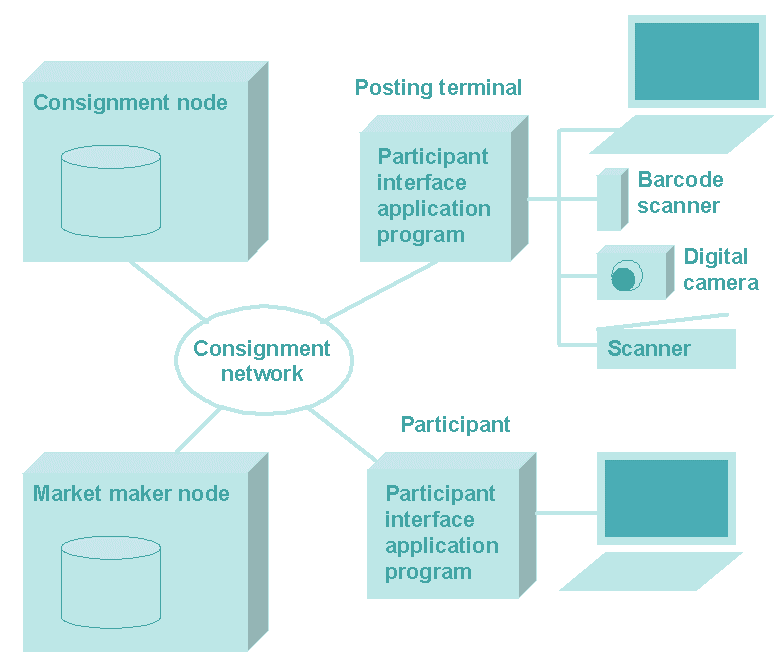
I believe that it is a fair representation of the following sentences:
"The present invention is a network of consignment nodes and a low cost easy to use posting terminal for the virtual presentment of goods to market. A consignment node is a computer database of used goods preferably operated by a used good, collectable shop keeper or a bailee. A posting terminal is a low cost easy to use computer and computer peripheral devices used by a small store owner to present goods to a computerized marker and track the sales of goods and control the posted inventory."
"Central market maker computer may be virtually divided into different markets with posting terminals used as the means for the market to obtain virtual title goods. Other consignment nodes, after taking physical possession of a good, may make an electronic presentment of that good to such a dominant consignment node market. Thus, a local collector of antique pens may bring a pen to a convenient consignment node in Smalltown, USA, the consignment network would allow this collector to electronically 'present' his pen to the dominant market maker node for antique pens in for example, Chicago."
The system that is disclosed is a distributed system without central database. There are essentially two types of actors:
The consignment/market maker nodes with a database that acts as servers for the participant PCs and can communicate with the other consignment/market maker nodes.
The participant PCs. These PCs are clients of consignment/market maker nodes. Though it is not explicitly said there are two kinds of participants, the professional users who operate "posting terminals" with barcode scanners and other equipments and the customers. Customers only buy. Professional user sell but can also buy.
Such system requires a number of protocols, which are described in that way:
"The consignment node may have four modes of operation: a software download mode, an auction mode, a market mode, and an agent mode. The software download mode allows a participant to log into the consignment node and receive a download of a participant interface application program. The auction mode allows a participant, from the participant interface application program, to log into a consignment node to partake in an electronic auction. The market mode allows a participant with the participant interface program to log into a consignment node to browse the consignment node database to search for a used or collectable good. The agent mode allows a participant to log into a consignment node to formulate a search request for a particular used good or collectable. The consignment node may search its own database for the requested good and/or generate agents to search and report back a search request of other consignment nodes."
In my view this is not enough to allow the reader to implement a practical solution without additional research. On the diagram I draw different boxes for the consignment node and for the market maker node but they are implemented in the same way:
"The present invention may allow a participant to electronically purchase goods from a consignment node and to select whether the good should be shipped to a participant designed location or the participant may take electronic legal ownership of a good and post a new participant defined offer or reserve price. By the interaction of a plurality of participants buying and selling collectibles on a consignment node, posting 'buy at' and 'sell at' quantities and prices the consignment node may establish a market or become a 'market maker' for collectable goods."
The system disclosed by 5,845,265 can be implemented. The problem in my view is that the system is barely more than a blueprint for the computerization of shop sales. Each shop operates a consignment node with a database accessed in ODBC. Protocols simply reproduce what the shop keeper does with her phone and fax. This statement is further confirmed by the description of the auction:
"At the auction date, perspective participants log onto the consignment node auction mode locally or through the consignment node network and await the first good to be auctioned. It is understood that in the best mode of the invention the participant will have a data terminal with a digital to analog converter such as a 'sound blaster' and speaker, the digital to analog capability may be used in the auction mode to bring the aural excitement of an auction, e.g., the call of the heckler, the caller and bidders, home to the auction participant."
"The consignment node takes the first item to be auctioned and posts the image of the good and the good's text record to the participants. The consignment node then posts the opening bid. It is understood that the bid postings may be in a protocol that invokes the generation of an auctioneer's voice at the participant terminals. The participants may then respond with a higher bid. The consignment node mode scans electronically the participants for bids and accepts the highest bid."
This point looks so important to the inventor that he disclose implementation details:
"The present invention uses pre-stored sound samples of different auction prices and auctioneer "string" along aural calls inside the participant interface software, and allows the generation of said pre-stored sound bites to be invoked by the consignment node driver through the said special protocol. This method greatly reduces the bandwidth necessary for a consignment node to support the generation of exciting auctioneers calls at a plurality of participant terminals. It is understood that the generation of an audio bit stream from the consignment node to the participant terminals is also with the scope of the present invention."
This auction is like 50’s Popular Mechanics anticipation. 5,845,265 use computers to reproduce as closely as possible a traditional auction. This is like if Wright has tried to patent a machine mocking the bird fly instead of a plane. There is no relationship between actual Internet auction and 5,845,265. Today buyers do not necessarily use directly the auctioning system. They prefer to use bid snippers and high proxy bids. There was a mistake in the reasoning behind 5,845,265. Bidders are not looking for excitement. What happened is quite the opposite of what was envisioned in 5,845,265: online auctions are kept as simple as possible and do not involve any multimedia means. Professional auctions evolve toward something close to eBay. When buyers still attend an auction (for flowers, fish, cattle...) they look at a screen and they silently bid with a remote control.
I think that a simple prototype tested with a small user panel would have been sufficient to find that this noisy auction was not practical. Such prototype would also have demonstrated that online sell and auction are not compute-intensive tasks and a distributed solution was not necessary. A centralized solution a la eBay was simpler to implement and operate. It seems to me that there are only two ways to invent and that 5,845,265 follows none of them. The long way goes through patient tests and trials. This is the way of Watt and of the Wright brothers. The fast way goes through intuition and can be quite effective for business methods. Someone feels that what she wants others also want. This is the way of Sony for the Walkman. eBay creators had a similar experience according to this story found on the eBay site: "The idea for eBay came from a conversation between Pierre Omidyar and his fiancée, an avid Pez collector. She thought it would be neat to find dispensers and meet other collectors over the Internet. Realizing that people needed a central, safe location to buy and sell unique items, Pierre founded and launched eBay on Labor Day in 1995."
I do not believe that applicants try to deceive the patent office but I think that examiners can be fooled by explanations and diagrams that look technical and detailed. Let’s take the example of FIG. 3 I reproduced here:
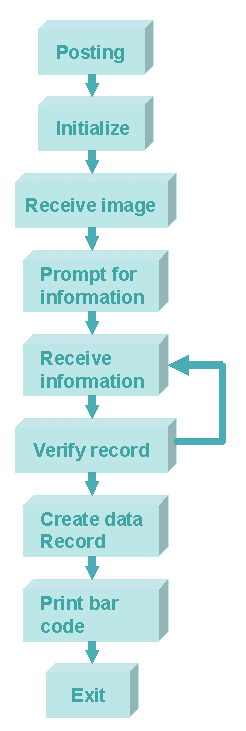
The corresponding explanation is:
"FIG. 3 shows a logical flow diagram of the steps the consignment node may use to create a database record of a good for sale or for auction."
"The consignment node user may invoke the consignment node program to enter the posting 200 mode to create a data record for the good. The posting 200 mode initializes 204 the consignment node to receive information on a new good. The initialization 204 step displays a data record with data fields on the consignment node terminal for the user to fill in information on the good. The initialization step 204 also initializes the consignment node peripheral devices such as the digital camera 12 and the printer 20. The consignment node user then 'photographs' or digitizes the image of the good from one or more perspectives as well known to the digital camera arts. The consignment node receives the digitized image(s) at receive image 206 step. The consignment node program then prompts the consignment node user for information on the good 208. The consignment node receives information 210 that the consignment node user inputs to the data record displayed at step 208. The consignment node program verifies 212 that the necessary information, such as owners name, reserve price, market or auction designation is in the data record. The verify step 212 will reject the record and return the consignment node user data entry mode 210 if the record does not have the minimum information. If the record is verified 212 as complete enough to commit to the consignment node database, a data record is created 214 and linked into the consignment node database. The consignment node program then generates and prints a bar code 216 that indicated the data record. The bar code system is used by the consignment node to maintain an accurate inventory and is a hook for local sales (discussed below)."
The selling basics of eBay whose html version is http://pages.ebay.com/education/sellingbasics/registration.html and PDF version is http://pages.ebay.com/education/sellingbasics/sellingBasics.pdf presents closely the same thing.
These figure and explanation look detailed but hardy convey any new idea. Any programmer would have designed closely the same thing given the following requirements
The post request must create good records in a database
The good data comprise an image and textual data
The post request must print a bar code identifying the good
The pattern "Prompt for information; receive information; verify record; create database record" is well known since the 70s. Because the image does not require verification, it makes sense to receive the image before handling textual data. The bar code can be printed only once the record number is known, so after the creation of the database record. For a person of the art these figure and explanation do not even convey information. The person of the art is trained to detect such figures because she reads analysis documents that contain plenty of them. An examiner is not.
Lack of skills may have helped 5,845,265 to be granted but only marginally. For some patents this lack of skills can have a serious impact. How can the patent office make a serious analysis of the prior art if it does not completely understand what the invention is about? But 5,845,265 uses words and concepts widely known in 1995 and is very readable.
A first constraint is the inventory database of the consignment node. This database requires a computer and disk space.
A second constraint is the network that consignment nodes must use to communicate with each other and that participant must use to post new offers (posting terminals) or to order and bid (end user terminals). The network implies a peer to peer protocol between the consignment nodes and a client/server protocol between the terminals and the consignment nodes, in which the terminals act as clients and consignment nodes act as servers.
An offer is represented by pricing data (for instance reserve price and initial price in case of auction), the quantity offered, a textual description and an image, which implies the following requirements.
The consignment node database must store:
traditional inventory data such as the quantity already sold that has to be delivered and the quantity available;
pricing data;
item images;
textual descriptions of the items.
The end user terminals must offer:
forms to order, to bid and to pay the goods;
facilities to display the textual description and the image of the good.
The posting terminal must offer:
forms to display offers and post a new offer;
means to link the good to the database record (bar code reader and printer);
means to enter the image of the good (scanner, digital camera).
If we put together these constraints and requirements we can see that
A consignment node necessarily contains a computer with disk space running a database, a peer to peer component, a server component and a logic that translates the requests of the peer to peer and server components into database requests. Consignment nodes therefore contain four design blocks, the database access block, the peer to peer block, the server block and the logic block.
An end user terminal necessarily contains a computer running a client component and a user interface able to display text, images and forms allowing ordering, bidding and paying goods. End user nodes therefore contain two blocks, a client block and a user interface block.
A posting terminal necessarily contains a computer running a client component and a user interface. To this computer must be connected a bar code reader, a bar code printer, a scanner and/or a digital camera. The user interface must display text, images and forms to display offers and post a new offer. The user interface must allow selecting an image, reading and printing bar codes. Posting nodes contain two blocks, a client block and a user interface block.
The blocks can be implemented using practices that were well known in 1995. They communicate with each other through interfaces and protocols whose design was known art in 1995. Note that the peer to peer block could have been inventive but not enough was disclosed about the consignment node to consignment node protocol to establish this inventiveness.
We have seen that 5,845,265 handles:
traditional inventory data such as the quantity already sold that has to be delivered and the quantity available;
pricing data;
item images;
textual descriptions of the items.
Combining images and textual description was well known in 1995, notably thank to the Web. 5,845,265 does not claim to innovate in that respect and suggests using www pages to present images and textual descriptions. Management of inventory and pricing data was also well known since the seventies. The combination of the four types of data was certainly known in 1995 because any online sale system has to display the price, the quantity and a description.
In applications developed in 1995 inventories, pricing data and descriptions were already stored in relational database. HTTP and CGI had been designed precisely:
to access computer resources such as databases to display their content on remote terminals;
to allow remote terminals updating the computer resources such as databases
A person of the art would have necessarily represented, accessed and distributed the data in the same manner.
5,845,265 combines data in a manner allowing sellers to post offers and end users to display offers and buy or bid. Fig. 13 of 5,845,265 shows the user interface of a posting terminal and this interface is essentially what is in use today. From Fig. 13 we can deduct that the envisioned user interface of an end user terminal is also what is essentially in use today.
There is however close prior art. For instance, since the seventies, Global Distribution Systems (GDS) also called Central Reservation Systems (CRS) were market places between users (travel agents) and providers (airlines, hotels, car rental companies...). Screenshots displayed by GDSs differed from Fig. 13 in two points:
GDS forms were displayed on text and not on graphic displays. Text displays were preferred because they were originally much cheaper than graphical displays and because the bandwidth needed to display graphics was not available before Internet.
GDS forms did not include pictures for one part because of the technical limitations of the displays and for another part because the professional user knew the good that was sold.
5,845,265 is a transformation patent that discloses an implementable, useful and new system.
We cannot regard this system as a significant innovation for two reasons:
Though it is reasonable the idea of using the system as the consignment node inventory is not practical. A consignment shop either already has an inventory or is too small to operate the system. In the first case the consignment shop problem is to interface its system with the market place. In the latter case the consignment shop faces the chicken and egg problem: many consignment shops must have adopted the system for the system to be appealing for one consignment shop.
Systems allowing professional users to buy online were well known since the seventies. The idea of offering essentially the same service to end users using new public networks like Internet was in the Web inventors’ minds.
However 5,845,265 is not obvious. The best evidence may be that 5,845,265 errs for auctioning and consignment nodes. Beyond that the author of 5,845,265 did not realize that the availability of public WAN networks and of simple and portable protocols allowed solving the 5,845,265 problem with loosely coupled components from different providers. The best solution to this problem is probably made of:
A posting terminal using HTML forms and multi-part POST requests to upload images in the same way as eBay.
A means to correlate the market place records with the consignment node inventory. This means can parse the HTML stream or use a Web service.
An inventory management that may use an applet or ActiveX object to scan and print bar codes.
A means to interface with the payment in the same way as PayPal.
An end user terminal using HTML forms in the same way as eBay auctions and Buy it now.
I wrote above that the claims of 5,845,265 are an improper generalization of the description subject matter, claims mentioning nowhere consignment nodes, while this is precisely the title of the patent and though the background of the invention describes a network of consignment nodes. This point is not the only weakness of the claims in my view. The key parts of the claim set are claim 1 that presents the posting system and claim 8 that presents how the invention is used to allow online sales.
Claim 1 system comprises:
a digital image means for creating a digital image of a good for sale;
a user interface for receiving textual information from a user;
a bar code scanner;
a bar code printer;
a storage device;
a communications means for communicating with the market; and
a computer locally connected to said digital image means, said user interface, said bar code scanner, said bar code printer, said storage device and said communications means, said computer adapted to receive said digital image of said good for sale from said digital image means, generate a data record of said good for sale, incorporate said digital image of said good for sale into said data record, receive a textual description of said good for sale from said user interface, store said data record on said storage device, transfer said data record to the market for goods via said communications means and receive a tracking number for said good for sale from the market for goods via said communications means, store said tracking number from the market for goods in said data record on said storage device and printing a bar code from said tracking number on said bar code printer.
Claim 8 discloses a market apparatus for use with a posting terminal apparatus, said posting terminal apparatus having means for creating a digital image of a good for sale, means for creating a data record of said good for sale, a tracking number printer means, a tracking number scanner means and means for communicating to said market apparatus, said market apparatus comprising:
a communications means for communicating with the posting terminal apparatus;
a post/de-post communications handler operably connected to said communications means, said communications handler receiving a data record of a good for sale from the posting terminal apparatus, said communication handler detecting a predetermined posting terminal apparatus identification code from the posting terminal apparatus and verifying from said code that the posting terminal apparatus is an authorized user of said market apparatus;
a storage device operably connected to said post/de-post handler, said storage device adapted to receive and store said data record of a good for sale, said data record containing an image of said good for sale and a textual description of said good for sale;
a presentation mapping module operably connected to said storage device and a wide area communication network, said presentation mapping module providing via said wide area communication network an interface to said market apparatus for a participant, said presentation mapping module providing said participant with access to said data record textual description and said image of said good for sale;
a transaction processor operably connected to said wide area communication network and said storage device, said transaction processor adapted to receive a purchase request and payment means from said participant, clear said purchase request and payment means and if said payment means clears then transfer the ownership of said good for sale by modifying said data record of said good for sale to reflect the new ownership of said good for sale by said participant; and
a notification means operably connected to said transaction processor said notification means notifying the posting terminal apparatus in response to said transaction processor transferring ownership of said good for sale denoting with a finality of transaction said new ownership of said good.
Both claims are independent but claim 8 uses the posting terminal system described by claim 1. This is an unusual construction. In the normal way claim 8 should be the first claim and claim 1 should depend on claim 8 with a sentence like "The apparatus of claim 8 wherein the posting terminal apparatus is a system comprising..."
Claim 8 describes the consignment node apparatus. This apparatus is the server whereas the posting terminal system is the client. The component of the consignment node apparatus that handles the communication with the posting terminal system is the post/de-post communications handler (2). The component of the consignment node apparatus that handles the communication with the end user terminal is the presentation mapping module (4). The presentation mapping module calls the transaction processor (5) to update the data record. Then the transaction processor calls the notification mean (6) to notify the posting terminal. The communication means (1) is a network and can be considered as obvious - the posting terminal and the consignment node being two different computers.
Claim 8 is difficult to interpret. The presentation mapping module (4) is connected to the end user terminal through a wide area communication network whereas the post/de-post communications handler (2) is connected to the posting terminal through a communication means. Because two different wording are used we necessarily conclude that the wide area communication network and the communication means can and usually are different. This is further confirmed by "communication handler detecting a predetermined posting terminal apparatus identification code from the posting terminal apparatus and verifying from said code that the posting terminal apparatus is an authorized user of said market apparatus." A reliable terminal identification code is a feature of networks like SNA or X25 but certainly not of TCP. With TCP the only reliable way to check if a user is authorized is to ask her to authenticate with a user/password or with a certificate. Using the IP address is not a solution. The use of a terminal identification code was common for instance in travel agent systems.
To my knowledge no online sale or auction system uses terminal identification codes. Beside security there is another reason. The presentation mapping module and the post/de-post communications handler can be implemented using the same means, what we call today a Web application. The presentation mapping module and the post/de-post communications handler share a substantial part of the logic and of the screens. Therefore this is simpler and cheaper to develop the presentation mapping module and the post/de-post communications handler in essentially the same Web application.
We can now turn our attention to claim 1. Claim 1 describes the posting terminal system. This system is the client whereas the consignment node apparatus is the server. The posting terminal system:
generates a data record of the good for sale,
incorporates a digital image of the good for sale into the data record,
receives a textual description of the good for sale,
locally stores the data record,
transfers the data record to the consignment node apparatus,
receives a tracking number for the good for sale from the consignment node apparatus,
stores the tracking number in the local data record,
prints the tracking number on the bar code printer.
This system can be implemented only with a fat client (either a traditional client or a big applet or ActiveX object) because it incorporates a digital image of the good in the data record, locally stores this data record and prints the tracking number on the bar code printer. I do not believe that any online sale or auction system implements this unnecessary complex apparatus. A thin client solution in which
the data record is stored only on the market node,
the posting user uploads the image on the market node,
the data record does not contain the image but a reference to the image,
the posting user enters the textual description of the good on a HTML form,
the market node returns a tracking number once the posting user has confirmed the creation of the offer,
the posting user can list her offer and display the offer status (sold, current bid price...)
is a simpler solution to the posting problem. This is the solution used by online sale or auction systems.
If 5,845,265 had been filed in the eighties we could rightfully regard the differences between the fat client and the thin client solutions as improvements obvious to the person of the art who knew about new facilities such as the Web. For instance we could find that storing a reference to the image is the same as storing an image.
But 5,845,265 was filed in 1995 and then digital image formats like GIF, which is still widely used today, were known. It was also known that data record including the text description and excluding the image had a size of about two hundred bytes and that a detailed and appealing color image had a size of five thousand bytes and more. Therefore we cannot find that storing a reference to the image is the same as storing an image.
There is another issue. In 1995 the development, deployment and administration cost of fat clients was also known. Keeping a local image of the data record presumably in a database such as Access had to be a conscious decision. I believe that the choice of a fat client design was motivated by the use of an old communication means like SNA or X25 at a time at which TCP, FTP and HTTP were available and at which the standardization of multipart requests (RFC 1867) was already considered.
I showed above the substantial differences between the description (studied in the technical analysis and innovation assessment) and the claims of 5,845,265. On one hand the description does not support the scope of the claims. On the other hand the description discloses components that are not covered by claims. The facility that allows a consignment node to search an item on other consignment nodes is not needed to support the 5,845,265 claims.
5,845,265 is actually a combination of three inventions:
An invention that allows posting, searching and buying goods on consignment nodes, which is claimed in the 5,845,265 claims.
An invention that allows a consignment node to search a good on other consignment nodes on behalf of end users.
An invention that allows consignment nodes to handle auctions
6,085,176 was filed to protect the second invention. Because it uses essentially the same description 6,085,176 can have the same priority date as 5,845,265. Because the description of 6,085,176 is close to the description of 5,845,265 we do not need to make again a technical analysis.
The 6,202,051 patent, presented later in this page, was filed to protect the third invention.
6,085,176 claims a method of searching a plurality of electronic markets to locate an item, the method comprising:
receiving a search request for an item from an internet participant at a first computer;
formatting said search request at said first computer into a predetermined format;
transmitting said search request, using a software search agent, from said first computer to a plurality of other computers in said predetermined format, at least one of the plurality of other computers performing a search for the item in response to receiving said search request; and
receiving at the first computer search results from at least one of the plurality of other computers in response to the transmitted search request.
In my opinion the description correctly supports the 6,085,176 claims. As we have seen in the technical analysis of 5,845,265 the description is implementable though not enough details are disclosed to allow a person of the art to implement the invention without additional work.
6,085,176 claims a system of distributed electronic markets whereas the online sale or auction sites I’m aware about are centralized electronic markets. However the 6,085,176 claims refer to computers and not to companies. Therefore a single company could infringe 6,085,176. [The description describes electronic markets hosted by consignment stores and by third parties, so by different organizations. But what can link different companies can a fortiori link computers inside a company. So the claim wording of 6,085,176 is legitimate].
We can suppose that large online sale or auction sites operate many server computers. The biggest sites probably combine three mechanisms:
Request load balancing between servers
Storage areas (SAN) containing the data records, which are shared by servers
Data dependent routing. A set of servers may handle cars and another set collectibles. When she searches cars on sale or auctions the user is routed to the proper server set.
These mechanisms are either simple to implement (data dependent routing) or available of the shelf (load balancers and SANs).
Half.com has been convicted for infringement of 6,085,176. This patent may also be a concern for the syndication sites that search lowest prices or lowest fares. Such sites query serially or in parallel many provider sites. They emulate an end user for instance to check for instance the availability and the fare of a flight. Most provider sites do not do anything to facilitate or forbid the work of syndication sites and they usually do not pay syndication sites. But the interest of providers is to make syndication sites’ queries easier and cheaper, for instance with Web services and to give them incentives. If providers do so and if syndication sites use these Web services then these syndication sites will be formatting and transmitting search requests, from their server computers to provider computers to perform searches. Together providers and syndication sites will be close to the first claim of 6,085,176.
However in my view 6,085,176 is not new. Since the seventies, as we have seen above, CRSs / GDSs are intermediates between travel agents and airlines. Travel agents must check the availability of airline seats. They can formulate their requests in general terms (list me the flights of next Monday from Boston to San Francisco, for which seats are available). Travel agents make their requests on the CRS system. Then to process the request the CRS queries airlines for available seats on their flights. This apparatus used to be regulated (and therefore public) since 1984 to ensure neutral display (not biased toward an airline.)
Because it uses essentially the same description (including the dubious excitement of a "live" auction house type atmosphere) 6,202,051 can have the same priority date as 5,845,265. Because the description of 6,202,051 is close to the description of 5,845,265 we do not need to make again a technical analysis.
The first claim of 6,202,051 describes an automated method, performed by a computer-based auction system, for enabling a seller to auction a uniquely identified item via the Internet to one or more potential buyers, the method comprising:
requiring the seller to establish a seller's account, the seller's account being based at least on the seller's identity and a financial instrument associated with the seller;
receiving information from the seller including a description of an item offered for auction by the seller;
creating a data record containing a description of the item based on the information received from the seller, the data record connoting an ownership interest by the seller in the item, the data record being stored in a computerized electronic database maintained by the computer-based auction system;
generating an identification code to uniquely identify the item;
scheduling an auction for the item, the auction to be hosted by the computer-based auction system;
presenting the item for auction to an audience of participants through a worldwide web mapping module executing in conjunction with the computerized database, the worldwide web mapping module translating information from the data record to a hypertext mark up language format for presentation through the Internet;
receiving bids on the item from participants via the Internet through an auction process that executes in conjunction with the computerized database;
terminating the auction for the item when the auction process encounters predetermined criteria;
notifying a winning auction participant that the winning auction participant has entered a high bid in the auction process;
providing the unique identification code to the winning auction participant to uniquely identify the item; and
charging a fee to the seller's account based on an amount of the high bid.
In my opinion the description correctly supports the first claim of 6,202,051. No information is given about the type of auction but the subsequent claims and the description of 6,202,051 suggests that this is the simplest type of auction that is envisioned. A person of the art can implement the described auction system relatively easily.
6,202,051 references fifty eight patents and twenty five papers that confirm that the idea of computer-based auctions was not new in 1995. Next I think that a person of the art who knows databases and HTTP servers has to develop an auction system in 1995 necessarily designs a system
receiving information from the seller including a description of an item offered for auction by the seller; [requirement. Participants must know what is sold]
creating a data record containing a description of the item based on the information received from the seller, the data record connoting an ownership interest by the seller in the item, the data record being stored in a computerized electronic database maintained by the computer-based auction system; [simplest solution]
generating an identification code to uniquely identify the item; [see the discussion below; identification code generation is known art since the seventies]
scheduling an auction for the item, the auction to be hosted by the computer-based auction system; [requirement]
presenting the item for auction to an audience of participants through a worldwide web mapping module executing in conjunction with the computerized database, the worldwide web mapping module translating information from the data record to a hypertext mark up language format for presentation through the Internet; [simplest solution]
receiving bids on the item from participants via the Internet through an auction process that executes in conjunction with the computerized database; [requirement and consequence of 5]
terminating the auction for the item when the auction process encounters predetermined criteria; [requirement]
notifying a winning auction participant that the winning auction participant has entered a high bid in the auction process; [requirement]
The last element ("charging a fee to the seller's account based on an amount of the high bid") describes a charging scheme used in auctions for centuries. A person of the art who has to implement this scheme will necessarily "require the seller to establish a seller's account" (first element) to make sure that the seller will pay her commission. The tenth element ("providing the unique identification code to the winning auction participant to uniquely identify the item") is not necessary for the invention to work. However the person of the art will also implement it. The reason is that the participant may be disappointed with the good (especially when the good is used or a collectible) and then needs to provide data uniquely identifying the good to the seller.
If you follow this reasoning you necessarily conclude that the first claim of 6,202,051 is obvious.
Business method patents probably do not help small- or middle-sized business to grow up. Here I try to illustrate this fact with the MercExchange vs eBay example.
The oldest http://www.ebay.com page I found contains: "Welcome to eBay! The most fun buying and selling on the Web! Take part in an exciting auction, or put your own merchandise on auction, all free for buyers!" Note that almost all sentences end with an exclamation mark, which looks amateur. This page was recorded on June 14, 1997 by archive.org [Internet Way back Machine] and its copyright notice contains "1995-1996 eBay Inc." [Copyright notice not updated] I also found that www.auctionweb.com mentioned eBay on April 9, 1997: "NETIS Auctions On the Web has no affiliation with eBay AuctionWeb online auction service."
I further found this little bio on the eBay site: "eBay was founded in Pierre Omidyar's San Jose living room back in September 1995. The original name of the company was Auction Web. It was from the start meant to be a marketplace for the sale of goods and services for individuals. In 1998, Pierre and his cofounder Jeff Skoll brought in Meg Whitman to sustain the success. Meg had studied at the Harvard Business School and had learned the importance of branding at companies such as Hasbro." This story matches archive.org entries: at the end of 1997 eBay was a successful small company that had already sold 3 millions items.
I think that the story of eBay is made of two phases:
Before Meg Whitman. eBay learns its business empirically (because this business is new, this is a valid approach; because eBay was one of the first companies to enter this business eBay is also one of the first companies to know this business; note that this empiricism does not mean that the business model is not well defined: from the beginning eBay is an online marketplace for the sale of goods and services for individuals). In this first phase eBay earns just enough to provide a living to its founders and ignores Intellectual Property issues. For instance eBay has to change its original name, Auction Web, because another company got this name first.
After Meg Whitman. eBay adopts state-of-the-art corporate management, including the marketing and legal aspects and files patents.
Since 1998 eBay was granted eight patents and has two other published patent applications. Six of these patents even refer to the MercExchange patents. Though this does not prove that eBay found that they were infringing the MercExchange patents this is evidence that eBay knew MercExchange patents in 2000. The eBay patents do not really look more inventive than MercExchange patents. So if eBay had applied the same patent standard to the MercExchange patents as they did for their own patents they should have concluded that the MercExchange patents were valid and would have sought a settlement with eBay. Also because they were filing patents they necessarily knew how dangerous it was to ignore the MercExchange patents.
5,845,265 is referenced by 6 eBay patents:
6,748,422 is titled "System and method to control sending of unsolicited communications relating to a plurality of listings in a network-based commerce facility". The 6,748,422 application claimed the priority from U.S. Provisional Patent Application No. 60/242,026, entitled "Spam Prevention Tool", filed on Oct. 19, 2000. 6,748,422 was classified as a business method and describes an anti spam facility whose principle is to hide the actual email address of the recipient.
6,732,161 is titled "Information presentation and management in an online trading environment". This is a continuation of application Ser. No. 09/177,726, filed on Oct. 23, 1998, now U.S. patent 6,058,417 that I present below.
6,604,107 titled "Generic attribute database system for storing items of different categories having shared attributes" and filed on April 24, 2000. 6,604,107 presents the prior art in that way: "For the storage of e-commerce goods or consumer product and/or service information into a database, each product (e.g., automobiles and shoes) will have its own category. Typically, in such databases, each category is stored in a separate data structure (e.g., a table), wherein such data structures will include the specific attributes for that category. For example, for a shoes category, the attributes could include (1) color, (2) size, and (3) type of material. Accordingly, a data structure is created that includes these attributes. Similarly, for an automobile category, the attributes could include (1) make, (2) model, (3) year and (4) color. Therefore, a separate data structure is created for these attributes." 6,604,107 claims the use of generic attributes "Accordingly, these different categories have attributes that are different as well as attributes that are the same. For example, the categories of shoes and automobiles both may have a color attribute. In contrast, the category of automobiles may have a year attribute, indicating the year of the automobile, while the category of shoes may not have this attribute." 6,604,107 was classified as a business method.
6,523,037 titled "Method and system for communicating selected search results between first and second entities over a network" was filed on September 22, 2000 in USA. It was also filed in Europe as EP1399832. 6,523,037 discloses a mean to communicate a subset of a search result selected for instance with checkboxes to a second user.
6,466,917 is titled "Method and apparatus for verifying the identity of a participant within an on-line auction environment". The 6,466,917 application claimed the benefit of U.S. Provisional Application No. 60/168,842 filed Dec. 3, 1999. 6,466,917 is presented like this: "A method and apparatus for verifying identity of a participant in a network-based transaction facility are described. According to one embodiment, user interface information is provided to the participant via a communications network. The user interface information specifies an identity verification interface for obtaining personal information of the participant. The personal information of the participant is passed to a third party for verification via the communications network. Subsequently, a verification result is received from the third party via the communications network. The verification result is then communicated to the participant via the communications network."
6,415,320 is titled "Information presentation and management in an online trading environment". This is a continuation of application Ser. No. 09/177,726 filed on Oct. 23, 1998 U.S. Pat. No. 6,058,417, that has been allowed for issue.
6,058,417 does not refer MercExchange patents. It is titled "Information presentation and management in an online trading environment" and was granted on May 2, 2000. 6,058,417 was classified as business method and presented in that way: "the present invention includes features for enhancing the online trading experience for both buyers and sellers. When sellers register an item for sale, they provide information about the item. For example, the seller may associate a textual description, an image, shipping terms, and other information with the item. Advantageously, according to one aspect of the present invention, to associate an image with an item for sale, the seller is not required to provide the image in a particular format or size; rather, the method and apparatus of the present invention automatically harvest images and transform them to an appropriate format for use with the system. According to another aspect of the present invention, prospective purchasers visiting an online commerce site employing the present invention need not navigate to a separate web page for each item to view images associated with the items; rather, thumbnail images for multiple items are aggregated onto a web page to allow quick preview by the prospective purchaser." So the technical part of the invention is a system for resizing images.
6,202,051 referenced by 5 patents of eBay that also refer to 5,845,265:
6,748,422
6,732,161
6,604,107
6,523,037
6,466,917
6,085,176 referenced by 5 patents of eBay that also refer to 5,845,265 and 6,202,051:
6,748,422
6,732,161
6,604,107
6,523,037
6,466,917
In the first phase and probably most innovative part of its existence eBay filed no patents. Then eBay filed patents worded in such way that numerous companies infringe its patents in the same way numerous companies infringe the MercExchange patents. You can observe ironically that eBay was convicted after having filed patent applications and that "for all they that take the sword shall perish by the sword" but this is not the point.
We have seen that an invention is essentially combinatorial and opportunistic. To contribute to the progress of the useful arts people need to find the correct combination of prior art (an iterative development process made of cycles of improvements and result analysis) to eventually get the right thing at the right time. Goodyear, I mentioned above, died with huge debts and spent years in jail for debt primarily because he invented vulcanization fifty years before tyre industry made his invention really useful. Timing is essential for the success of an innovation. To be on the safe side innovators have to start a bit too early and then to cope with the situation in which they must be dedicated to a new business that does not yet make money. At this stage it is essential to last and therefore to not spend too much, which means to be focused on the innovation and accept compromises on aspects, like Intellectual Property, that were not essential for the innovation development.
Usually many people have the innovation idea and can deduce the outlines of the related invention. What differentiates the ones who make the innovation successful from the ones who fail or stay at the idea level is the quality of their development process. The problem with the loose patent system of today is that a winning strategy is to patent the outlines and leave the burden of pulling chestnuts out of the fire to others. The approach that allows the real innovator to deal with Intellectual Property issues from the beginning is to make a business plan, get money from investors and start a fully-fledged company with a focus on management and planning rather than on the innovation. This approach has further drawbacks. It requires more money. It makes of innovation a business of experienced people. It may exclude younger people and minorities from innovating.
The patent system is the best tool we have to regulate and organize the progress in useful arts but we must keep it within bounds. To define these bounds we must study how the patent system impacts business. USA favor innovation. Even when they get convicted for patent infringement companies like eBay remain richer than the patent holders. Creating an innovation start up is still a winning strategy. Outline patenting strategy is a form of parasitism. It seeks to get a share of the innovator profits but the innovator must survive for the outline patent holder to keep getting license fees. Outline patent holders eventually may even have to protect their golden egg gooses and the system self regulates. In other countries the situation may be different. In a place where innovating is already hard enough the burden of outline patenting can kill it and the system cannot self regulate. For such places the best solution is to enforce a higher standard of patents.
In this section I use the documents that MercExchange published on their site, at http://mercexchange.com/docs.htm and http://mercexchange.com/news.htm. I thank MercExchange for their contribution to Intellectual Property knowledge.
Here is the Amended Complaint for Patent Infringement filed by MercExchange on November 21, 2001 against eBay, Half.com (a subsidiary of eBay) and ReturnBuy. In this complaint MercExchange says that:
eBay infringes 6,202,051 (Facilitating internet commerce through internetworked auctions);
eBay and Half.com infringe 6,085,176 (Method and apparatus for using search agents to search plurality of markets for items);
eBay, Half.com and ReturnBuy infringe 5,845,265 (Consignment nodes).
The complaint presents the defendant business but does not explain in which way the defendants infringe the MercExchange patents. MercExchange did a good work in analyzing the defendant web sites and press releases. Though MeckExchange found that ReturnBuy "had completed the integration with eBay’s Application Programming Interface (API) that allow[ed] the two companies to instantly exchange data through a fully secure and private communication hotline" MeckExchange did not sue ReturnBuy for infringement of 6,085,176.
In its complaint MercExchange primarily explains why it thinks that the Court for the Eastern District of Virginia is competent for ruling this case:
MercExchange is a Virginian company;
the inventor, Thomas G. Woolston is a Virginian resident;
though the defendant are not Virginian companies, they regularly transact business in the Eastern District of Virginia by offering their services via the Internet to customers, advertisers, business affiliates and partners in the Eastern District of Virginia.
Note that this version of the Complaint for Patent Infringement is amended. The amendment has probably consisted in explaining why the Court for the Eastern District of Virginia was competent for ruling the case. This is a reasonable assumption because eBay, Half.com and ReturnBuy filed a joint motion to transfer the case to the Northern District of California. The defendants explained that:
the Half.com and ReturnBuy alleged infringement arises from their relationships and activities with eBay;
the hub of the alleged infringing activity is in California, where eBay houses all its computers, databases and servers;
numerous documents and witnesses are in California and inconvenient to transport to Virginia.
They offered to pay to the lodging and transportation of Thomas G. Woolston, sole owner and employee of MercExchange.
The Court denied this motion. To explain its decision the Court first said that it had to decide:
if the suit could have been brought in the Northern District of California (1);
whether the interest of justice (3) and the convenience of the parties (2) justify transfer to the Northern District of California.
USA law says that "a civil action for patent infringement may be brought in the judicial district where the defendant resides or where the defendant has committed acts of infringement and has a regular and established place of business". But because the principal place of business of Half.com and ReturnBuy was not the Northern California the Court answered no to (1).
USA law further says that "the plaintiff’s choice of forum [Court] should be given significant weight, and should not be disturbed unless the balance is strongly in favor of transfer". Here again because Northern California was not the principal place of business of Half.com and ReturnBuy and because eBay was already a multi-billion company with the financial means to transport the necessary evidence for trial in Virginia when MercExchange was a small, one-employee company the court found that litigating this case in Virginia was no more inconvenient than it would have been in California and answered no to (2).
USA law also says that the interest of justice can include "the pendency of a related action, the court familiarity with the applicable law, docket conditions, access to premises that might have to be reviewed, the possibility of an unfair trial, the ability to join other parties and the possibility of harassment". The Court found that none of these conditions was met and answered no to (3).
The Court choice is important. First the interest of a party is usually to have its case ruled by its home Court. The home state of the party has a "substantial interest in having local controversies decided at home and protecting local inventors" [or local business]. Second in a Federation like USA there are differences in the way Courts rule cases.
With Internet it may seem that any Court can rule a case (a company having customers everywhere). However if MercExchange had chosen to sue only eBay the case could have been transferred to the Northern California Court.
The following actions were made by the parties:
6,085,176: Half.com made a motion for Summary Judgement that claims 1 to 9 and 29 to 41 of 6,085,176 (Method and apparatus for using search agents to search plurality of markets for items) were invalid.
5,845,265: The three defendants made a joint motion for Summary Judgement that claims 1, 4, 5, 8, 10, 13, 15, 17, 20, 22, 23 of 5,845,265 (Consignment nodes) were invalid for lack of novelty based on a patent 5,424,944 of a company called Asset Management and Control Inc. MercExchange responded with a motion to Strike Fictitious Drawing (remove from the motion a drawing alleged to have been invented).
6,202,051: eBay made a motion for Summary Judgement that all claims of 6,202,051 (Facilitating internet commerce through internetworked auctions) were invalid for an inadequate written description. Then MercExchange made a motion for Summary Judgement that all claims of 6,202,051 were valid for an adequate description. Then eBay made a motion for Summary Judgement that claim 12, 14, 15, 17 to 20, 22, 24 to 27, 30 to 35 of 6,202,051 were invalid for lack of novelty and obviousness.
The Court took two decisions:
Schedule a Markman hearing in order to construe (interpret) a number of contested claims in the patents. USA law recognizes that the inventor can use words and build claim sentences in an arbitrary and ambiguous way. In such cases the exact meaning of claim words and sentences can be determined from the patent description and is a matter of law [not a matter of facts that a jury can rule]. This process was defined and first used in Markman vs Westview Instruments hence the name. We discuss this Markman hearing in a next section.
Rule the pending motions that do not require claim construction under Markman. The Court denied the joint motion about 5,845,265, granted the motion to Strike Fictitious Drawing and denied the second motion of eBay about 6,202,051 (lack of novelty and obviousness). We detail now this ruling.
Here is its order.
The Court applied the USA law that says that:
"When a patent has been examined and duly granted, judicial review must give due weight to the presumption of validity. The presumption of validity is based on the presumption of administrative correctness of actions of the agency charged with examination of patentability" [USPTO].
"The courts are the final arbiter of patent validity and, although courts may have recognizance of, and benefit from, the proceedings before the patent examiner, the question is ultimately to the courts to decide, without deference to the rulings of the patent examiner."
Before analyzing the Court decision we must review 5,424,944, the patent that could make 5,845,265 invalid for lack of novelty.
5,424,944 entitled "System and methods for controlled asset disposition" was filed on February 2, 1994 and granted on June 13, 1995. The object of this business method patent is to "provide a system and method for the controlled disposition of assets". The meaning of asset is clarified by the beginning of the background "In many industries there is a need to control the disposition of certain capital assets for various reasons. Assets may become surplus due to obsolescence or overproduction, they may need refurbishing with new parts, they may need environmentally unsound parts removed or replaced, and the like".
5,424,944 is "a controlled capital asset disposition process supported by an interactive multi-media system which combines images of the assets with relevant data and audio records and disposition instructions for security and reconciliation purposes. The method of the present invention of controlling the disposition of an asset comprises the steps of transporting the asset from a customer facility to a disposition facility, receiving the asset at the disposition facility and creating a receipt record thereof, sorting the asset in accordance with a preselected method of disposition, and disposing of the asset in accordance with the preselected method of disposition."
5,424,944 is a system tracking asset disposition through the creation and use of records associated with assets. These records comprise an image of the asset and are stored in a database that can be displayed by customers. 5,424,944 further uses stations that contain an image capture device and a data capture device coupled to a computer capable of communicating with the server that handles the database.
In my view 5,424,944 is prior art of interest though 5,424,944 handles assets and not collectibles or used goods, the 5,424,944 station having the same function as the 5,845,265 posting terminal. 5,424,944 contains three figures named Fig. 1a, Fig. 1b and Fig. 2. Fig. 2 is the only figure relevant in the 5,845,265 dispute. It looks like this:
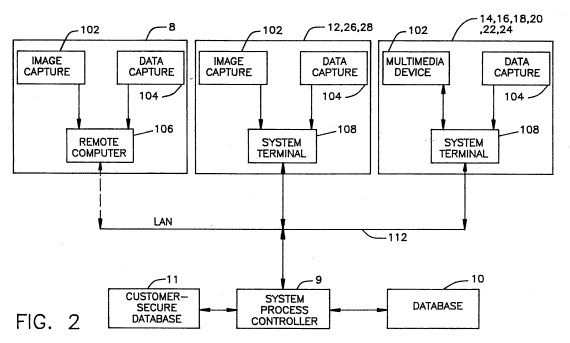
The three boxes containing data capture devices are stations.
5,424,944 is owned by Asset Management & Control, Inc.
The 5,845,265 patent does not refer to 5,424,944. The USA law says that "while the presentation at trial of a reference that was not before the examiner does not change the presumption of validity, the alleged infringer’s burden may be more easily carried because of this additional reference." However MercExchange showed that they distinguished 5,424,944 and disclosed their finding to the USPTO. They further explained that the "USPTO misplaced a certain page of the application and as a result, it appears that the 5,424,944 patent was not reviewed."
So we are in the situation where 5,424,944 was presented to but not reviewed by the patent examiner. Such cases [errors of agencies and offices] are not uncommon. The rule that applies then is that the alleged infringer’s burden is no more easily carried or to say it differently this is the alleged infringer who is impacted by the mistake of the office.
The Court first ruled the motion to Strike Fictitious Drawing.
I did not see the considered drawing. I know that this drawing was based on the Fig. 2 above and the testimony of the inventor of 5,424,944 and a former employee of the inventor’s company. The drawing included a digital camera, a bar code scanner and the use of the World Wide Web. Therefore the Court found the drawing highly misleading and granted the motion to Strike Fictitious Drawing.
The Court said that defendants should have listed the various embodiments of an image capture device to present 5,424,944 in a way that was not misleading and considered later the question of whether or not the 5,424,944 actually used the World Wide Web.
This is difficult to not agree with the court on this point. I found surprising that 5,424,944 did not include bar code scanner and printer. The use of such devices is debatable in 5,845,265 because they address an inventory problem. In a tracking system like 5,424,944 bar code scanners and printers are needed to quickly and reliably identify assets. The World Wide Web is the simplest way to display the content of a database but reliable World Wide Web components (browsers and HTTP servers) were not available early enough before February 2, 1994 [the 5,424,944 system was in use starting in February 1993]. So I think that, though adding the World Wide Web to the picture was obvious for the person of the art, the World Wide Web could hardly be present in the original 5,424,944 system.
MercExchange said that the testimony of the inventor and of the former employee was not corroborated. The Court analyzed the factors that had been defined by the Federal Circuit to determine whether there is sufficient corroboration:
the relationship between the corroborating witness and the alleged prior use;
the time between the event and the trial;
the interest of the corroborating witness in the subject matter in suit;
contradiction or impeachment of the witness’ testimony;
the extent and details of the corroborating testimony;
the witness’ familiarity with the subject matter of the patented invention and prior use;
probability that a prior use could occur considering the state of the art at the time;
impact of the invention on the industry, and the commercial value of its practice.
Here comes the fun. The Court found that the inventor "does not appear to know many details regarding the system". The inventor explained "You should understand that I am the system architect and did not code the system". The Court further reported that while the inventor "invented the 5,424,944 system, there were numerous areas where he was unsure of how the system operated".
[I do not know enough about this case to make my mind. But for people who are not familiar with the patent business I must explain that a company inventor is a person who thank to his or her position in a company has the opportunity to sign a power to attorney paper. You should not assume that a company inventor has contributed to the invention or knows the patent. In the patent search page I explain how to read inventor lists.]
The former employee was a 16-year old intern, with no formal computer training, at the time the 5,424,944 system was implemented and ceased to work with the company either in late 1993 or early 1994. The inventor "often told the plaintiff’s attorney to talk to him about something especially if it dealt with Internet but the former employee could not [obviously] answer questions about sensitive aspects like billing.
The inventor said that his company created two sites
www.totalsurplus.com in 1995 or 1996
I made the following findings:
The first site URL was actually www.asset-mgtandcontrol.com.
On archive.org the oldest pages were recorded on December 2, 1998 for www.asset-mgtandcontrol.com and on January 9, 1998 for www.totalsurplus.com.
www.asset-mgtandcontrol.com is the site handling asset disposition
The customer may choose to resell the assets. www.totalsurplus.com is a site helping other parties to buy these assets (considered here as computer components and full systems and supplies). When www.asset-mgtandcontrol.com is the equivalent of the posting terminal of 5,845,265. www.totalsurplus.com is the equivalent of the mapping system allowing end users to buy or bid used goods and collectibles in 5,845,265.
We may remember here that the eBay site was recorded on June 14, 1997 on archive.org (Internet Wayback Machine) and that a page recorded on April 9, 1997 on archive.org already referred the eBay site. archive.org does not record all pages on the Web. I do not know precisely how archive.org is doing but a rule of thumb is that when a page is indexed by search engines it is recorded by archive.org. So the dates are the dates at which the sites became popular. So we can conclude that eBay was known before www.asset-mgtandcontrol.com and www.totalsurplus.com.
MercExchange found that neither of these web site names was registered with the Internet Domain registry until 1997. I can confirm this finding. I used the whois service of http://www.networksolutions.com and I found that asset-mgtandcontrol.com was registered on January 19, 1997 and that totalsurplus.com was registered on June 20, 1997. I even found that the administrative contact for both domains was Dottie Magliato (the inventor, who is also the president and co-owner of the company that owns 5,424,944, is Nicolas J. Magliato).
[In 1994 like today subscriptions to ISPs and network connections were managed by network administrators. The inventor (president) was too high in the company hierarchy and the former employee (intern) too low in the hierarchy to know these details. I do not believe that the Internet story was invented. In 1994 things were still managed informally. The company may have used the subscription of another party, for instance of a university. On the other hand witnesses talk about Internet whereas the Court tries to understand if the company used the Word Wide Web (so browsers and HTTP servers over Internet) in 1994.]
Coming back to the Federal Circuit factors the Court observed that
As we have seen the corroborating witnesses did not know sufficiently the alleged prior use.
The time between the event [5,424,944 system in use] and the trial was over nine years. Therefore the testimony of the former employee is nine years recollections.
The corroborating witnesses had no special interest in the subject matter in suit.
While neither witness explicitly contradicted the other, their answers directed attorneys in a circle of unanswered questions and unsupported answers. [Internet story above]
Witnesses were unable to recall details of the system.
Neither witness was familiar with the specifics of the prior use of the system.
Based on lack of supporting documentation in this case, it was merely possible, not probable that the system described by witnesses existed.
The witnesses’ testimony, absent any documentation such as billing records, Internet service records, records of sales of goods over Internet, design documents, copies of web site screens, etc cannot corroborate that the 5,424,944 system used the World Wide Web to conduct transactions in 1993 or 1994.
Therefore the Court denied the joint motion for Summary Judgement about 5,845,265.
Then the Court analyzed the eBay motion for Summary Judgement that all claims of 6,202,051 (Facilitating internet commerce through internetworked auctions) were invalid for lack of novelty and obviousness. eBay found that a philatelist (stamp collector) posted a proposal on a newsgroup called rec.collecting.stamps on June 17, 1994:
"What would be really nice would be a BidBroker software. It might work something like this:
Interested bidders register their email address with BidBroker.
A seller sends his description, reserve price, cut-off-date, etc to BidBroker.
BidBroker assigns a lot number to the description, and forwards it to the list of registered bidders.
On the cut-off-date, BidBroker determines the winning bidder and the winning price and forwards this information to the seller and the winner bidder. The seller and the winner bidder communicate directly to complete the transaction. The sell price is forwarded to all bidders who put a bid.
To pay for the upkeep of such a system, the seller (and possibly the purchaser) pays the operator / owner of the system a commission based on percentage of the sell price, or perhaps a flat handling charge per lot. Perhaps a company like AOL might provide this service."
To be valid the system disclosed in this posting had "to be known or used in this country [USA], or patented or described in a printed publication in this or a foreign country" before the invention of 6,202,051 according to USC 35 § 102. The court considered that though the posting was intended for the communication of ideas to persons who subscribed to the stamp collection group and an individual was required to obtain permission to join in the newsgroup and that there were no guarantee that MercExchange would have been granted permission. Furthermore these postings were not indexed or catalogued in any way. Therefore the Court found that the BidBroker posting did not have the status of a printed publication and denied the eBay motion for Summary Judgement that all claims of 6,202,051 (Facilitating internet commerce through internetworked auctions) were invalid for lack of novelty and obviousness.
I think that another Court could have found that the BidBroker posting had the status of a printed publication:
MercExchange explained Google acquired an archive of old newsgroup messages and wrote software to index them so they would be searchable. Google could not acquire confidential newsgroup messages. So MercExchange would have been granted permission. Furthermore rec.collecting.stamps is a Usenet newsgroup. As explained in http://www.uncensorednewsfeed.com/usenet.html "anyone wishing to read or post messages in a particular group, does so by connecting to a Usenet Server across an internet connection. A newsreader (like Outlook Express) is needed on the user’s computer to read articles and download attached files. You 'subscribe' to a group by telling the software in your own computer to check the messages in a particular group. [...] Nowhere is there ever a subscriber list. The term 'subscribe' is used in reference to how you set up your computer and software." To confirm my understanding I connected to the NNTP server of my ISP. I only had to provide my e-mail address. Then I listed the newsgroups, I found rec.collecting.stamps.discuss, rec.collecting.stamps.marketplace and I downloaded the message lists. I think that the Court misinterpreted the argument of MercExchange that simply said that, "to obtain an access to a newsgroup in 1994, [...] one must have received the permission to access a [Usenet] server." But subscribing to a Usenet server was the same as subscribing to an ISP and setting up a Usenet server was a bit like setting up a HTTP server and most Unix users had access to a Usenet server.
Newsgroup postings are not indexed or catalogued but they can be sorted and scanned by title. In case of the BidBroker proposal the title contained bid and broker - a subject matter of interest for MercExchange. Newsgroup postings are easier to browse than most printed publications. rec.collecting.stamps.discuss and rec.collecting.stamps.marketplace have today a retention of three to four months but older postings are normally archived [at least the BidBroker posting was archived because it was later acquired by Google]. Though newspapers qualify as printed publication, try to find an old newspaper without writing to the publisher... On the other hand it is almost impossible to find how long the BidBroker posting remained on the newsgroup because the retention period depends on the disk space: when there is no more space older messages are removed and disks had a lower capacity in 1994 than today.
MercExchange patents are about creating a market place for used goods and collectibles. The specification of 6,202,051 contains 25 occurrences of collectible. Stamps are one of the most common collectibles and 6,202,051 uses "stamp" two times. Its background contains "Certain items and used goods have a large following of collectors. These items include baseball cards, dolls, pens, watches, comic books, stamps, coins, and the like." rec.collecting.stamps had one of the most self explanatory newsgroup names and was a popular newsgroup. This was a very logical place to make a prior art search.
This does not mean that this other court would have granted the eBay motion. The BidBroker posting (150 words!) does not disclose two elements of the first claim of 6,202,051:
requiring the seller to establish a seller's account, the seller's account being based at least on the seller's identity and a financial instrument associated with the seller;
charging a fee to the seller's account based on an amount of the high bid.
The goal of a Markman hearing is to construe the meaning of language used in patent claims. A Markman hearing is a kind of sub-trial without jury because, as the Supreme Court confirmed, the interpretation of claims is a matter of law reserved entirely for the court.
Before analyzing the Markman Order and Opinion about the MercExchange patents I must give more explanations about Markman hearings.
In April 1984, Herbert Markman filed a patent application titled "Inventory control and reporting system for drycleaning stores". In October 1985 he was granted a patent 4,550,246 for his invention. As reported in a paper entitled "Markman v. Westview Instruments, Inc." by Sue Ann Mota, Herbert Markman sued Westview Instruments, Inc. and Althonon for patent infringement of claims 1, 10, and 14 of 33,054, a reissue of 4,550,246. "Westview produced the system accused of violating Markman's patent, and Althonon used the device in one of its dry cleaning shops. Westview responded that it did not infringe upon Markman's patent because Westview's system merely records an inventory of receivables, rather than recording and tracking an inventory of articles of clothing. The case was tried before a jury to determine whether Westview's system infringed claims 1, 10, and 14 of Markman's patent. The jury found that Westview infringed independent claim 1 and dependent claim 10 but found no infringement on independent claim 14."
Claim 1 of his patent reads "The inventory control and reporting system, comprising:
a data input device for manual operation by an attendant, the input device having switch means operable to encode information relating to sequential transactions, each of the transactions having articles associated therewith, said information including transaction identity and descriptions of each of said articles associated with the transactions;
a data processor including memory operable to record said information and means to maintain an inventory total, said data processor having means to associate sequential transactions with unique sequential indicia and to generate at least one report of said total and said transactions, the unique sequential indicia and the descriptions of articles in the sequential transactions being reconcilable against one another;
a dot matrix printer operable under control of the data processor to generate a written record of the indicia associated with sequential transactions, the written record including optically-detectable bar codes having a series of contrasting spaced bands, the bar codes being printed only in coincidence with each said transaction and at least part of the written record bearing a portion to be attached to said articles; and,
at least one optical scanner connected to the data processor and operable to detect said bar codes on all articles passing a predetermined station,
whereby said system can detect and localize spurious additions to inventory as well as spurious deletions therefrom."
Claim 10 reads "The system of claim 1, wherein the input device is a keyboard having alpha-numeric keys, and also having keys specific to a plurality of common attributes of the articles and common optional attributes of the sequential transactions, said common attributes being recorded using single key strokes."
A district court granted a deferred motion of Westview for judgment as a matter of law (JMOL) concerning claims 1 and 10. "The court held that inventory as used in the claims meant 'articles of clothing' and not simply transaction totals or dollars. Under the district court's construction, the claims require that the system be able to track articles of clothing through the dry-cleaning process, detect and localize missing and additional articles of clothing, and generate reports about the status and location of the articles of clothing. It is undisputed that Westview's system is incapable of doing this because it does not retain information regarding the particular articles of clothing, but rather only a listing of the invoices and the cash total of the inventory. Among other things, the court concluded that Westview's device does not have the means to maintain an inventory total required by claim 1, and cannot detect and localize spurious additions to inventory as well as spurious deletions therefrom, and [therefore] directed a verdict of noninfringement of claims 1 and 10."
The core issue was about the meaning of inventory in the context of 4,550,246/33,054. Markman appealed the JMOL. He argued that
The district court should not have substituted its construction of the claim for the jury's.
The district court misconstrued the term "inventory" to mean "articles of clothing" in addition to "cash" or "invoice totals" in order to find that claim 1 defines a system that "tracks" articles of clothing through the dry-cleaning process. Markman said that the term "inventory" as used in claim 1 means "articles of clothing" or "dollars" or "cash" or "invoices," and is not necessarily limited to a construction that always includes "articles of clothing."
The Court Of Appeals For The Federal Circuit affirmed the District Court decision and wrote "We affirm the judgment of noninfringement. In doing so, we conclude that the interpretation and construction of patent claims, which define the scope of the patentee's rights under the patent, is a matter of law exclusively for the court. Thus, in this case the district court properly discharged its obligation to delineate the scope of the claim on motion for judgment as a matter of law when the jury had rendered a verdict that was incompatible with a proper claim construction."
Regarding the first objection of Markman the Court of Appeal For The Federal Circuit explained "The reason that the courts construe patent claims as a matter of law and should not give such task to the jury as a factual matter is straightforward: It has long been and continues to be a fundamental principle of American law that the construction of a written evidence is exclusively with the court." This is the responsibility of the judge to interpret and construe written instruments, whatever their nature.
Regarding the meaning of inventory The Court of Appeal For The Federal Circuit also found that the term "inventory" refers, at least in part, to articles of clothing based on
The claim wording. If the inventory does not include articles of clothing the claim phrase "detect and localize spurious additions to inventory as well as spurious deletions therefrom" does not make sense.
The specification.
The prosecution history.
Markman hearings are new in USA and do not exist elsewhere in the world for the moment though countries like Canada (RealSearch case) seem to go in that direction. Markman hearings exist in USA partly because of the Seventh Amendment that says: "In Suits at common law, where the value in controversy shall exceed twenty dollars, the right of trial by jury shall be preserved, and no fact tried by a jury, shall be otherwise re-examined in any Court of the United States, than according to the rules of the common law." The Supreme Court further found that the Seventh Amendment guarantees that "a jury will determine the meaning of any disputed term of art about which expert testimony is offered". When it does not have the equivalent of the Seventh Amendment a country does not necessarily need the equivalent of Markman hearings.
I recommend reading the dissent opinions also included in the Court of Appeal For The Federal Circuit ruling. I love the comment of Judge Mayer: "Today the court jettisons more than two hundred years of jurisprudence and eviscerates the role of the jury preserved by the Seventh Amendment of the Constitution of the United States; it marks a sea change in the course of patent law that is nothing short of bizarre. Sadly, this decision represents a secession from the mainstream of the law. It portends turbulence and cynicism in patent litigation. For this is not just about claim language, it is about ejecting juries from infringement cases. All these pages and all these words cannot camouflage what the court well knows: to decide what the claims mean is nearly always to decide the case. But today's action is of a piece with a broader bid afoot to essentially banish juries from patent cases altogether. If it succeeds juries will be relegated, in those few cases where they have any presence at all, to rubber stamps, their verdicts preordained by 'legal' and 'equitable' determinations that brook only one 'reasonable' result."
However I think that the decision of the Court of Appeal For The Federal Circuit (confirmed by the Supreme Court) is correct. Claim construction is not the kind of thing that can be decided case by case. On the contrary it has to follow rules that say, for instance, that if a claim contains a term and does not contain another term then this claim has a given meaning. Inventors, potential infringers and patent examiners who must identify the patent scope must be able to apply the same rules as courts, so this has to be a matter of law.
Furthermore Markman hearings establish a new and much needed field of research that can give us rules easier to use for the persons of the art.
Here are excerpts of what the Court used to conduct its Markman hearing:
The first step in a literal patent infringement case is claim construction, which is a matter of law.
Claim interpretation begins with an examination of the intrinsic evidence, i.e., the claims, the rest of the specification and, if in evidence, the prosecution history. The specification acts as a dictionary when it expressly defines terms used in the claims... [and thus], it is the single best guide to the meaning of a disputed term. Interpreting what is meant by a word in a claim is not be confused with adding an extraneous limitation appearing in the specification [like limitations coming from the preferred embodiment]. But the usage "preferred" does not of itself broaden the claims beyond their support in the specification. If the specification describes only one single preferred embodiment the court may consider that the claims have the scope of this embodiment.
The prosecution history limits the interpretation of the claim terms so as to exclude any interpretation that was disclaimed during prosecution. It is appropriate for the court to consider not only the changes made during prosecution, but also the reasons for the change.
The Court may properly rely on extrinsic in the form of expert opinions, treatises, etc. But the claims, specification, and prosecution history rather than extrinsic evidence, constitutes the public record of the patentee’s claim, a record on which the public is entitled to rely. In other words, competitors are entitled to review the public record, apply the established rules of claim construction, ascertain the scope of the patentee’s claimed invention and, thus, design around the claimed invention. Allowing the public record to be altered or changed by extrinsic evidence introduced at trial, such as expert testimony, would make this right meaningless.
The Court complained: "The Court was forced to construe practically every term in the claims of all three patents. Not only was this tremendously time consuming, it was completely unfair to this court. The law firms representing the parties, experts in patent law, had a number of partners and associates working on this case, as it was evident by the number of lawyers at the Markman hearing. In contrast, this court had far fewer resources available [...]. As the result of the parties’ inability to cooperate at all, this court has been forced to expend an incredible amount of time and resources handling this case."
I find this comment surprising. Claim construction has a dual nature. This is a technical work but its consequence is the strengthening or weakening of a party position. Some consequences of claim construction are apparent, some are not. Involved people need a framework in which they can give in on some points and in which they do not have to support the unpredictable consequences of their choices. The consequence is that parties cannot participate to claim construction except when they reached some kind of settlement.
Then the court construed claims for patents 6,202,051, 6,085,176 and eventually 5,845,265. I comment below the most interesting constructions.
Because most of the claims use the Court had only to address claim 1, 12 and 23.
The Court first considered the preamble of claim 1, which is "an automated method, performed by a computer-based auction system". The question was to determine whether "automatically" was a limitation to apply to claim elements. The Court explained that "A claim preamble has the import that the claim as a whole suggests for it. If the preamble adds no limitation to those in the body of the claim, the preamble is not itself a claim limitation and is irrelevant to proper construction of the claim." The Court found that two steps of claim 1 contained "computer-based auction system". Considering that all claims of 6,202,051 used the same language and finding that another claim contained the same preamble and steps with the word "automatically" the Court concluded the preamble had to be ignored in the claim construction.
The next disputed term was the word "auction". The Court accepted "process where participants can bid an item" as ordinary meaning of auction. It found that 6,202,051 "revolved around a trusted intermediary to present the good to the market, add value to the description of the item, and extract a commission based on sale price" and therefore does not "disclose a person-to-person transaction". Therefore the Court construed the term auction as "a process over a trusted network, or with a trusted intermediary, where participants can bid on an item".
Next the Court considered the term "seller’s account". Here MercExchange sought the term to be defined as a list of monetary transactions whereas for eBay "seller’s account" had to be defined as an account for receiving, holding and disbursing funds. The Court checked the prosecution history to conclude that a seller’s account is a list of monetary transactions. To clarify the Court interpretation I must say that choosing the "account for receiving, holding and disbursing funds" would have meant that 6,202,051 acted a bit like a bank and that I read this term in the same way as the Court.
Then the Court considered the term "Charging/debiting a fee to the seller’s account based on an amount of the high bid". This term was the focus of the eBay motion for Summary Judgement that all claims of 6,202,051 were invalid for an inadequate written description. MercExchange said that this meant "record as a debt against a person’s name or account to charge a purchase. eBay said that this meant "extracting the fee from the seller’s account". So this dispute relates to the "seller’s account" dispute. The court decided accordingly that "Charging/debiting a fee to the seller’s account" meant "record a debt (or charge) against a person’s name or account. I also read this term in the same way as the Court. [For both "seller’s account" and "account for receiving, holding and disbursing funds" there was maybe a misunderstanding. When I read 6,202,051 in 2004 I understood that the account was managed by a service similar to PayPal. This service does not have and in the inventor idea did not manage accounts. This service is included in 6,202,051 whereas PayPal is a company different of eBay. Though PayPal is a subsidiary of eBay you can use PayPal without using eBay and eBay without using PayPal.]
The Court considered claim 1 and the step sequence in claim 1, 7, 29 and 39.
The step sequence discussion is interesting. Half.com argued that the steps had to be performed in the sequence recited by the order of the limitations for all claims. MercExchange cited the law: "The general rule is that unless the literal language or the physical constraints of the process claim dictate otherwise, the steps of the claim have no required order of performance." This is not a Byzantine discussion. If a company runs or sells a product that performs the same steps as, but in an order different from a patent claim and if the Court construes the claim as an ordered list of steps this company does not infringe the patent whereas if the Court construes the claim as an unordered list of steps this company infringes the patent.
Claim 1 is:
"A method of searching a plurality of electronic markets to locate an item, the method comprising:
receiving a search request for an item from an internet participant at a first computer;
formatting said search request at said first computer into a predetermined format;
transmitting said search request, using a software search agent, from said first computer to a plurality of other computers in said predetermined format, at least one of the plurality of other computers performing a search for the item in response to receiving said search request; and
receiving at the first computer search results from at least one of the plurality of other computers in response to the transmitted search request."
Claim 7 is like claim 1.
Claim 29 reads:
"A computer-implemented method of searching for an item in a plurality of electronic markets interconnected by a computer network, each electronic market having an associated data repository, the method comprising:
receiving input identifying an item; and
instructing a software search agent to search for the item on the computer network in the respective data repositories of one or more of the electronic markets."
Claim 39 is like claim 29.
The Court determined that claim 1 and 7 recite an order of steps to be performed and the steps of claim 29 and 39 have no required order of performance. I think that for most readers all these claims recite an order of steps. In the context of claim 29 and 39 it seems illogic to search for an item on the computer network before receiving the input identifying the item [search before knowing what to search]. However claim construction follows precise rules. In claim 1 the inventor uses the word "said", which means that the search request at the second step is the same as at the first step and therefore that the second step necessarily happens after the first step. Using "an item" on the first step of claim 29 and "the item" on the second step is insufficient to establish that it is the same item.
The claim 29 and 39 findings matter. A company that would implement a method using a software search agent to search items in data repositories and cache the responses to answer faster to the user requests would infringe 6,085,176. If the Court had found that claims 29 and 39 recite an order of steps then the company would not have infringed 6,085,176. Note however that MercExchange (and maybe the Court) would have found that adding a caching facility to the method was an obvious change.
Because 5,845,265 contains a number of means-plus-function claims the Court explained the method of construction of such claims: "An element in a claim for a combination may be expressed as a means or step in performing a specified function without the recital of structure, material or acts in support thereof, and such claim should be construed to cover the corresponding structure, material or acts described in the specification and equivalents thereof". A means-plus-function claim is a statement that names a means and explains its function but does not explain how this means implements this function. Inventors should use means-plus-function claim when the how is obvious and for the sake of conciseness. The fact is that business methods frequently combine large claim sets and overuse of means-plus-function claims.
Then the Court considered claim 1, 2, 8, 15, 23, 26 and 27. We analyze here the most interesting findings in claim 1 and 8.
Regarding claim 1 the Court found that
A "market for goods" is a trusted network where items or goods can be bought and sold, following the same reasoning as in case of 6,202,051 (see above).
A "payment clearing means for processing a purchase request from said purchase" is a means-plus-function term. The Court further found that a "clearing means for processing a purchase request from said purchase" was a computer system that accepts electronic payment information from a participant, such as a credit card number, e-money or debit account number via an interface to an external clearing network or debit the amount from an account that is accessible from Internet, and any structural equivalent thereof.
A digital image means for creating digital image of good for sale was another means-plus-function term. The Court further found that a "digital image means for creating digital image of good for sale" was a digital camera or digital scanner or a structural equivalent. MercExchange wanted digital image means to also include image repositories. The decision was not that obvious. Most users store images in files, optionally enhance these images with programs like PhotoShop and then import these image files with file system selects. I read "digital image means for creating digital image of good for sale" like the Court for two reasons (1) the word "creating" (2) the presence at the same level of bar code scanners and printers. Because of that I considered that the inventor enumerated hardware and software means.
In "Transfer said data record to the market for goods via said communication means" the data record that is transferred must come from the data records stored on the computer’s local storage device. This was disputed though the previous phrase was "store said data record on said storage device". There are other terms whose meaning seems similarly obvious but were disputed and that the Court construed in the most logical way (in my view).
Claim 8 is "A market apparatus for use with a posting terminal apparatus, said posting terminal apparatus having means for creating a digital image of a good for sale, means for creating a data record of said good for sale, a tracking number printer means, a tracking number scanner means and means for communicating to said market apparatus, said market apparatus comprising:
a communications means for communicating with the posting terminal apparatus;
a post/de-post communications handler operably connected to said communications means, said communications handler receiving a data record of a good for sale from the posting terminal apparatus, said communication handler detecting a predetermined posting terminal apparatus identification code from the posting terminal apparatus and verifying from said code that the posting terminal apparatus is an authorized user of said market apparatus;
a storage device operably connected to said post/de-post handler, said storage device adapted to receive and store said data record of a good for sale, said data record containing an image of said good for sale and a textual description of said good for sale;
a presentation mapping module operably connected to said storage device and a wide area communication network, said presentation mapping module providing via said wide area communication network an interface to said market apparatus for a participant, said presentation mapping module providing said participant with access to said data record textual description and said image of said good for sale;
a transaction processor operably connected to said wide area communication network and said storage device, said transaction processor adapted to receive a purchase request and payment means from said participant, clear said purchase request and payment means and if said payment means clears then transfer the ownership of said good for sale by modifying said data record of said good for sale to reflect the new ownership of said good for sale by said participant; and
a notification means operably connected to said transaction processor said notification means notifying the posting terminal apparatus in response to said transaction processor transferring ownership of said good for sale denoting with a finality of transaction said new ownership of said good."
In claim 8, the Court found that in "said communication handler detecting a predetermined posting terminal apparatus identification code from the posting terminal apparatus and verifying from said code that the posting terminal apparatus is an authorized user of said market apparatus" the posting terminal apparatus is verified as an authorized user of said market apparatus. In my view this interpretation is correct and refers to the way security is still enforced today for instance in travel agencies. This type of security implies that the user is working in an office registered in the market apparatus and that some kind of control of the physical access to the terminal is in place.
After the first ruling the following actions were pending:
6,085,176: Half.com made a motion for Summary Judgement that claims 1 to 9 and 29 to 41 of 6,085,176 (Method and apparatus for using search agents to search plurality of markets for items) were invalid.
6,202,051: eBay made a motion for Summary Judgement that all claims of 6,202,051 (Facilitating internet commerce through internetworked auctions) were invalid for an inadequate written description. Then MercExchange made a motion for Summary Judgement that all claims of 6,202,051 were valid for an adequate description.
After the Markman hearing the Court ruled these motions, denying the Half.com motion about 6,085,176 and granting in part, denying in part the motions about 6,202,051. Here is its order.
Here are excerpts of what the Court used in his ruling:
"The question is not whether a claimed invention is an obvious variant of that which is disclosed in the specification. Rather, a prior application must describe an invention, and do so in sufficient detail that one skilled in the art can clearly conclude that the inventor invented the claimed invention as of the filing date sought."
"In order to satisfy the written description requirement, the disclosure as originally filed does not have to provide in haec verba support for the claimed subject matter at issue." In haec verba means "in these words". The sentence means that the disclosure does not to use the exact language of the claims.
"The test of sufficiency of support in a patent application is whether the disclosure of the application relied upon reasonably conveys to the artisan that the inventor had possession at the time of the later claimed subject matter."
"It is not sufficient for purposes of the written description requirement that the disclosure, when combined with the knowledge of the art, would lead one to speculate as to modifications that the inventor might have envisioned, but failed to disclose."
eBay contended that MercExchange did not envision a seller’s account when the application was filed. Seller’s account was one of the terms whose meaning was construed in the Markman hearing. In the hearing the Court found that seller’s account means a list of monetary transactions. So the Court had to answer the question of whether or not the application reasonably conveyed to one skilled in the art that the inventor had possession of the idea of a seller’s account defined as a list of monetary transactions.
Because the application contained sentences like "It is understood that a consignment node user may have established a credit or deposit account for the participants from past sales or transfer of funds" the court found that seller’s account was adequately supported in the written description.
eBay also argued that the application does not contain any language regarding debiting a seller’s account a commission or fee. In the Markman hearing the Court held that debiting a seller’s account means to record a debt against a person’s name or account. The Court found that the specification envisions the consignment node operator removing the commission from the sales price prior to crediting the seller’s account. Therefore the Court concluded that "debiting a seller’s account" is not adequately supported by the written description.
Quite interestingly in the Markman hearing this was MercExchange that argued that debiting a seller’s account means to record a debt against a person’s name or account whereas eBay argued that debiting a seller’s account means removing the commission from the sales price prior to crediting the seller’s account. The reason was simple. The eBay system records debts. So if MercExchange had agreed on the latter definition eBay would not have infringed this part of the invention. But precisely because they won for the dispute on the "debiting a seller’s account" term MercExchange lose for the adequate written description dispute on this term.
Half.com found that nine months before MercExchange filed 6,085,176, a computer programmer named Keith Basil working at Internet Presence and Publishing Inc. invented a program called Shopkeeper and a search engine called MESCH (Multi-WAIS Engine for Searching Commercial Hosts). MESCH allowed Shopkeeper users to search the participating sites for keywords. The MESCH system was published on Internet bulletin boards and presented in Internet conferences.
The applicable rule is defined in 35 USC 102.
§102 (a) reads "a person should be entitled for a patent unless the invention was known or used in this country, or patented or described in a printed publication in this or a foreign country, before the invention thereof by the applicant for the patent."
§102 (g) allows a patent to issue unless before the invention thereof, the invention was made and not abandoned, suppressed or concealed
The Court first found that the prior art submitted by Half.com qualified as prior art under this 35 USC 102.
Under 35 USC 102 anticipation requires the disclosure in a single piece of prior art of each and every limitation of a claimed invention and the Court found that the MESCH system anticipates each and every limitation in the contested claims of 6,085,176 except searching for goods, and this only for two reasons:
Some participating sites just allowed users to exchange information about prices and product offerings;
MESH could search sites for articles that cannot be considered as items according to the construction of item in the Markman hearing. [I found that MESH was listed as a search engine like AltaVista. It does not seem that this finding could be disputed.]
Therefore the Court denied the motion of Half.com.
Here is this order.
Some documents are missing on the MercExchange site about:
The injunction order of February 26, 2003
The jury verdict of May 23, 2003 finding defendants (eBay, Half.com and ReturnBuy) liable for $32 million for willfully infringing 6,085,176 and 5,845,265
The ruling of willful infringement was one of the most interesting decisions of the jury.
MercExchange said that because the defendants knew of its patents since at least June of 2000 [presumably evidenced by the eBay patents referring to the MercExchange patents], and failed to obtain an opinion of counsel or conduct a patent clearing investigation, they cannot a good-faith belief that the patents were invalid or not infringed. The defendants argued that they could have designed around these patents for less than $15000. The court commented this argument in that way:
"The fact that this simple, inexpensive process would have saved the time, expense and necessity for this litigation and yet was not done by the defendants, [...] weights against them."
Therefore "based on the defendants’ notice of the patents and their duty to avoid infringement, the lack of a patent clearing policy, and the lack of a written opinion of counsel, there is sufficient evidence to allow a jury to determine willfulness."
So the lack of a written opinion of counsel was a determining factor for the jury to determine the willfulness of the infringement and willfulness matters a lot because in case of willful infringement the Court has discretion to increase the damages up to three times the actual amount (punitive rather than compensatory damages) and to require the defendant to pay the plaintiff attorneys’ fees. The Federal Circuit wrote "The role of a finding of willfulness in the law of infringement is partly as a deterrent—an economic deterrent to the tort of infringement—and partly as a basis for making economically whole one who has been wronged, for example by assessment of attorney fees under 35 USC sect. 285".
An opinion of counsel is a means that exists in USA but not in many other countries, in which even lawyers do not necessarily know that opinions of counsel exist. However with Internet the whole world is the regular and established place of business of a company. The dispute about the case transfer of the MercExchange litigation taught us that this is enough to have a partnership with a company whose headquarter is in another place, partnership that can be easily established with means such as Web services, for an American Court to feel competent for ruling a complaint for patent infringement filed by a local company or person.
An opinion of counsel is the opinion of an independent third party, knowledgeable in the relevant law. Opinion of counsel does not exist only for patent infringement. It exists for instance for contracts as in this example. In case of patents an opinion of counsel aims to show that the alleged infringer, after learning of another's patent protection, investigated the scope of the patent and formed a good-faith belief that it was invalid or not infringed. The opinion should be prepared by an outside, independent U.S. patent attorney and the party seeking the opinion must not have withheld material information from counsel. To be reliable an opinion should:
Discuss pertinent case law.
Set forth an adequate foundation based on a review of all available facts. The foundation should include a meaningful review of the prosecution history of the patents in issue, and a review and discussion of the pertinent prior art.
Set forth a detailed description of the accused composition, device, or process.
Set forth an analysis of the claims of the patents in issue, including analysis of specific claims (i.e., the claims should not be discussed as a group), an interpretation of the claim language, and discussion of any means plus function claim limitation.
Reach an unequivocal conclusion at least of probable non-infringement, invalidity, or unenforceability for each patent in issue.
Such opinion cannot be cheap and this is not enough for a company to hire a skilled patent attorney. The company must also present the accused composition, device, or process and answer the attorney questions, keeping in mind that the opinion of counsel can be disclosed to the patent holder and discussed in trial. I do not completely agree with "Ending Patent Law's Willfullness Game" by Mark A. Lemley and Ragesh K. Tangri though I think that this paper is worth reading. What I believe is that:
An opinion of counsel is a challenging work.
The average customer being able to check the bill but the quality of an opinion of counsel, the future is easy to predict. An opinion of counsel will be a "sort of pseudo-legal advice", a construct that courts will not anymore take seriously in consideration.
The reasoning that gives such weight to opinion of counsel in patent infringement disputes is exposed in Patent Infringement: The Role of Opinions of Counsel by John R. Wetherell Jr. This paper quotes the Federal Circuit:
"'Willfulness' in infringement, as in life, is not an all-or-nothing trait, but one of degree. The law recognizes that infringement may range from unknowing, or accidental, to deliberate, or reckless, disregard of a patentee's legal rights. [...] The term 'willfulness' thus reflects a threshold of culpability in the act of infringement. [...] The law of willful infringement does not search for minimally tolerable behavior, but requires prudent, and ethical, legal and commercial actions. Thus precedent displays the consistent theme of whether a prudent person would have had sound reason to believe that the patent was not infringed or was invalid or unenforceable, and would be so held if litigated. [...] Where a potential infringer has actual notice of another's patent rights, he has an affirmative duty to exercise due care to determine whether or not he is infringing [...] Such an affirmative duty includes, inter alia, the duty to seek and obtain competent legal advice from counsel before the initiation of any possible infringing activity. "
Upon appeal of the case of Knorr-Bremse GmbH v. Dana Corporation, the Court of Appeals for the Federal Circuit should answer to these questions:
When the attorney-client privilege and/or work product privilege is invoked by a defendant in an infringement suit, is it appropriate for the trier of fact to draw an adverse inference with respect to willful infringement?
When the defendant has not obtained legal advice, is it appropriate to draw an adverse inference with respect to willful infringement?
If the court concludes that the law should be changed, and the adverse inference withdrawn as applied to this case, what are the consequences for this case?
Should the existence of a substantial defense to infringement be sufficient to defeat liability for willful infringement even if no legal advice has been secured?
It is anticipated that the court will conclude that this is not appropriate to draw an adverse inference from the fact that an alleged infringer use its attorney-client privilege to not disclose an opinion of counsel. The Association of Corporate Counsel strongly supports this point of view in its Counsel of Amicus Curiae. This document sounds like a pro domo address. It seems logical to draw an adverse inference from the fact that an alleged infringer refuses to disclose an opinion of counsel in the same way as it is logical to suspect someone from a crime if he refuses to give an alibi. However an alibi and an opinion of counsel are not the same thing. The Society must encourage companies to get opinions of counsel. In no case it should be better to do nothing rather than spending time and money to get an external opinion or to monitor and analyze competitor patents.
I think that:
There is uncertainty in infringement determination by patent attorneys and internal analysts. The main causes are (1) lack of time; do you seriously believe that the same investigation is made when an analysis costs $500, an attorney opinion $15000 and a trial $2 million? (2) lack of information; products are not designed in legal terms; the legal definition of the method or process has to be built by the attorney or analyst through interviews and mails and bigger is the bill more comprehensive is the answer. I come back to this in the analysis of MercExchange v. eBay.
The use of opinions of counsel and of patent watches in courts should remain a secondary purpose. The main purpose of these opinions and watches should be to warn a company about possible risks in order to induce the company to make its process or method more different of the patented process or method.
Anyway in 2004 this is definitely a good idea for a company to get an opinion of counsel at least when it receives the letter of the patent holder. This letter has to be the affirmative communication of a specific charge of infringement of a specific patent by a specific accused product or device (definition of a notice of infringement in 35 USC sect. 287(a)). The "specific charge of infringement" may be a threat of suit, a demand for cessation of infringement, or an offer for a license under the patent in issue.
Then defendants filed three motions and MercExchange seven motions. We review now what the Court decided about these motions.
Half.com argued that it was entitled to judgment as a matter of law (JMOL) on non-infringement and invalidity for obviousness. The Court found that in its motion Half.com reargued arguments made to the jury and denied the motion.
More precisely Half.com made five arguments as to why JMOL was required for non-infringement including:
No reasonable jury could have found the 6,085,176 market/trusted network limitations.
No reasonable jury could conclude that Half.com searches a plurality of electronic markets for an item.
Half.com uses a non-infringing centralized database technique with file transfers using FTP.
No reasonable jury could find willfulness.
The Court rejected the two first arguments because it found that Half.com reargued the Markman hearing and the last argument because Half.com failed to obtain an opinion of counsel or conduct a patent clearance investigation. The Court did not challenge the third argument (FTP). It simply said that it was the jury right to accept or not the Half.com evidence or not. The Court explained that "JMOL should not be granted unless:
there is such a complete absence of evidence supporting the verdict that the jury’s findings could only be the result of sheer surmise and conjecture or
there is such an overwhelming amount of evidence in favor of the movant that reasonable and fair-minded men could not arrive at a verdict against him."
The Court further observed that Half.com used "a somewhat lengthy animation clip" to present its centralized database technique and that an expert supported MercExchange.
I find this third (FTP)argument quite strong. FTP (File Transfer Protocol) is one of the oldest Internet protocols. The preferred embodiment of 6,085,176 cites FTP four times:
To download the interface program to the PCs of the consignment node users (I understand that these PCs are the posting terminals in most cases).
To send updates of the advertising space to consignment nodes.
To download market information to the PCs of the consignment node users.
To receive records from and send record updates to the posting terminals.
"FTP" is used in combination either with UNIX or with xmodem and Kermit. So FTP has to be understood as the Internet/UNIX FTP and not as any protocol able to make file transfers. So MercExchange knew FTP but did not choose to use it in the "agent handler the consignment node may use to establish agent-to-agent and consignment node-to-consignment node connections to process participant agent requests." However the preferred embodiment cannot directly help construing the claims. So we must now turn our attention to the explanation of the agent mode:
"The Agent checks a list of other consignment nodes network addresses kept by the local consignment node database and generates an Agent communication message to each consignment node on the list and begins to establish communications to the other consignment nodes. An Agent message between consignment nodes begins by coordinating or reconciling the database on each consignment node of the locations and/or address of other consignment nodes. If a consignment node has a different list of consignment nodes in its database it will pass the node update information to the other consignment node. The consignment node originating the Agent task will generate a new Agent task to accommodate the information concerning the new consignment node."
So it seems that 6,085,176 uses a distributed database and a kind of peer to peer protocol and not a centralized database and FTP. This is further confirmed by claim 10 that also presents the system for updating the consignment node list and by claim 16 whose method instructs "a software search agent to search for the item on the computer network in the respective data repositories of one or more of the electronic auctions." We can also look again at claim 1 and 7:
"A method of searching a plurality of electronic markets to locate an item, the method comprising:
receiving a search request for an item from an internet participant at a first computer;
formatting said search request at said first computer into a predetermined format;
transmitting said search request, using a software search agent, from said first computer to a plurality of other computers in said predetermined format, at least one of the plurality of other computers performing a search for the item in response to receiving said search request; and
receiving at the first computer search results from at least one of the plurality of other computers in response to the transmitted search request."
Because the Court determined in the Markman hearing that claim 1 and 7 recite an order of steps to be performed it also seems that the search is performed on multiple computers upon user request and not from a single computer whose database has been populated before the user request and therefore that the jury ignored the claim construction of the Markman hearing.
Now we can look at the second part of the Half.com motion, the request of JMOL on invalidity for obviousness.
The section 2143 of the Manual of Patent Examining Procedure (MPEP) says that three basic criteria must be met to establish a prima facie case of obviousness:
there must be some suggestion or motivation, either in the references themselves or in the knowledge generally available to one of ordinary skill in the art, to modify the reference or to combine reference teachings;
there must be a reasonable expectation of success;
the prior art reference (or references when combined) must teach or suggest all the claim limitations.
The Court provided the jury the following instruction on motivation:
"In deciding whether to combine what is described in various items of prior art, you must keep in mind that there must be some motivation or suggestion for a person of ordinary skill in the field of the invention to make the combination covered by the patent claims [2143.1]. For each claim, you should also consider whether or not any of the prior art items teach away from the invention covered by the patent claim [2143.3]. The question to be answered is: Would someone reading the prior art be discouraged from following the path taken by the inventor?"
Because the jury was provided correct instructions the Court found no ground for a JMOL or a new trial. We can note that the examiner (though MPEP 2143) and the jury were given similar instructions and made the same conclusion, which was that 6,085,176 was not obvious.
So to determine what the infringer has to pay to the patent holder the Federal Circuit has "repeatedly endorsed the conceptual framework of a hypothetical negotiation between patentee and infringer as a mean for determining a reasonable royalty."
eBay needs essentially the same system with 100,000 buyers and 50 millions buyers. $32 million of damages represent about 300 man * years, enough time to design and implement a comprehensive online sale system with all features discussed in the MercExchange patents.
A hypothetical negotiation between MercExchange, eBay and Half.com would have logically failed, MercExchange computing royalties based on the money earned by eBay and Half.com with the patents’ methods, and eBay and Half.com computing royalties based on the development cost of a different method achieving the same result without infringing the MercExchange patents. Therefore this is not surprising that eBay and Half.com made a motion on damages, the jury having chosen the MercExchange way of computing damages.
To assess the merits of the two licensing models we must consider what a patent enables. Vulcanization being the only means known to make something useful from rubber, the Goodyear patent enabled selling rubber goods. So Goodyear could ask for the difference between the value of rubber goods for customers and the production cost and therefore choose sales-based royalties. But vulcanization is an exception. Usually there are several ways to produce a good or a result, some of them being patented. Then the value of a patent is the difference between this patent way and the most effective patent-free way. The difference may equal (unit cost with the patent system – unit cost with the most effective patent-free way) * number of unit produced when the patent reduces the variable cost or the fixed cost delta when the patent reduces a fixed cost. The patent holder should logically choose a corresponding licensing model to allow companies to rationally choose between paying a license for the patented way, trying to find a new way or using a less effective patent-free way.
Usually a company can design around a software or business method patent and develop the design-around at a predictable and relatively low cost without serious feasibility concerns. Most of the time software or business method patents do not disclose enough details to make the implementation easier and the effort needed to understand a patent is almost the same as the effort needed to find a design-around. Therefore a company usually do not see any reason to deal with the patent holder. Therefore such business method and software patents have a small value. In case of infringement the damages can be computed with accuracy and don’t represent large amounts of money.
Let assume that the company involuntarily infringes the patent. When it is notified about the infringement by the patent holder the company, which does not want to sign a license agreement, should rationally implement the design-around to avoid additional damages and because it will have anyway to do so. In Corning Glass Work v. Sumitomo Electric Research Triangle, Inc the court wrote: "To proceed [after an infringement determination] to manufacture and sell the same [infringing product] without changes designed to avoid infringement can only be construed as outright defiance or baseless optimism... [which entitles the patentee] to recover increased damages."
For the settlement or for the damage computation the two parties can use the design-around cost as a basis.
This consists in considering the case of a hypothetical company that wants to offer a service using the patent method. The hypothetical company finds that the method is patented and that it can design around this patent for, let say $15,000. To be sure that this design-around is sufficient to not infringe the patent the hypothetical company must ask an opinion of counsel at $15,000. The hypothetical company can probably negotiate a license agreement with the patent holder at $30,000. If the patent holder wants more money the hypothetical company may rationally prefer the design-around option and the patent holder may lose the license money and have a weaker position to sue the hypothetical company. At $30,000 the interest of the hypothetical company is to acquire the license to avoid trials with the owners of neighbor patents.
The infringing company did not take care about patents and used these $30,000 in another way. So the patent holder is an involuntary shareholder of the business enabled by the patent. If the infringing company is a mono-product startup things are simple. If its share value is multiplied by ten between the time at which the patent is granted and the time at which the settlement is made or the jury renders the verdict, then it is logical to assess the damage to 10 x $30,000, $300,000. If the product enabled by the patent is only one of the numerous products of the infringing company it is obviously harder to determine the impact of the patent method on the company share value, especially if the patent method was not strategic for the company. However the product required an investment, generated a certain return on investment and had a certain synergistic effect with the other products of the infringing company. The consequences were improvements in revenues, market perception and market share and therefore a higher value for the infringing company. These improvements may just counterbalance the decline of other products but they should normally exist. Otherwise the infringing company made a wrong choice, lost money with the patent method and should pay only for the fact that the patent holder did not choose to take a share of this business and could have used the license money in a better way.
However business method and software patents claim notably new ways of interacting with users. These interaction means have to be as simple and convenient as possible for the invention to be useful. Given that (1) the user computer is usually a personal computer running a graphical system like Windows and a browser; (2) users got used to use these graphical systems and browsers in a certain way; it is almost impossible to innovate in user interactions and the simplest and most convenient interaction means is also the most obvious. When we consider the interaction need and apply the advice given by books and vendors’ guidelines we usually find precisely the claimed interaction means. However, when this obvious interaction means is supported by the design, processes and data of the invention, then claiming this means is a valid way to make the invention understandable. It would be harder for the inventor to explain in abstract terms how the invention interfaces with its users.
When a business method or software patent achieves a certain purpose with certain user interaction means and when products implementing the patent are successful then the inventor is a bit like Goodyear. However instead of providing a good it provides a service. So he is more like a franchiser and he can ask for the difference between the revenue generated with the patent system and the cost of implementing and operating the system and therefore choose revenue-based royalties.
Let’s turn back our attention to MercExchange v. eBay. The MercExchange damage experts used Gross Merchandise Sales (GMS) as the base in computing the reasonable royalty due to MercExchange for the defendants’ infringement of the patents at issue. The defendants’ expert offered four alternative amounts for damage:
The design-around cost, $14,500 (200 hours for the eBay 5,845,265 design-around, 100 hours for the Half.com 5,845,265 design-around, 100h for the Half.com 6,085,176 design-around).
The valuation of MercExchange for tax purpose, $50,000.
The valuation of MarcExchange in a stock exchange, $2,5 million.
The application of the royalty rate determined by the MercExchange damage expert to the revenue instead of the GMS, $2,4 million.
Here is the way I summarize the pros and cons of the GMS chosen by MercExchange as a royalty base.
Pros:
The main MercExchange damage expert had negotiated numerous license agreements.
eBay uses GMS to calculate its commission for the sales of the items.
The GMS is a reliable figure used in eBay financial reports.
Cons:
The MercExchange damage experts (1) had never used GMS as a royalty base before (2) had never seen GMS used as a royalty base before.
GMS was not used in the MercExchange licensing agreements.
Revenue is also a reliable figure, presumably also used in eBay financial reports.
The jury followed the MercExchange experts. Then eBay and Half.com made a motion to strike the testimony of the MercExchange damage experts because it did not meet the standard set forth in Federal Rule of Evidence 702.
Rule 702 provides that expert testimony is admissible only if
"the testimony is based upon sufficient facts or data;
the testimony is the product of reliable principles and methods;
the witness has applied principles and methodology reliably to the facts of the case."
To apply this rule there is a Daubert test [from Daubert v. Merrell Dow Pharmaceuticals, Inc.] that requires checking:
"whether the expert’s technique or theory can or has been tested - that is, whether the expert’s theory can be challenged in some objective sense, or whether it is instead simply a subjective, conclusory approach that cannot reasonably be assessed for reliability;
whether the technique or theory has been subject to peer review and publication;
the known or potential rate of error of the technique or theory when applied;
the existence and maintenance of standards and controls; and
whether the technique or theory has been accepted in the scientific community."
The Daubert principles were later found to apply not only to scientific testimony, but to all expert testimony.
The Court found that the testimony of MercExchange experts met the criteria of rule 702 and complied to the Daubert checklist and therefore that what remained was a question of facts for the jury to decide. So the Court denied the motion to strike the testimony.
The jury initially found no indirect infringement of 6,085,176 and, yet, awarded a total of $5 million in damage for this infringement. The Court informed the jury from this inconstancy. Then the jury asked to the Court asking they could adjust the other damage figures after curing this inconsistency. The Court permitted them to do this and the jury returned a new verdict in which they had increased the damages for direct infringement of 5,845,265 by $5 million.
So the Court resubmitted the verdict to the jury. eBay and Half.com found that the Court erred in doing so, relying on a McCollum v. Stahl case. In this case the jury found that the defendant was not liable for his actions. However they rewarded punitive damages for his malicious conduct. Then the Court resubmitted the verdict to the jury that found this time that the defendant was liable for his actions. The Appeal Court found that the "resubmission was procedurally impermissible". The Appeal Court held that "the remand of the questions to the jury was tantamount, in its effects, to a direction to the jury to find liability in order to warrant the award for damage." The McCollum Court precisely gave the instructions that if the jury answered no to the liability question, they were not to answer any further question. The MercExchange Court merely noted the pages where the errors were on in the verdict form and told the jurors to read again the instructions. For this reason the Court denied the eBay and Half.com motion.
In my view the Court is right. From the fact that damages are awarded for infringements, anybody can deduce logically that (1) the combination (non-infringement, damages) is inconsistent and that (2) if there is no infringement there are no damages. However with (1) the juror has to reconsider her findings whereas the juror can immediately deduce from (2) that to award damages she has to find an infringement.
eBay and Half.com found that the jury verdict represent damages that are $15,824,834 over the amount the MercExchange experts found reasonable. For instance because of the second verdict that increased the damages for direct infringement of 5,845,265 by $5 million Half.com had to pay $14;5 million, 3,5 time the amount that MercExchange experts found appropriate and reasonable. The Court explained that
the reasonable royalty represents the floor to damages, not the ceiling;
the jury was entitled to consider other factors in determining what amount of damage would compensate MercExchange;
it is of no consequence that this amount is greater than the amount asked by MercExchange;
eBay contended that because ReturnBuy was is a eBay seller, ReturnBuy’s GMS are included in eBay’s GMS calculation and thus, awarding separate damages amounts is double counting. The Court agreed and struck from the jury’s damage award the damages awarded for eBay’s inducement of ReturnBuy to infringe 5,845,265, $5.5 million.
Why the Court did not find this double counting and inform the jury about it when it resubmitted the verdict to the jury? Should we understand that if the Court had not resubmitted the verdict then they would have struck the $5 million in damage for indirect infringement of 6,085,176? I understand that the reason is that ReturnBuy entered a license agreement with MercExchange before the trial. Because of this agreement there was no double counting inside the verdict.
MercExchange made a motion for entry of a permanent injunction order to prevent the defendants, eBay and Half.com from further infringing its patents.
Permanent (like preliminary) injunctions are a matter of equity and not of law. The principle is to issue a permanent injunction "once the infringement has been established unless there is a sufficient reason to deny it" because a patent represents a property right. The Federal Circuit Court said in Richardson v. Suzuki Motor Corp.:"It is contrary to the laws of property, of which the patent law partakes, to deny the patentee’s right to exclude others from use of his property."
[This property right should not be confused with the proprietarian model discussed above. We explained there that patents are the counterpart of having found something new and useful (a progress of the useful arts) and of having disclosed this thing. The counterpart is a property right (the incentive to invent). The proprietarian model consists in patenting what has been made not because it is a progress of the useful arts but because (1) it has been made (2) the maker has the resources to buy a property right. So the proprietarian model aims to change the reason why patents are granted. The Federal Circuit explains injunctions in the following way: "Without the injunctive power of the courts, the right to exclude granted by the patent would be diminished, and the express purpose of the Constitution, to promote the progress of useful arts, would be seriously undermined."]
The Court used the following text:
"Issuance of injunctive relief against [the defendant] is governed by traditional equitable principles, which require consideration of
whether the plaintiff would face irreparable injury [irreparable harm] if the injunction did not issue,
whether the plaintiff has an adequate remedy at law,
whether granting the injunction is in the public interest, and
whether the balance of hardships tips in the plaintiff’s favor."
The Court denied the motion for the reasons summarized in this table:
Question | Reason |
|---|---|
Irreparable harm | MercExchange does not practice its inventions and exists merely to license its patented technology to others. The Federal Circuit has observed that "the lack of commercial activity by the patentee is a significant factor in the calculus" of whether the patentee will suffer irreparable harm absent an injunction. [This reasoning also applies in case of license infringement. In MySQL v. Progress the preliminary injunction of MySQL was denied for the same reason.] Moreover MercExchange never moved the court for a preliminary injunction. |
Remedy at law | MercExchange has licensed its patents to others and expressed its willingness to license the patent to defendants. The Federal Circuit has held that evidence showing that the patent holder is willing to license his patent rights "suggests that any injury suffered by [the patent holder] would be compensable in damages assessed as part of the final judgment in the case." |
Public interest | As a general rule the interest of the public is to maintain the integrity of the patent system and hence to grant an injunction. However the public interest is also to benefit from the inventions that the patent holder declined to practice. |
Balance of hardship | Any harm suffered by MercExchange can be recovered by way of damages. |
MercExchange sought a Judgment as a Matter Of Law (JMOL) that the claims of 6,085,176 and 5,845,265 were valid. Specifically, MercExchange argued that the validity of these claims should not be tried because the jury’s verdict demonstrated that no reasonable jury could determine that:
6,085,176 and 5,845,265 were invalid for failure to comply with the enablement or written description requirement,
6,085,176 was invalid due to anticipation or obviousness,
5,845,265 was invalid due to anticipation or obviousness.
Rule 50(b) states that if a verdict is returned the court can allow the judgment to stand, order a new trial or direct entry of judgment as a matter of law. The Court found that "there was substantial evidence presented by the defendants to contest the validity of the patents at issue" and that another jury could have viewed this evidence in another way. There jury did not direct the entry of JMOL but allowed the judgment to stand.
MercExchange made a motion for enhanced damaged and the award of attorney fees based on the jury’s finding of willful infringement.
"In determining whether a particular case requires enhanced damages, the Federal Circuit has provided a number of factors a court should consider. These include:
whether the infringer deliberately copied or design of others;
whether the infringer, when he knew of the other patent protection, investigated the scope of the patent and formed a good-faith belief that it was invalid or that it was not infringed;
the behavior of the infringer as a party in the litigation;
the defendant’s size and financial condition;
the closeness of the case;
the duration of the defendant misconduct;
the remedial action by the defendant;
the defendant motivation to harm;
whether the defendant attempted to conceal its misconduct."
Note that some of these factors (3, 5 and 7) are not independent. A defendant who is convinced that a patent is invalid or was not infringed will presumably be uncooperative and slow to put a remedy in place.
The Court denied the motion for the reasons summarized in this table:
# | Factor | Reason given by the Court | |
|---|---|---|---|
1 | Deliberate copy | The Court agreed with the defendants that the patents offer no business or engineering guidance which the defendants could copy. | - |
2 | Good-faith belief | The defendants failed to obtain an opinion of counsel or conduct a patent clearing investigation. They could not form a good-faith belief that the patents were invalid or not infringed. | + |
3 | Behavior | Neither side came at this stage with perfectly clean hands. | = |
4 | Financial condition | While eBay is large and wealthy corporation is certainly a factor in determining whether to enhance the damages, the Court will only give minor consideration when weighting the totality of circumstances. | = |
5 | Closeness | The jury found that neither defendant indirectly infringed 6,085,176 and that Half.com did not indirectly infringe 5,845,265 and the Court found 6,202,051 invalid. Both facts support the finding that the case was close. | - |
6 | Duration | MercExchange never filed a motion for a preliminary injunction. | - |
7 | Remedial action | The defendants failed to design around the patents. | + |
8 | Motivation to harm | MercExchange did not allege that the defendant’s motivation was to harm it. | - |
9 | Concealment | There was no indication that the defendants attempted to conceal their misconduct. | - |
There are two + (to increase damages) and five - (to not increase damages) but the determining factor was the closeness of the case.
After the final order and opinion, on August 20, 2003 eBay filed a notice of appeal with the United States Court of Appeal for the Federal Circuit, raising again issues of invalidity. At the time of writing (October 2004) the decision is still pending or not yet public.
This is impossible to talk about this appeal without mentioning the tape. This story was reported by Forbes (Phyllis Berman) on September 9, 2004. "The tape, narrated by former newsman Edwin Newman, was made by New York gallery owner Ken Nahan in 1994 for his company Hanicorp. Nahan hoped the investors who saw it would back his patent to tie together art inventories across the world, allowing customers to view art via computer." This tape was used in the trial though the way eBay obtained it is unclear: "[I]n a deposition to be used in oral arguments in the appeal, Nahan says he told the lawyers that the tape was never publicly distributed to anyone prior to 1996 and thus that it could not be considered prior art to the Woolston patents. It was not as...eBay has asserted...an infomercial, i.e., a public advertisement, Nahan says. What's more, Hanicorp required anyone who viewed the tape to sign a confidentiality agreement and since that was still in force, Nahan declined to give the tape to the eBay lawyers."
In March 2004 eBay filed requests for the re-examination of 5,845,265, 6,085,176 and 6,202,051. These re-examinations were assigned the following control numbers (which look like application numbers in Pair):
Application number | Control number |
|---|---|
5,845,265 | 90/006,956 |
6,085,176 | 90/006,957 |
6,202,051 | 90/006,984 |
The three requests for re-examination were granted. I analyze now the re-examination stories. For background information about re-examination look at the Examination page. Here I would like to explain how a re-examination differs from a trial. In a trial for patent infringement the alleged infringer has the burden of proving:
that the patent claims are invalid, or
that it does not infringe the patent claims.
A re-examination works like an examination. An examiner examines the patent with the prior art submitted by the requester that was not properly considered in the original prosecution (substantial new questions of patentability.) The burden of proof is on the examiner to show why the invention does not deserve patent protection.
The examiner can make re-examination non-final or final actions, which are like non-final and final rejections and that the patentee can amend its claims.
This re-examination takes place with a control number 90/006,956.
In the re-examination files I found an amendment in response to an office action mailed on October 16, 1997, so after the second Non-Final Rejection and just before the 5,845,265 issuance (Notice of Allowance mailed). The amendment contained:
A corrected Figure 1.
Substantial modifications of claims. Claims 1-11 and 26-32 were cancelled. The claim 19 was amended and claims numbered 33-47 were added. Note that the claim numbering used here is the original claim numbering. Claim 12 became claim 1, claim 19 became claim 8 and claims 33-47 became claims 15-29 in the 5,845,265 patent. One independent claim was amended and three independent claims were added just before issuance.
I understand that the examiner made the second Non-Final Rejection because he
objected to Figure 1,
rejected claims 1-9, 11 and 19-25 as being indefinite,
rejected claims 6-7 and 26-32 for double patenting,
rejected claims 1-9, 11 and 26-32 as obvious over 5,285,383 in view of 5,283,731 and 4,789,928.
We learn here that the 5,285,383, 5,283,731 and 4,789,928 references used by eBay in the re-examination request were already considered by the examiner.
In its request eBay asked for the re-examination of claims 1, 4, 5, 7, 8, 10, 11, 13-15, 17, 18, 20-23 and 26-29. eBay found that:
claims 8, 10, 11, 13-15, 13-15, 17, 18, 20-22 and 26-29 were anticipated by 5,664,111,
claims 8, 10, 11, 13-15, 13-15, 17, 18, 20-22 and 26-29 were obvious over 5,664,111, in view of three articles,
claims 8, 10, 11, 13-15, 13-15, 17, 18, 20-22 and 26-29 were obvious over 5,664,111, in view of 6,049,785,
claims 8, 10, 11, 13-15, 13-15, 17, 18, 20-22 and 26-29 were obvious over 5,285,383, in view of 4,789,928,
claims 1, 4, 5, 7 and 23 were anticipated by 5,664,111,
claims 1, 4, 5, 7 and 23 were obvious over 5,664,111, in view of three articles,
claims 1, 4, 5, 7 and 23 were obvious over 5,664,111, in view of 5,424,944,
claims 1, 4, 5, 7 and 23 were obvious over 5,424,944, in view of 5,664,111,
claims 1, 4, 5, 7 and 23 were obvious over 5,285,383, in view of 4,789,928 and/or 5,283,731.
eBay analyzed the prosecution files of MercExchange patents and found that the examiner rejected claims based on 5,664,111 for 6,202,051 and 6,266,651 but not for 5,845,265 though all these MercExchange patents are based on the same common disclosure. eBay found no evidence that 5,664,111 had been considered in the prosecution of 5,845,265.
eBay also found that, to the opposite of 5,845,265:
the eBay and Half.com systems allow sellers to post items from everywhere in the world without posting terminals;
the eBay and Half.com systems rely on sellers to describe goods accurately;
the eBay and Half.com systems step out of the transaction. Sellers and buyers arrange the shipment of the good themselves.
I present now the patents cited by eBay except 5,424,944 that is presented above.
5,664,111 was invented by Ken Nahan and others and assigned to Hanicorp. So 5,664,111 and the tape mentioned above have the same origin. 5,664,111 was filed on February 16, 1994. The abstract of 5,664,111 shows that the subject matter of 5,664,111 is close to the subject matter of 5,845,265:
"The present invention includes a system and method of electronically executing transactions with a preprogrammed main computer having data and image storage and retrieval equipment. A plurality of electronic images of works of art which are for sale are created by at least one listing dealer and stored on the storage equipment associated with the main computer. Data is input about each stored image and input data is associated with each corresponding stored image. A plurality of preprogrammed intelligent terminals each having data storage and retrieval equipment, at least one display screen and at least one input device, located at at least one listing dealer location and at at least one buying dealer location communicate with the main computer. Search criteria are input through the intelligent terminals for selecting at least one of the stored electronic images for review. Selected images and corresponding data are communicated to the intelligent terminals and at least a portion of the selected electronic images are displayed. A reservation on at least one of the displayed electronic images can be made to prevent the completion of a sale transaction involving the artwork corresponding to the selected reserved electronic image. An indication of the reserve status of the work is displayed in conjunction with the display of the reserved work on any of the intelligent terminals. A buy order can be input on the intelligent terminals to transact a purchase of the artwork corresponding to the electronic image subject to the buy order. Instructions to complete the purchase are automatically generated and communicated to the intelligent terminals corresponding to the appropriate listing dealer and the appropriate buying dealer."
Claims of 5,664,111 have limitations close to the limitations of 5,845,265. However 5,664,111 (like BidBroker) lacks two elements:
requiring the seller to establish a seller's account, the seller's account being based at least on the seller's identity and a financial instrument associated with the seller;
charging a fee to the seller's account based on an amount of the high bid.
6,049,785 was invented by David Gifford and assigned to OpenMarket. This patent was filed in 1998 but is a continuation of application Ser. No. 08/563,745, filed Nov. 29, 1995 (now U.S. Pat. No. 5,724,424) which is a continuation of application Ser. No. 08/168,519, filed Dec. 16, 1993 (now abandoned).
6,049,785 is entitled "Open network payment system for providing for authentication of payment orders based on a confirmation electronic mail message" whereas 5,724,424 and 08/168,519 were entitled "Digital active advertising". The description of 5,724,424 already describes an online payment means with seven methods to authenticate users, one of them using the network address. Both patents describe essentially a network payment system for transferring funds having real monetary value from a sender to a beneficiary, so a means to establish a seller’s account.
5,285,383 was invented by James D. Lindsey, Charles D. Hutton, Joe W. Tubb, Carol L. Shipman and Albert S. Kyle III and assigned to the Plains Cotton Cooperative Association. This patent was filed in 1991 but is a continuation-in-part of application Ser. No. 582,551 filed Sep. 14, 1990, now U.S. Pat. No. 5,063,507.
5,285,383 is entitled "Method for carrying out transactions of goods using electronic title" and describes a "commodity trading system having a centralized computer and data base. Each commodity, such as a bale of cotton, or a block of bales, is represented in the data base as a file having all the information unique to such bale, including a title flag." Its first claim claims an electronic trading system:
"A method for carrying out computerized trading of goods, comprising the steps of:
storing in a centralized data base of a computer system information unique to at least one type of goods of a seller, the goods of the type each being distinct and different from each other and the information stored in the computer provides distinguishing characteristics of each of the individual goods of the seller;
in response to a command input into the system by a seller, visually displaying and making available to the seller of the goods a listing of the goods owned by an owner of the goods;
receiving an indication by the computer system of the identity of a subset of the listing, the subset defining the goods desired to be sold by the seller;
in response to a command input into the system by a buyer, visually displaying to the buyer a screen display of information that is unique to the goods of the subset identified by the seller as being for sale;
receiving an indication by the computer system of the identity of one or more of the goods of the subset desired to be purchased by the buyer;
preventing by the computer system the one or more goods of the subset identified by the buyer and agreed to be purchased from being shipped by the owner or made available for purchase by a second buyer to thereby prevent the identified goods from being sold twice; and
updating the data base to reflect a buyer ownership of the particular goods purchased by the buyer, said updating of the data base of new ownership being carried out after payment for the particular goods by the buyer."
The preferred embodiment uses IBM mainframes, an SNA network, and the CICS transaction manager, so a close equivalent to the MercExchange inventions, including the trusted network and the identification of participants with their terminal IDs, but without multimedia means.
4,789,928 was invented by Masataka Fujisaki and assigned to Flex Japan Inc. and Aucnet Inc. This patent was filed in 1987 but claims the priority of a Japanese patent filed on February 17, 1986.
4,789,928 is entitled "Auction information transmission processing." 4,789,928 describes a conventional electronic auction system of 1986 in the following way "an auction system by which articles such as used cars can be auctioned automatically is available and includes an auction data processor installed at the auction site for processing predetermined data relating to the used cars to be presented at the auction, as well as data relating to the registered members of the auction group, display units installed at prescribed locations of the auction site for displaying various items of auction information, and bidding buttons also available at these locations so that they can be operated by those participating in the auction. A participant presses the bidding buttons while observing the auction information that appears on the screen of the display unit, thereby issuing a bid-up signal that is then processed by the auction data processor. In this manner a successful bidder can be determined automatically." 4,789,928 aims to address two drawbacks of this auction system:
cars have to be transported to the auction site;
participants must be present at the auction site.
4,789,928 uses a hierarchical computer network and laser disks containing "the necessary auction data, such as the auction starting time, name, external appearance, year, model, evaluation and distance traveled of the automobiles to be exhibited" delivered by mail.
5,283,731 was invented by James E. Lalonde and Terry R. Dettmann and assigned to EC Corporation. This patent was filed in 1992 but is a continuation-in-part of 07/819,484 filed on Jan. 19, 1992.
5,283,731 is entitled "Computer-based classified ad system and method." The 5,283,731 system comprises a data processor with an "ad database comprising a plurality of ads, each ad containing text data describing an item to be made available through the system", means for receiving profile data describing an item sought from others through the system, and for comparing the profile data to the ads and for generating text output data when matches are found. Similar apparatus are commonly used today on Internet.
The prior art is "the well known classified ad system used in most newspapers, [in which] a seller may place an ad offering an item for sale. The ad includes a description of the item, and a phone number or other information permitting a potential buyer to contact the seller. The ad then appears in the classified ad section of one or more editions of the newspaper, indexed according to the nature of the item offered for sale, e.g., real estate, automobile, etc. A potential buyer can read the classified ads in the newspaper, and then contact the sellers of any items that appear to match the buyer's need. This system is used not only for buy-sell transactions, but also for the leasing of real estate, for employment, for services offered, and for miscellaneous other matters." 5,283,731 discloses a system allowing the potential buyer to use phone to find relevant ads.
eBay further found that market claims 8, 15, 26 and posting terminal claims 1 and 23 were based on subject matter that was added to the application on November 7, 1995, whereas eBay is online since September 1995. I checked the original application 08/427,820. It has continuity data of interest:
08/554,704 filed on 11-07-1995 which is Patented claims the benefit of 08/427,820 (5,845,265)
09/166,779 filed on 10-06-1998 which is Pending claims the benefit of 08/427,820
09/203,286 filed on 12-01-1998 which is Pending claims the benefit of 08/427,820
09/253,014 filed on 02-19-1999 which is Pending claims the benefit of 08/427,820
09/253,015 filed on 02-19-1999 which is Abandoned claims the benefit of 08/427,820
09/253,021 filed on 02-19-1999 which is Patented claims the benefit of 08/427,820 (6,202,051)
09/253,057 filed on 02-19-1999 which is Patented claims the benefit of 08/427,820 (6,266,651)
09/264,573 filed on 03-08-1999 which is Patented claims the benefit of 08/427,820 (6,085,176)
09/418,564 filed on 10-15-1999 which is Abandoned claims the benefit of 08/427,820
09/556,653 filed on 04-24-2000 which is Abandoned claims the benefit of 08/427,820
09/557,617 filed on 04-25-2000 which is Pending claims the benefit of 08/427,820
09/644,857 filed on 08-24-2000 which is Abandoned claims the benefit of 08/427,820
09/670,561 filed on 09-27-2000 which is Pending claims the benefit of 08/427,820
09/670,562 filed on 09-27-2000 which is Pending claims the benefit of 08/427,820
09/779,551 filed on 02-09-2001 which is Pending claims the benefit of 08/427,820
10/740,151 filed on 12-17-2003 which is Pending claims the benefit of 08/427,820
10/824,322 filed on 04-13-2004 which is Pending claims the benefit of 08/427,820
90/006,956 filed on 03-08-2004 which is Pending claims the benefit of 08/427,820
90/006,957 filed on 03-08-2004 which is Pending claims the benefit of 08/427,820
90/006,984 filed on 03-29-2004 which is Pending claims the benefit of 08/427,820
PCT/US96/06205 filed on 04-26-1996 which is Pending claims the benefit of 08/427,820
08/427,820 was filed on April 26, 1995. I found the prosecution history of 08/427,820, which notably contains:
a Preliminary Amendment (before examination) on December 6, 1996,
a Non-Final Rejection on January 2, 1997,
an Examiner Interview reported on September 10, 1997,
a second Non-Final Rejection on September 15, 1997,
a Final Rejection on May 11, 1998,
an Appeal filed on October 13, 1998,
a decision of the Board of Patent Appeals and Interferences (BPAI), which found that the examiner was right on July 17, 2003,
a complaint about the BPAI decision that was dismissed by Court on May 5, 2004.
So I cannot confirm that market claims 8, 15, 26 and posting terminal claims 1 and 23 were based on subject matter that was added to the application on November 7, 1995. I further think that the question is not whether eBay went online September 1995. The question is to know when eBay made public its system. Remember the sentence from the eBay site: "eBay was founded in Pierre Omidyar's San Jose living room back in September 1995." Even if Pierre Omidyar did not create eBay to please his girlfriend as says the legend there was just no time to design and implement something substantial. The case is close because there is also almost no substance in 5,845,265. So a newsgroup posting like BidBroker or a HTML page can anticipate 5,845,265.
I found the decision of the board of appeal for the 08/427,820 application. This was a decision on appeal from the examiner’s final rejection of claims 6-28, which were all of the claims pending in the application [I read that the BPAI used the original claim numbering and that MercExchange cancelled claims 1-5]. The examiner considered the 4,789,928, 5,283,731, 5,285,383 and 5,526,479 patents in his decision. [We learn here that the 4,789,928, 5,283,731 and 5,285,383 references used by eBay in the re-examination request were considered by the examiner.] The examiner rejected:
claims 16-20 as vague and indefinite;
claims 6-15 and 21-28 as obvious over 5,285,383 in view of 5,283,731;
claim 16 and claims 18-20 as obvious over 4,789,928 in view of 5,285,383;
claim 17 as obvious over 4,789,928 in view of 5,285,383 and 5,526,479.
Claim 6 is the first independent claim. It reads:
"A method for creating a computerized market for used goods and collectibles using a computer, a database and a plurality of participant terminals comprising the steps of
posting a used or collectible good on a market maker computer by creating a data record for said good having an item identification and offer price;
displaying in response to a participant request from said participant terminal to display said data record information on said participant terminal;
processing an order to buy said good from said participant terminal by transferring ownership of said good from a first owner to a second owner and changing said data record to reflect a new offer price from said second owner; and
posting said good on said market maker computer at said second owner offer price."
This claim claims nothing related to the posting terminal [5,845,265], to the consignment network [6,085,176] and to auctions [6,202,051]. It is therefore wider than independent claims of 5,845,265, 6,085,176 and 6,202,051.
The BPAI reversed the indefiniteness rejection of claims 16-20 and affirmed the rejection for obviousness of claims 6-28 [all claims]. In its reasoning the BPAI considered:
Whether the examiner complied with the burden of presenting a prima facie case of obviousness.
The commercial success of the invention. The BPAI explained that "objective evidence of commercial success must be commensurate in scope with claims," which means that the success must be due to the claimed features. The BPAI further explained that "success is relevant in obviousness context only if it is established that the sales were a direct result of the unique characteristics of the claimed invention."
The long felt need addressed by the invention. The BPAI explained that "the need must have been a persistent one that was recognized by those of ordinary skill in the art."
In his rejection the BPAI notably said that MercExchange failed to establish that there was a long felt need for an "electronic settlement that allows participants to speculate on used and collectible goods without taking physical possession of their goods themselves."
The USPTO agreed that the references provided by eBay raised a substantial question of patentability as to claims 1, 4, 5, 7, 8, 10, 11, 13-15, 17, 18, 20-23 and 26-29 and granted the re-examination request.
This re-examination takes place with a control number 90/006,957.
The re-examination request teaches us the reason for a rejection in light of the centralized search technique of the 4,992,940 patent (whose inventor was Ross E. Dworkin), which occurred in the prosecution of 6,085,176: "Dworkin discloses a computer, or equivalent; which is linked to a database containing information about products and services and the vendors that supply them. [...] Dworkin discloses the present system that enables the user to shop for products and services having particular specification, and having the lowest price. [...] The user can quickly and easily find the product or service having the lowest price, and having the required specification. [...] The system displays a template of technical data pertaining to the product selected. These criteria are used by the system to limit the search for products."
To overcome this rejection MercExchange amended pending claims, adding sentences like "the search request is transmitted from the first electronic market to a plurality of other electronic markets." eBay understands that "MercExchange explicitly limited 6,085,176 to a distributed search system.
4,992,940 was invented by Ross E. Dworkin and assigned to H-Renee, Incorporated. This patent was filed on March 13, 1989.
4,992,940 is entitled "System and method for automated selection of equipment for purchase through input of user desired specifications." It describes a system for assisting users in locating and purchasing goods or services sold by a plurality of vendors: "The system includes a programmed computer which is linked to a database. The database contains information about a large number of different products and/or services, arranged in various categories. For each product or service, the database contains information on price, vendor, specifications and/or availability. In operating the system, the user first indicates the general type of product or service desired. The system responds by displaying a template giving specifications for the type of product or service selected. The user then fills in one or more blank spaces in the template, to tell the system the minimum desired specifications for the product or service. The computer then searches the database to retrieve all products or services, within the product or service category selected, having the specifications required by the user."
The background refers to the CompuServe Consumer Information Service provides a computerized shopping service known as the "Electronic Mall" and allows a user to select a category of merchandise, and to place an order for certain items, listed on the system, within that category. I described the "Electronic Mall"when I analyzed the re-examination of 6,289,319. This was a Videotex service that already allowed sellers to create offers but did not include a search facility as disclosed in 4,992,940.
In its request eBay asked for the re-examination of claims 1, 5, 6, 29, 31, 32 and 34-39. eBay found that:
claims 1, 5, 29, 31, 32 and 34-39 were anticipated or rendered obvious by a conference presentation entitled "A Smart Catalog and Brokering Architecture for Electronic Commerce" by Arthur M. Keller and al.;
claim 6 was rendered obvious by "A Smart Catalog and Brokering Architecture for Electronic Commerce;"
claims 29, 31, 34 and 36-39 were anticipated or rendered obvious by a 5,402,336 patent;
claims 1, 5, 6, 32 and 35 were rendered obvious by the 5,402,336 patent;
claims 29, 31, 34 and 36-39 were anticipated or rendered obvious by an article entitled "Software agents will make life easy" by Andrew Kupfer;
claims 1, 5, 6, 32 and 35 were rendered obvious by "Software agents will make life easy,"
claims 1, 5, 29, 31, 32 and 34-39 were anticipated or rendered obvious by a technical report entitled "A protocol and server for a distributed digital technical report library" by James R. Davis and Carl Lacoze;
claim 6 was rendered obvious by "A protocol and server for a distributed digital technical report library."
According to eBay each of these references teaches a computer-implemented method of searching for an item in a plurality of electronic markets connected by a computer network, each electronic market having a data repository.
"A Smart Catalog and Brokering Architecture for Electronic Commerce" describes a method of searching for an item in a plurality of virtual catalogs connected by a computer network, each catalog having a data repository.
The following figure illustrates the architecture "used to permit users, accessing the system via the Internet from computers equipped with Mosaic browsers, to dispatch software agents [catalog agents] to search for items in the product data repositories of various catalogs and receive back the search result in HTML format."
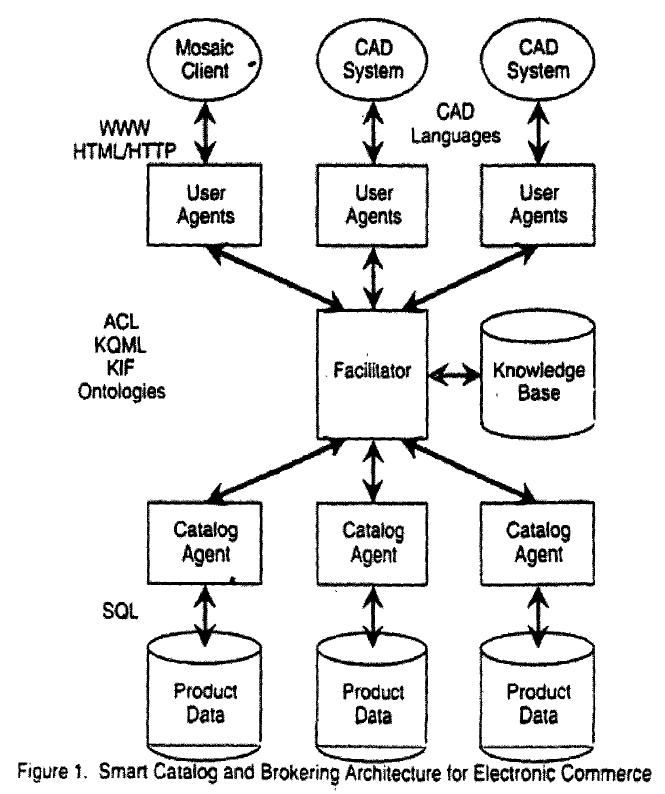
Notes:
KIF stands for Knowledge Information Format. HTML search requests were translated into KIF.
The authors were working at the Center for Information Technologies at Stanford University when they submitted the paper to a conference (October 10, 1994.)
The paper was considered in the trial.
The jury was invited to ignore the paper "as a result of uncorroborated testimony at trial concerning an August 1994 conception date for the MercExchange patent" according to eBay. [In USA the date of invention rather than the date of filing is considered to determine priority. In this case we see the unfortunate implication of this rule. We compare apples and oranges, the date at which the MercExchange invention was invented and the date at which a paper was submitted at a conference (the paper had to be written and its subject matter tested before the submission.) The European system that consider the filing date is not perfect either, a patent writing requiring more work than a conference submission.]
5,402,336 was invented by Steven Spiegelhoff and Joseph Kraetz and assigned to SS&D Corporation. This patent was filed on January 15, 1993.
5,402,336 is entitled "System and method for allocating resources of a retailer among multiple wholesalers." 5,402,336 describes a system that "receives an input request from the orderer for a retailer [such as a grocer], of searching selected wholesalers, and of then comparing these wholesalers to one another so as to provide a desired allocation of resources among these selected wholesalers. The system is preferably capable of searching both the warehouse of a primary wholesaler and the warehouses of a number of secondary wholesalers and of allocating resources so as to meet designated ordering criterion or constraints for the warehouse of the primary wholesaler. The search may be performed, for example, on the basis of net price per unit item or on the basis of net price per unit weight or per unit volume."
5,402,336 aims to permit a permit a retailer to optimize its resources among a plurality of wholesalers, which implies to perform searches on wholesalers’ databases, to compare their prices and to fulfill the obligations of contracts that retailers usually have with wholesalers (weight or volume constraints, or other criterion to obtain a designated minimum or maximum amount of goods.) Inventors recognize the existence of prior art: "Some computerized systems are currently available for permitting comparison among various suppliers. [...] For instance, U.S. Pat. No. 4,992,940, which issued to Ross E. Dworkin on Feb. 12, 1991, discloses an automated system permitting consumers to compare the goods being offered by one or more vendors and to obtain a listing of various information about price and availability of the product. U.S. Pat. No. 5,063,506, which issued to Brockwell et al. on Nov. 5, 1991, discloses a similar system for permitting a manufacturing facility to optimize its cost when ordering parts from various suppliers. U.S. Pat. No. 5,060,165, which issued to Schumacher et al. on Oct. 22, 1991, discloses a computerized system for optimizing mail processing by matching publisher and printer entities."
"Software agents will make life easy" was published on January 24, 1994 in Fortune.
Here is an excerpt from this article: "General Magic has invented a software language, Telescript, that can be used to create and dispatch so-called software agents. Like disembodied servants, they will travel all over regular and cellular phone circuits to just any type of computer database and carry out tasks on the user’s behalf." The article describes software agents that can search for an item in a plurality of independent retailers and report back the best deals.
This publication is called the CSTR/Dienst publication in the re-examination request. "A protocol and server for a distributed digital technical report library" is a Technical report published by the Computer Science Department of the Cornell University in April 1994 by James R. Davis and Carl Lacoze.
"A protocol and server for a distributed digital technical report library" describes a system that provides "Internet access to a distributed, decentralized, multi-format document collection. The collection is distributed and decentralized in that documents are indexed and stored on many different machines across the net, sometimes with more than one administration on each site" and "the ability to perform parallel searching of multiple document indices via a a server-to-server communication."
Note:
The CSTR/Dienst publication was discussed in the MercExchange litigation. MercExchange explained that this publication was not relevant prior art because it disclosed searching for documents and not for items can be bought and sold.
The USPTO agreed that the references provided by eBay raised a substantial question of patentability as to claims 1, 5, 6, 29, 31, 32 and 34-39 and granted the re-examination request.
This re-examination takes place with a control number 90/006,984.
The claims of 6,202,051 originally had a wider scope. Notably claim 17 [original numbering, presumably claim 1 of the patent] read:
"A method for auctioning a uniquely identified item with a computerized electronic database of data records comprising:
creating a data record containing a description of an item, said data record connoting an ownership interest in said item to a seller participant on said computerized electronic database of said data records;
generating an identification code to uniquely identify said item;
scheduling an auction for said item at said computerized database of records;
presenting said item for auction to an audience of participants through a worldwide web mapping module executing in conjunction with said computerized database, said worldwide web mapping module translating information from said data record on said computerized database of records to a hypertext markup language format for presentation through the internet;
receiving bids on said items from participants on the internet through an auction process that executes in conjunction with said computerized database of records;
terminating said auction for said item when said auction process reaches predetermined criteria;
notifying an auction participant of the high bid in said auction process; and
providing said unique identification code to said auction participant with said high bid to uniquely identify said item."
The examiner found the first claims obvious, referring to the following prior art:
an article "From Army Knives to Gold Coins, Collectors Attend Online Auctions" by Amy Sharp published in the Memphis Business Journal on July 28, 1986;
an article "Save the Earth Foundation: Internet Rock and Roll Art Auction Celebrating Earth Day Is Declared Open to The World For One Month" published in Business Wire on April 25;
a paper "Computer Museum Holds an Internet Auction" published in 1994 in Open System Today;
the 5,664,111 patent discussed above.
This is to overcome this rejection that MercExchange added the "seller’s account" that "can be charged a fee based on an amount of the high bid."
eBay noticed that "while the MercExchange was pending, MercExchange sought additional Internet auction claims with the same "seller’s account" feature in a 09/253,014 co-pending application. [On February 19, 1999 MercExchange filed four applications claiming the benefit of its original 08/427,820 application, 09/253,014, 09/253,015 that was abandoned, 09/253,021 that was issued as 6,202,051 and 09/253,057 that was issued as 6,266,651.] 6,202,051 (then 09/253,021) and 09/253,014 were assigned to different examiners. The examiner of 09/253,014 found prior art (presented in the next section) that was not identified by the examiner of 6,202,051:
The article entitled "Internet Providers Take Next Step Toward Electronic Commerce." The examiner of 09/253,014 rejected 09/253,014 and its "seller’s account" feature, notably writing that "the ['Internet Providers Take Next Step Toward Electronic Commerce' article] teaches passing payment information from a host computer to an external clearinghouse and receiving from a host computer a response that payment has cleared [...], receiving payment information via a worldwide web page server [...]; inherently debiting an account identified by the payment information and clearing credit card transactions since there are necessary to complete the transaction."
The 5,592,375 patent.
In its request eBay asked for the re-examination of all claims (1-52). eBay found that:
Claims 1-15, 17-32, 36-47 and 51 were rendered obvious by a 5,383,113 patent in view of an article entitled "Save the Earth Foundation: Internet Rock and Roll Art Auction Celebrating Earth Day Is Declared Open to The World For One Month" published in Business Wire on April 25, 1995, of a paper "Computer Museum Holds an Internet Auction" published in 1994 in Open System Today and of an article entitled "From Army Knives to Gold Coins, Collectors Attend Online Auctions" by Amy Sharp published in the Memphis Business Journal on July 28, 1986.
Claims 1-15, 17-32, 36-47 and 51 were rendered obvious by a presentation entitled "NetBill: An Internet Commerce System Optimized For Network Delivered Services" from an IEEE CompCon in March 1995 in view of "Save the Earth Foundation: Internet Rock and Roll Art Auction Celebrating Earth Day Is Declared Open to The World For One Month", "Computer Museum Holds an Internet Auction" and "From Army Knives to Gold Coins, Collectors Attend Online Auctions".
Claims 1-52 were rendered obvious by "Save the Earth Foundation: Internet Rock and Roll Art Auction Celebrating Earth Day Is Declared Open to The World For One Month" or "NetBill: An Internet Commerce System Optimized For Network Delivered Services" in view of "Computer Museum Holds an Internet Auction", "From Army Knives to Gold Coins, Collectors Attend Online Auctions" and of the 5,664,111 patent discussed above.
Claims 1-52 were rendered obvious to the 5,285,383 patent discussed above.
Claims 1-52 were rendered obvious by the 5,285,383 patent in view of a paper entitled "Electronic Agricultural Auctions in the United Kingdom" published in Electronic Markets by Borman and al. in October 1993 and of "Save the Earth Foundation: Internet Rock and Roll Art Auction Celebrating Earth Day Is Declared Open to The World For One Month", "Computer Museum Holds an Internet Auction" and "From Army Knives to Gold Coins, Collectors Attend Online Auctions."
Claims 1-52 were rendered obvious by "Electronic Agricultural Auctions in the United Kingdom" in view of "Save the Earth Foundation: Internet Rock and Roll Art Auction Celebrating Earth Day Is Declared Open to The World For One Month", "Computer Museum Holds an Internet Auction" and "From Army Knives to Gold Coins, Collectors Attend Online Auctions."
Claims 1, 4-6 and 8-52 were rendered obvious by a 5,592,375 patent in view of an article entitled "Internet Providers Take Next Step Toward Electronic Commerce" published in Electronic Marketplace Report on December 20, 1994 and "From Army Knives to Gold Coins, Collectors Attend Online Auctions."
Claims 1-52 were rendered obvious by BidBroker (see above) in view of the second edition of The Official America Online for Macintosh Tour Guide published in 1994 by Ventana Press.
Claims 1-52 were rendered obvious by the second edition of The Official America Online for Macintosh Tour Guide combined with any of the publication listed above.
5,383,113 was invented by Peter J. Kight, Mark A. Johnson, Tamara K. Christenson, Regina Lach, Philip Pointer and Kenneth Cook and assigned to Checkfree Corporation. This patent was filed on July 25, 1991.
5,383,113 is entitled "System and method for electronically providing customer services including payment of bills, financial analysis and loans." 5,383,113 discloses a "computerized payment system by which a consumer may instruct a service provider by telephone, computer terminal, or other telecommunications; means to pay various bills without the consumer having to write a check for each bill. The system operates without restriction as to where the consumer banks and what bills are to be paid. The service provider collects consumers' information, financial institutions' information and merchant information and arranges payment to the merchants according to the consumers' instructions based on a financial risk analysis."
The method of 5,383,113 includes:
"gathering consumer information and creating a master file with banking information and routing codes;
the generation of payment instructions by the consumer at a convenient location, typically remote from the payment service provider (e.g., at home), through an input terminal such as a personal computer, a push-button telephone or other like communication means;
applying the payment instructions to the consumer's file; using computer software of the present invention to examine various files to determine the appropriate form of payment based on variables involving banking institutions and merchants;
validating each transaction against a dynamic credit file and routing based on set parameters; and,
if after processing no flags are encountered, adjusting the consumer's account (usually by debiting) and making payment directly to the payee in accordance with the consumer instructions."
5,383,113 describes and only describes an electronic payment facility.
5,592,375 was invented by Bardwell C. Salmon, John D. Borgman and Thomas O. Holtey and assigned to Eagleview, Inc. This patent was filed on March 11, 1994.
5,592,375 is entitled "Computer-assisted system for interactively brokering goods or services between buyers and sellers." 5,592,375 discloses a system "for brokering transactions between sellers and a buyer of goods or services, including a database, a seller interface, and a buyer's interface. The database contains information, including multimedia information, descriptive of respective ones of the goods or services. The seller interface enables the sellers to interactively enter information, including multimedia information, into the database." 5,592,375 has both a buyer and a seller interface and include an approximate-comparison system "for presenting to the buyer, goods or services that approximately match selection criteria entered into the Buyer's Interface."
5,592,375 maintains a action log, which is according to eBay an account for buyers and sellers. The action log is presented in this way:
"The Action Log also is the basis for billing for system services. In general, both buyers and sellers would pay a subscription fee for access to the system. Charges could also be made for connect time, communications costs, database storage and other system services. Each match that results in a completed transaction could also incur a charge to the buyer or seller depending upon the application."
[I do not agree with eBay on this point. The action log allows billing per use and not to charge a percentage of the sale to the seller. Logging the actions of logged-in users is not considered by people of the art as the same as defining accounts and recording for said accounts the paid amounts.]
The USPTO agreed that the references provided by eBay raised a substantial question of patentability as to claims 1-52 and granted the re-examination request.
Patents Presentation Search Issues Strategies Business Methods Patentability Analysis MercExchange eBay Trial Reexamination Business view Granted patents Examination USPTO EPO PanIP Eolas 1-click family 1-click analysis 1-click prior art Trademark Copyright
Contact:support@pagebox.net
©2001-2005 Alexis Grandemange
Last modified